
The Best Budget Circular Saws of 2026
Spending less on a circular saw does not mean giving up accurate cuts — it means choosing the right trade-off between corded power, cordless freedom, and where you stop on the price curve. The Skil 5280-01 is the sharpest value at under $80, delivering a full 15 amps and a laser guide from a brand that invented the circular saw. Ryobi's PBLCS300B is the cordless answer for ONE+ owners who need portability without sacrificing brushless efficiency. The Milwaukee 2731-20 and DeWalt DCS573B cost more but deliver professional-grade performance at prices that feel like bargains compared with their premium siblings.
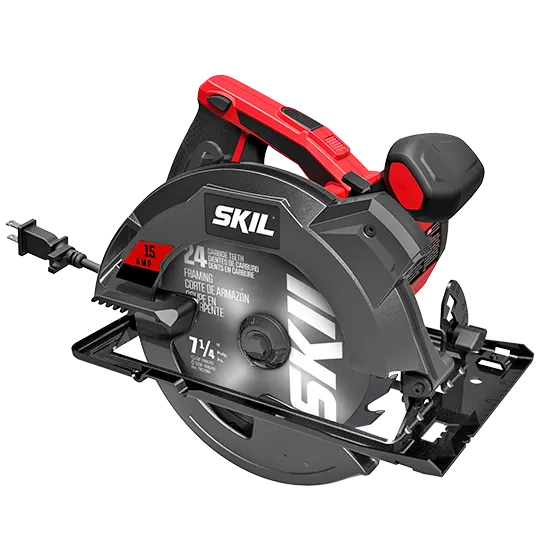
Skil 5280-01 15-Amp Circular Saw
At $65 to $80, the Skil 5280-01 is the most straightforward value in this guide. Its 15-amp brushed motor spins the blade at 5,300 RPM, a speed that clears framing lumber and sheet goods without straining, and the laser guide — rare at this price — makes freehand ripping far more consistent than guessing from the sight notch alone. The 2.5 HP motor handles repeat cuts through 2x material all day. The 8.7 lb weight is typical for a corded 7-1/4" saw, and the 0–51° bevel range covers common roof pitches and stair stringers. For a fixed workstation or any shop with an outlet nearby, nothing else at this price comes close.
- ✓ Full 15-amp motor at under $80 — the most power per dollar in this guide
- ✓ 5,300 RPM blade speed clears framing and sheet goods efficiently
- ✓ Laser guide improves freehand rip accuracy without any add-on accessories
- ✓ 0–51° bevel range covers roof pitches and stair stringer angles
- ✗ Corded design limits reach and requires a long extension cord on large sheets
- ✗ Brushed motor is less efficient than the brushless cordless picks above it
- ✗ 8.7 lbs is heavier than modern brushless cordless saws at a similar blade size
We may earn a commission from this link.
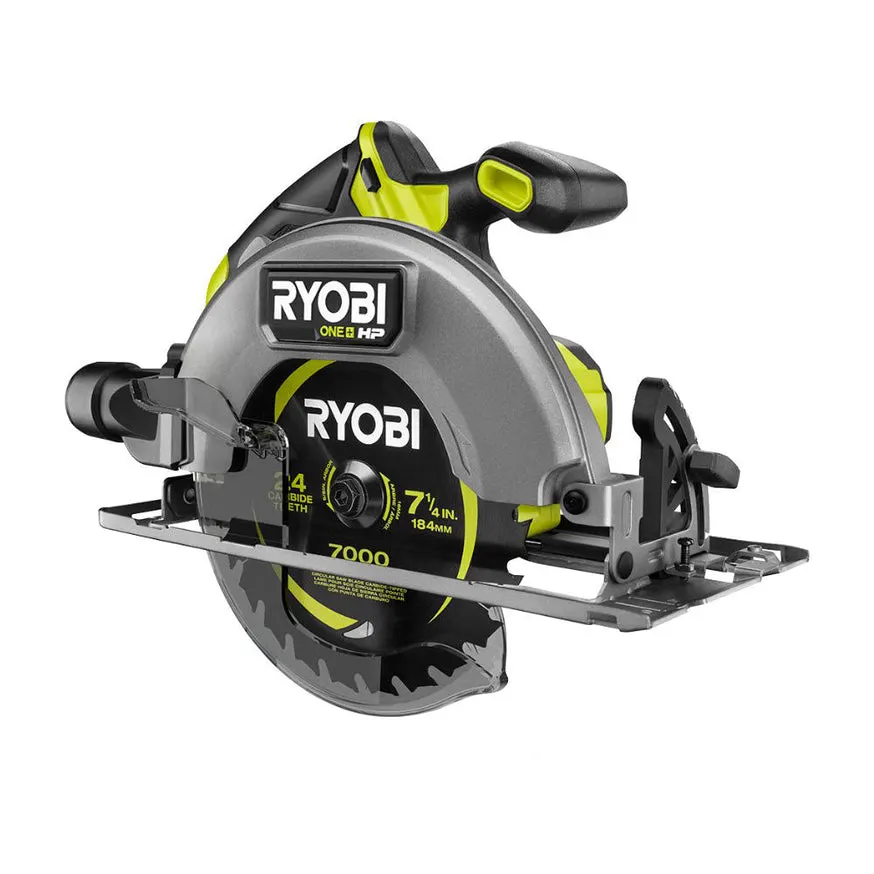
Ryobi PBLCS300B 18V HP Brushless Circular Saw
The PBLCS300B earns the cordless budget slot by combining a brushless motor, a left-blade configuration for better sightlines, and Ryobi's broad ONE+ platform — all for $79 to $120 bare. Its 4,300 RPM and 0–56° bevel capacity match or beat saws priced $50 higher, and the high-efficiency brushless motor delivers 325-plus cuts per charge with a 6Ah pack. The left-blade layout puts the blade on the operator's side of the shoe, which is the preferred orientation for most right-handed users making freehand plunge cuts. Battery-platform buyers on ONE+ get the best dollar-per-cut value in the cordless category.
- ✓ Brushless motor and left-blade layout usually found at a higher price tier
- ✓ 325+ cuts per charge with a 6Ah pack — strong runtime for a budget cordless
- ✓ 0–56° bevel capacity exceeds several more expensive competitors
- ✓ Backed by the massive, affordable Ryobi ONE+ 18V platform
- ✗ 4,300 RPM blade speed trails the Milwaukee 2731-20 and DeWalt DCS573B
- ✗ Sold as bare tool — add the cost of a battery if you are new to ONE+
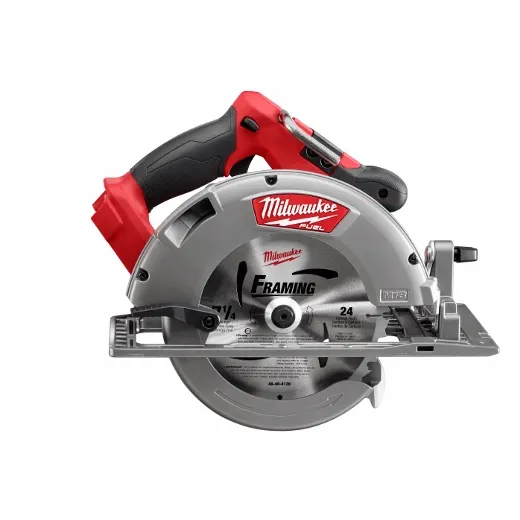
Milwaukee 2731-20 M18 FUEL 7-1/4" Circular Saw
At $179 to $210 bare, the Milwaukee 2731-20 is where budget ends and professional performance begins — and the premium is real. Its FUEL brushless motor reaches 5,000 RPM, a magnesium shoe keeps weight at 7.5 lbs bare while resisting jobsite abuse, and the 0–50° bevel range covers virtually every compound angle. M18 battery owners who cut a lot of framing or sheet goods will feel the difference the first time they rip plywood against a long fence: the saw does not fade mid-cut, the shoe stays flat, and the blade guard retracts predictably. For anyone already on M18 and doing real carpentry work, the step up from a budget corded saw costs less than it looks.
- ✓ 5,000 RPM and FUEL brushless motor produce noticeably cleaner, faster cuts
- ✓ Magnesium shoe resists flex and jobsite damage better than stamped aluminum
- ✓ Deep M18 FUEL ecosystem means shared batteries with dozens of professional tools
- ✓ 0–50° bevel range and solid base make accurate compound angles manageable
- ✗ Bare tool price of $179–210 is more than double the Ryobi's street price
- ✗ Requires M18 batteries and charger — significant added cost for new platform entrants
We may earn a commission from this link.
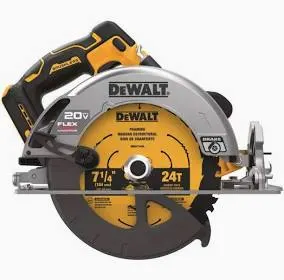
DeWalt DCS573B 20V MAX FLEXVOLT ADVANTAGE
The DCS573B is the most capable saw in this guide and the one that benefits most from shopping with patience. At $230 to $260 bare its full price is the highest here, but the FLEXVOLT ADVANTAGE circuitry lets it extract more power from higher-capacity FLEXVOLT packs, which means the saw effectively scales up as your battery collection grows. Its 5,500 RPM blade speed is the fastest in this guide, the 0–57° aluminum shoe bevel is the widest, and at 8.2 lbs bare it is reasonably balanced for a full-featured sidewinder. For a DeWalt 20V MAX owner doing production framing, siding, or decking, the DCS573B is a budget-minded choice relative to what it replaces.
- ✓ 5,500 RPM is the highest blade speed in this guide, enabling faster, cleaner through-cuts
- ✓ FLEXVOLT ADVANTAGE scales runtime and power with larger FLEXVOLT packs
- ✓ 0–57° aluminum shoe gives the widest bevel capacity here
- ✓ Strong value for existing DeWalt 20V MAX platform owners
- ✗ $230–260 bare is the highest full price in this guide
- ✗ FLEXVOLT ADVANTAGE benefit only materializes if you already own FLEXVOLT packs
Getting the most saw for your money
Circular saws are one of the clearest examples of diminishing returns in power tools. The jump from $65 to $250 buys you real improvements — brushless efficiency, better shoe construction, faster blade speed — but the cut quality on dimensional lumber is nearly indistinguishable between the Skil 5280-01 and the Milwaukee 2731-20 when both are fitted with a sharp blade. Knowing where the value cliffs are is the whole point of a budget-focused guide.
The four saws ranked here represent four distinct price and capability tiers. The Skil is the pure-value corded pick. The Ryobi is the cordless equivalent. The Milwaukee is the first professional-grade option, and the DeWalt is the most capable tool at the top of what this guide considers the accessible price range. All four have been reviewed individually; the picks below are organized specifically around value rather than outright performance rank.
What the numbers actually mean
Three specifications show up in every circular saw listing: amp rating (for corded), RPM, and bevel capacity. Here is what each one tells you in practice.
Amp rating on corded saws translates directly to available cutting power. Fifteen amps — the maximum available on a standard 120V outlet — means the motor can sustain full load through repeated cuts without thermal shutoff. The Skil 5280-01 is rated at 15 amps, which puts it at the same motor tier as saws costing twice as much. Anything below 13 amps should raise questions about sustained use through dense hardwood or thick engineered lumber.
RPM at no-load is the blade speed with nothing in the cut. Higher RPM generally means faster feed rates and cleaner crosscuts through sheet goods. The DCS573B at 5,500 RPM and the Milwaukee at 5,000 RPM lead this guide; the Ryobi's 4,300 RPM is the lowest but still fast enough for framing lumber without binding. No-load speed drops under load, so use RPM as a relative benchmark rather than an absolute predictor.
Bevel capacity determines how steep a compound angle the shoe can tilt to. The standard 45° bevel handles most trim and roof work; the extended ranges on all four saws here (51° to 57°) add usefulness for steep roof pitches and some stair applications. If your work never calls for bevels beyond 45°, this number matters less than shoe flatness or blade quality.
The corded-vs-cordless decision at a budget
For buyers shopping this price tier, the corded-versus-cordless question has a clean answer: it depends on whether you have an outlet.
A 15-amp corded saw like the Skil 5280-01 delivers full power on every cut, with zero battery management and no runtime ceiling. For a garage workshop, a job-site trailer with power, or any fixed cutting station, corded is the rational choice. A single heavy extension cord costs less than one 5.0Ah battery.
A brushless cordless saw like the Ryobi PBLCS300B becomes the rational choice when you are cutting on a roof, in a framed structure without power yet, or anywhere more than 50 feet from an outlet. The 325-plus cuts per charge with a large pack is a real-world number, not a marketing ceiling — framing a wall section on a slab without tripping over a cord is a genuine quality-of-life improvement.
The Milwaukee and DeWalt sit in a middle zone: they are cordless tools at prices where the quality of the battery electronics and motor justify spending over the budget cordless tier, but only if you already own those platforms.
Shoe construction and why it matters
The shoe — the flat base plate the saw rides on — is where budget saws most visibly cut costs, and it is also where cut quality suffers most when things go wrong. Stamped steel shoes are the norm at the low end of the market. They are adequate when new and when the saw is used carefully, but they dent, flex under lateral pressure, and can develop a slight bow that throws bevel angles off over time.
The Milwaukee 2731-20 uses a magnesium shoe that is cast rather than stamped, which means it resists flex and impact damage far better. The DeWalt DCS573B uses an aluminum shoe, a step above stamped steel and below magnesium. The Skil and Ryobi both use stamped aluminum, which is lighter than steel and handles routine use well.
For a DIY homeowner doing a deck or a one-time remodel, shoe material is a minor concern. For someone ripping 50 sheets of plywood a week, a magnesium or extruded-aluminum shoe is worth prioritizing.
Blade quality changes everything
Every saw in this guide ships with a general-purpose blade. Every saw in this guide will cut noticeably better with an aftermarket blade. A $20 to $30 finish-cut or framing-specific blade from Freud, Diablo, or Irwin transforms the Skil 5280-01 from a rough-cut tool into something that produces clean enough edges for paint-grade trim.
If you are working within a tight budget, consider allocating $20 of your saw budget to a better blade before upgrading from the Skil to the Ryobi — the blade swap will produce a more obvious improvement in cut quality than the saw change will.
Safety features that matter at any price
All four saws include a blade guard, an electric brake (the blade stops spinning within two to three seconds of releasing the trigger), and an upper guard. The electric brake is worth confirming on any saw you evaluate — older and very cheap designs may not include it, and the two to three seconds it saves between cuts adds up over a full day.
The Skil's laser guide is a budget safety aid of a different kind: a saw that cuts on the line is a saw less likely to require a second pass that introduces error and fatigue. No other saw at the Skil's price includes a laser by default.
Which pick is right for you
The Skil 5280-01 is the default answer for anyone who has an outlet nearby and is trying to spend as little as possible for a capable, full-power saw. Its 15 amps and laser guide are the best features-per-dollar in this guide, and its limitation — the cord — is a non-issue in a workshop or on a site with power.
The Ryobi PBLCS300B is the answer for ONE+ battery owners who want cordless freedom without moving to a new platform. The brushless motor and left-blade layout justify its price over a budget brushed cordless saw.
The Milwaukee 2731-20 is the step up that makes sense for M18 owners who do real carpentry: the magnesium shoe, 5,000 RPM, and professional-grade motor durability are tangible upgrades over the budget picks.
The DeWalt DCS573B is the top pick for 20V MAX or FLEXVOLT owners who want the fastest, most capable saw at a price that still undercuts premium alternatives. It is not cheap, but measured against what it does, it delivers value that justifies the extra spend over the Milwaukee if you are already on DeWalt.
A note on pricing
All prices in this guide are street prices as of mid-2026 and will fluctuate. The Skil and Ryobi in particular see regular sale pricing that narrows the gap with the next tier up. Checking current prices before buying can occasionally make the Milwaukee or DeWalt a better value than the gap between this guide's listed ranges suggests.
Advertisement
Frequently asked questions
- What is the best budget circular saw for general DIY use?
- For plugged-in work, the Skil 5280-01 is the clearest value — a full 15-amp motor with a laser guide for under $80. If you want cordless freedom and already own Ryobi ONE+ batteries, the PBLCS300B brushless model gives you 325-plus cuts per charge at a price that beats most corded competitors once you count in the battery you already have.
- Is a corded circular saw better than cordless for the money?
- At the same dollar amount, a corded saw typically delivers more power and runtime because it draws directly from the wall. The Skil 5280-01 proves this — its 15-amp motor outperforms nearly any battery-powered saw at the same price point. Cordless saws like the Ryobi PBLCS300B close the gap significantly at a slightly higher price, and the freedom from a cord can be worth more than the power difference depending on where you work.
- Do I need a brushless motor in a circular saw?
- Not if your primary concern is keeping the price as low as possible. A brushed motor like the Skil's 15-amp unit handles framing and sheet-good cutting without issue for years. Brushless motors, as in the Ryobi PBLCS300B, Milwaukee 2731-20, and DeWalt DCS573B, run cooler, extract more cuts per charge, and generally last longer — advantages that pay off for frequent or heavy use.
- What blade size should I look for in a budget circular saw?
- All four saws in this guide use a standard 7-1/4-inch blade, which is the dominant size in framing and general carpentry. A 7-1/4-inch blade provides a maximum depth-of-cut of roughly 2-7/16 to 2-9/16 inches at 90° — enough to cut through standard dimensional lumber in a single pass — and replacement blades at this diameter are widely available at every price point.
- How important is bevel capacity in a circular saw?
- For most cuts, the 0–45° bevel range that older saws provided is sufficient. The saws in this guide all exceed that: the Skil goes to 51°, Ryobi to 56°, Milwaukee to 50°, and DeWalt to 57°. The extra range matters specifically for roof sheathing, compound angle trim, and stair stringers. If those cuts come up regularly, favor a saw with at least 50° of bevel travel.
- Should I buy a circular saw kit or a bare tool?
- Buy a complete kit if you do not already own compatible batteries. The Skil 5280-01 is corded and needs no battery at all. The Ryobi, Milwaukee, and DeWalt are sold as bare tools, meaning you need to add batteries and a charger to the price. If you already own those platforms' batteries, the bare-tool price is the true cost. If you are starting fresh, factor in at least one battery and a charger — which often makes a drill-combo kit from the same brand a better starting purchase.