
Skil 5280-01 Circular Saw Review: Best $70 Corded Saw
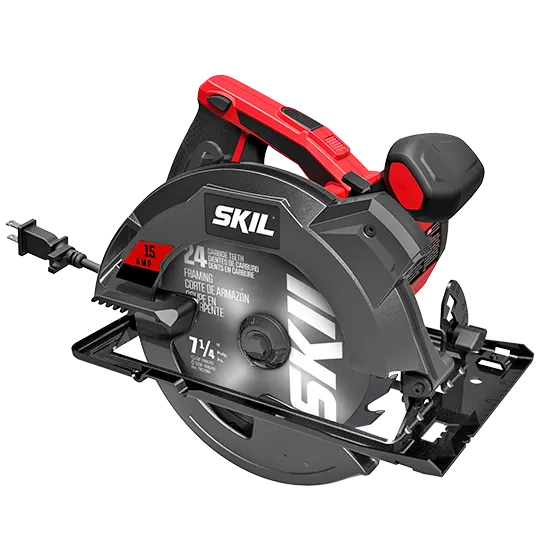
| blade Size | 7-1/4 in., 24-tooth carbide blade included |
|---|---|
| power Source | 120V corded electric, 15 amps |
| motor | Brushed, 2.5 HP |
| no Load Speed | 5,300 RPM |
| bevel Capacity | 0–51 degrees (positive stop at 45°) |
| depth At Ninety | 2-7/16 in. |
| depth At Forty Five | 1-15/16 in. |
| shoe | Stamped steel |
| weight | 8.7 lbs |
| laser Guide | Single-beam laser |
Pros
- 15-amp motor delivering 5,300 RPM — faster blade speed than either Milwaukee 2731-20 (5,000 RPM) or Ryobi PBLCS300B (4,300 RPM), and it never slows down because there is no battery to deplete
- Single-beam laser guide gives a practical cut-line reference that most saws at this price omit entirely
- Integrated dust blower keeps sawdust off the cut line and sight notch while cutting, reducing the need to pause and clear the line
- At $70 retail, replacing it after theft, loss, or physical damage is a minor economic event compared to a $200+ cordless saw
- Rear-view depth adjustment lets you set depth without flipping the saw over — a genuine quality-of-life feature more common on $150+ tools
Cons
- Corded operation requires an extension cord at every cut, which is a real inconvenience on large job sites, roof work, or any location far from a power outlet
- Stamped steel shoe is adequate but lacks the rigidity of aluminum (DeWalt DCS573B) or magnesium (Milwaukee 2731-20) — will flex slightly under sustained lateral pressure on long rips
- No electric blade brake: the blade freewheels for five to eight seconds after the trigger releases, which is the normal behavior for lower-cost corded saws but noticeably less safe than the brake-equipped cordless alternatives
- 2.5 HP motor is a consumer-grade designation; sustained heavy framing work through dense wet lumber stresses the motor more than a brushless professional saw
What the Skil 5280-01 actually is
The Skil 5280-01 is one of the best-known value propositions in the circular saw market, and not by accident. At around $70 retail — including the saw, a 24-tooth carbide blade, and a carrying bag — it delivers more raw blade speed than either the Milwaukee 2731-20 or Ryobi PBLCS300B and runs indefinitely without a battery to manage. For a homeowner who cuts within extension-cord range of an outlet, the economics are nearly impossible to argue with.
The tool is straightforward: 15-amp motor, steel shoe, 7-1/4-inch blade, 51-degree bevel with a positive stop at 45 degrees, and a single-beam laser guide that Skil adds at this price point while most competitors at the same tier do not. It is not a professional production saw, but it is a more capable tool than its price suggests.
Performance at 5,300 RPM
Blade speed is a genuine performance advantage here. The 5,300 RPM no-load speed sits above both the Milwaukee 2731-20 (5,000 RPM) and Ryobi PBLCS300B (4,300 RPM). Because the 5280-01 is corded, that speed does not decay as a battery discharges — cut 100 or cut 1,000, the blade enters each piece at the same RPM.
Through dimensional lumber, the 5280-01 performs like a proper full-size saw. 2x4 and 2x6 cuts in dry SPF happen in one fluid stroke with no bogging. Pressure-treated 5/4 decking and 2x10 joists also cut cleanly, though the stamped-steel shoe flexes slightly under sustained pressure on long rip cuts — a noticeable difference from the aluminum shoe on the DeWalt DCS573B.
For plywood and sheet goods, the saw works well with the stock blade for construction and rough cuts. The laser guide is more helpful here than on dimensional lumber — on a 4x8 sheet without a fence, the visual reference reduces drift over a long freehand cut. For fine finish work on cabinet plywood, a 40-tooth or 60-tooth upgrade blade is the right move regardless of which saw you are using.
What the stamped steel shoe means in practice
The shoe on the 5280-01 is stamped steel, which is functional but not ideal for precision work. It is flat out of the box and adequately rigid for most cuts, but under sustained lateral force during a long rip — especially if the saw contacts the workpiece edge — the shoe can flex in a way that the rigid aluminum and magnesium alternatives do not. For construction framing and general carpentry, this matters little. For cabinet work where the shoe is your reference surface on a plywood edge, the 5280-01 is workable but not as confidence-inspiring as the pro-tier options.
The laser guide in use
Skil's single-beam laser is a practical feature that adds real value at this price point. The line projects ahead of the blade on the layout mark and is visible in most indoor lighting conditions. It is not a precision reference — it can shift with vibration over time and is subject to parallax — but for freehand cuts where you are tracking a pencil line on dimensional lumber, it reduces the concentration required and helps less-experienced users stay on line. For repetitive cuts where you are referencing the saw to a fence or speed square, the laser is irrelevant and you would not miss it.
The cord as a constraint
The 5280-01's only genuine structural limitation is the power cord. On a flat concrete slab or in a workshop with overhead outlets, the cord is a minor inconvenience. On a second-floor framing deck, a pitched roof, or any location where the nearest outlet is 100 feet away, cord management becomes a real workflow friction. The Milwaukee 2731-20 and Ryobi PBLCS300B both eliminate that friction, which is the entire value proposition of their battery systems.
The corded design also means no electric brake — the blade freewheels after the trigger releases. That is normal for budget corded saws but worth noting for users accustomed to the two-second stop on Milwaukee and DeWalt brushless tools.
Where this saw makes sense
Four scenarios favor the Skil 5280-01 clearly:
Workshop use: stationary cuts near a dedicated circuit. The corded motor never fatigues and cuts as fast at hour eight as hour one.
Backup or beater tool: at $70 it is cheap to own a second saw for rough cuts, dumpster jobs, or situations where a cordless saw would be a theft risk.
New homeowner first saw: someone who needs a circular saw for occasional projects and does not yet own any battery platform gets full functionality for $70 rather than $150–$260.
High-volume cutting with limited budget: for a small contractor or serious DIYer who cannot justify $200 for a cordless saw, 5,300 RPM and unlimited runtime beat any cordless option in the same price range.
Verdict
The Skil 5280-01 is the right answer when the question is "what is the best circular saw for under $100?" It cuts as fast as any cordless saw in its price range — faster than most — and the laser guide and rear-view depth adjustment are features that thoughtfully exceed budget-saw expectations. The cord is the only real constraint, and for buyers who cut near outlets, that constraint rarely matters. For job-site portability and elevated work, the Milwaukee 2731-20 or Ryobi PBLCS300B are the practical alternatives.
Advertisement
Frequently asked questions
- Does the Skil 5280-01 need a special extension cord?
- For runs up to 50 feet, a 12-gauge extension cord is sufficient to avoid voltage drop at the 15-amp draw. For runs of 50 to 100 feet, use a 10-gauge cord. Undersized cords cause motor overheating and reduced cut speed. Never use a 16-gauge or 14-gauge cord for a 15-amp saw — it restricts current and causes the motor to run hot.
- Can the Skil 5280-01 cut through 2x lumber in a single pass?
- Yes. At 90 degrees the saw cuts 2-7/16 inches deep, which clears standard 2x framing lumber (1-1/2 inches thick) with nearly an inch of clearance. At 45 degrees it cuts 1-15/16 inches — still enough to slice through a 2x4 in one bevel pass.
- How accurate is the laser guide on the Skil 5280-01?
- The single-beam laser projects a line parallel to the blade cut path and is a useful reference for freehand cutting, but it is not a precision instrument. It can drift slightly over time as the guide ages and is subject to parallax depending on your eye position. For demanding accuracy, use a straightedge fence or track system rather than relying on the laser alone.
- How does the Skil 5280-01 compare to cordless saws at the same price?
- At $70, the 5280-01 has no cordless equivalent that delivers the same power and unlimited runtime. Cordless saws in the $70–$100 range use lower-voltage brushed motors with shorter battery life. The corded Skil's 5,300 RPM brushed motor simply outperforms any cordless saw at the same price. The trade-off is the cord itself — cordless wins on portability and job-site flexibility.
- Is the Skil 5280-01 good for cutting plywood?
- It handles plywood well for rough and intermediate cuts. The included 24-tooth carbide blade produces adequate results for construction plywood. For visible plywood edges on cabinet or furniture work, upgrading to a 40-tooth or 60-tooth blade eliminates most tearout. The laser guide also helps track a straight freehand cut on large sheets.
Ready to buy the 5280-01?
We may earn a commission if you buy through these links, at no extra cost to you.