
Ryobi PBLCS300B Review: 18V HP Brushless 7-1/4" Saw
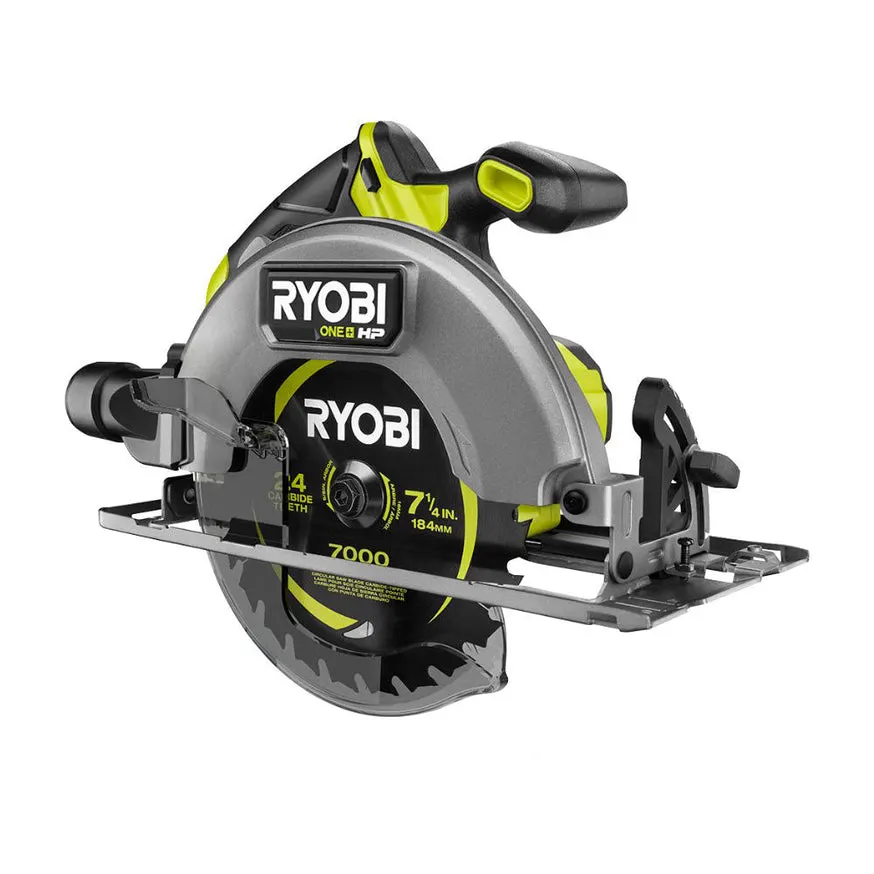
| blade Size | 7-1/4 in., left-blade location |
|---|---|
| power Source | Ryobi 18V ONE+ (HP battery recommended for full performance) |
| motor | Brushless HP |
| no Load Speed | 4,300 RPM |
| bevel Capacity | 0–56 degrees (detents at 0°, 15°, 22.5°, 30°, 45°, 56°) |
| depth At Ninety | 2-9/16 in. |
| depth At Forty Five | 1-27/32 in. |
| shoe | Composite with reinforcement |
| weight | 6.6 lbs (tool only) |
| runtime | Over 325 cuts per charge with 6Ah HP battery |
Pros
- 6.6 lbs makes it the lightest 7-1/4-inch cordless saw in this comparison — lighter than the Milwaukee 2731-20, DeWalt DCS573B, and Skil 5280-01
- Brushless HP motor is a genuine upgrade over older Ryobi brushed circular saws and other brand's brushed cordless competitors — more efficient, longer-lasting, and maintains speed better under moderate load
- 56-degree bevel capacity matches the DeWalt DCS573B's generous range and beats the Milwaukee 2731-20 (50 degrees)
- ONE+ platform compatibility spans over 225 tools — battery investment carries over to every Ryobi ONE+ tool in the lineup, including drills, jigsaws, sanders, and outdoor equipment
- Over 325 cuts per charge with a 6Ah HIGH PERFORMANCE battery is competitive with pro-tier saws running moderate-capacity packs
Cons
- 4,300 RPM no-load speed is significantly lower than the Milwaukee 2731-20 (5,000 RPM), DeWalt DCS573B (5,500 RPM), and Skil 5280-01 (5,300 RPM) — slower blade speed translates to slower throughput and more tearout on certain materials
- Plastic shoe with reinforced composite construction — functional for most tasks, but lacks the reference-plane stability of magnesium (Milwaukee) or aluminum (DeWalt) shoes on demanding precision cuts
- Sold as a bare tool at around $90 — buyers starting fresh on ONE+ still need a battery and charger, and Ryobi HP HIGH PERFORMANCE batteries cost more than the base ONE+ packs required to unlock full HP motor performance
A budget brushless that surprises
Ryobi's PBLCS300B sits at the intersection of two decisions the brand made strategically: put a brushless motor in the HP line, and price the bare tool below $100. Both choices pay off in a tool that outperforms its price class meaningfully — particularly for a homeowner who already owns Ryobi ONE+ batteries from a drill or jigsaw.
At 6.6 lbs, it is lighter than every other saw in this roundup including the Milwaukee 2731-20 at 7.5 lbs bare. That weight advantage is real for someone carrying the saw up a ladder, working overhead, or making one-handed cut starts on a vertical board.
What the HP brushless motor changes
Earlier Ryobi ONE+ circular saws used brushed motors that were adequate for occasional cuts but less efficient, slower to accelerate, and more prone to heat buildup under sustained load than brushless alternatives. The PBLCS300B's HP brushless motor changes that equation. Efficiency improves, which means more cuts per charge. Motor longevity improves because brushes no longer wear against the commutator. And the motor maintains speed more consistently under light to moderate load than its brushed predecessors.
The 4,300 RPM no-load speed is the one area where the PBLCS300B is measurably behind the Milwaukee 2731-20 (5,000 RPM), DeWalt DCS573B (5,500 RPM), and Skil 5280-01 (5,300 RPM). In dimensional lumber, lower blade speed means each tooth does more work per pass, which produces more tearout on cross-grain cuts and requires slightly more forward pressure. For rough framing, this difference is minor. For finish cuts where edge quality matters, the gap is noticeable.
Cutting capacity and bevel range
The 2-9/16-inch cutting depth at 90 degrees is identical to the DeWalt DCS573B and fully capable for dimensional lumber framing. At 45 degrees the 1-27/32-inch depth handles standard bevel cuts through 2x material.
The 56-degree bevel range is a genuine standout in the budget tier — most saws at this price max out at 45 or 50 degrees. Six bevel detents at 0, 15, 22.5, 30, 45, and 56 degrees give quick access to common angles for rafter work without needing to read the bevel scale for every setup.
The shoe: where the price shows
The composite shoe is the most noticeable place where the PBLCS300B differs from pro-tier saws. It is flat and square from the factory and performs adequately for most tasks. Under the kind of sustained lateral pressure that occurs during a long rip cut through 3/4-inch plywood or a full sheet of OSB, it flexes more than the machined aluminum shoe on the DeWalt or the magnesium shoe on the Milwaukee. That flex does not cause the saw to cut badly — it means the reference between the shoe and the blade is slightly less consistent over a long cut than with a stiffer shoe.
For a homeowner making occasional plywood cuts for a deck or fence project, the composite shoe is not a practical limitation. For a contractor making dozens of precision rip cuts daily, it is a real distinction worth paying more for.
Battery platform considerations
The Ryobi ONE+ platform has over 225 tools. At the price point of ONE+ tools, that breadth is the main reason to enter the system: one battery investment connects to drills, circular saws, jigsaws, orbital sanders, leaf blowers, string trimmers, and more. For a homeowner who wants a complete cordless toolset without a $600+ battery-plus-tools investment, ONE+ is the realistic entry point.
The PBLCS300B specifically requires HIGH PERFORMANCE batteries for full motor output, which cost more than standard ONE+ cells. The PBP004 4.0Ah HP battery is typically around $60–$70 standalone. A standard ONE+ 2.0Ah pack runs the saw at reduced performance. For the full PBLCS300B experience, budget for at least one HP battery.
Comparison context
Against the Milwaukee 2731-20: the Ryobi is lighter, cheaper by $90–$120, and has a wider bevel range (56 vs 50 degrees). The Milwaukee has a faster motor (5,000 vs 4,300 RPM), a magnesium shoe, and significantly better sustained-load performance. For professional production use, the Milwaukee's advantages compound over time. For residential DIY, the Ryobi's price and weight are compelling.
Against the DeWalt DCS573B: the Ryobi is $150+ less expensive as a bare tool and lighter by 1.6 lbs. The DeWalt's FLEXVOLT Advantage scalability, aluminum shoe, and 5,500 RPM motor place it in a genuinely different performance class. As bare tools, they serve different buyers.
Against the Skil 5280-01: the Ryobi's cordless advantage is its core differentiator. For any work away from a power outlet, the PBLCS300B eliminates the cord-management friction entirely. The Skil is faster (5,300 vs 4,300 RPM) and costs less, but the cord limits its practical range.
Final take
The Ryobi PBLCS300B is the best answer to the question: what is the most capable cordless 7-1/4-inch circular saw under $120? The brushless HP motor, 56-degree bevel range, and 6.6-lb weight are genuine advantages over budget competition. Its limitations — 4,300 RPM, composite shoe — reflect its price honestly. For ONE+ platform users and homeowners who want a cordless saw without a $200+ bare-tool investment, the PBLCS300B is a strong choice.
Advertisement
Frequently asked questions
- Does the Ryobi PBLCS300B need a HIGH PERFORMANCE battery?
- The PBLCS300B's HP brushless motor works with any Ryobi 18V ONE+ battery, but it delivers its rated performance with HIGH PERFORMANCE batteries. Standard ONE+ batteries run the saw, but the HP motor draws more current and benefits noticeably from the higher discharge rate of the HP series (PBP004, PBP006, etc.). For occasional cutting, a standard battery is acceptable; for sustained framing work, the HP pack is the right choice.
- How does the Ryobi PBLCS300B compare to older Ryobi circular saws?
- The PBLCS300B uses a brushless HP motor, which is a meaningful upgrade over the brushed motors in older Ryobi ONE+ circular saws like the P508. Brushless motors are more efficient (more cuts per charge), run cooler, and last longer before requiring maintenance. The HP designation also indicates the motor is wound to accept the higher current delivery of HP batteries for more sustained power.
- Is the PBLCS300B accurate enough for finish carpentry?
- For trim and finish work requiring clean edges, the PBLCS300B can produce acceptable results with a quality 40-tooth or 60-tooth finishing blade. The composite shoe is flat and functional for most tasks, though it lacks the rigidity of machined aluminum or magnesium shoes on pro-tier saws. For demanding finish carpentry requiring consistent precision over many cuts, a track-saw setup or miter saw is a more appropriate tool.
- What is the blade position on the PBLCS300B — left or right side?
- The PBLCS300B has a left-blade orientation, which means the blade is on the left side of the motor housing. This layout gives a right-handed user a clear sightline to the cut line over the top of the motor rather than through the blade guard. Left-blade saws are increasingly common among cordless designs because they place the bulk of the saw's weight over the supported side of the workpiece.
- What does the Ryobi PBLCS300B cost with a battery included?
- As a bare tool, the PBLCS300B is typically $79–$90 at Home Depot. The PBLCS300K1 kit, which includes a 4.0Ah HIGH PERFORMANCE battery and charger, is commonly priced around $179–$199. For a first-time ONE+ buyer, the kit is usually a better value than buying the bare tool and battery separately. If you already own ONE+ batteries, the bare tool is the economical choice.
Ready to buy the PBLCS300B?
We may earn a commission if you buy through these links, at no extra cost to you.