

The Best Shop Vacuums of 2026
For most garages and workshops, the RIDGID HD1600 is the shop vacuum to buy in 2026. Its 16-gallon tank, 6.5 peak HP motor, and lifetime warranty cover the broadest range of cleanup jobs — from sawdust to spilled coolant — and its detachable blower port adds real utility without extra cost. If cord-free mobility matters more than suction output, the Ryobi PCL735B is the only cordless option here and fits naturally into the large ONE+ battery ecosystem.
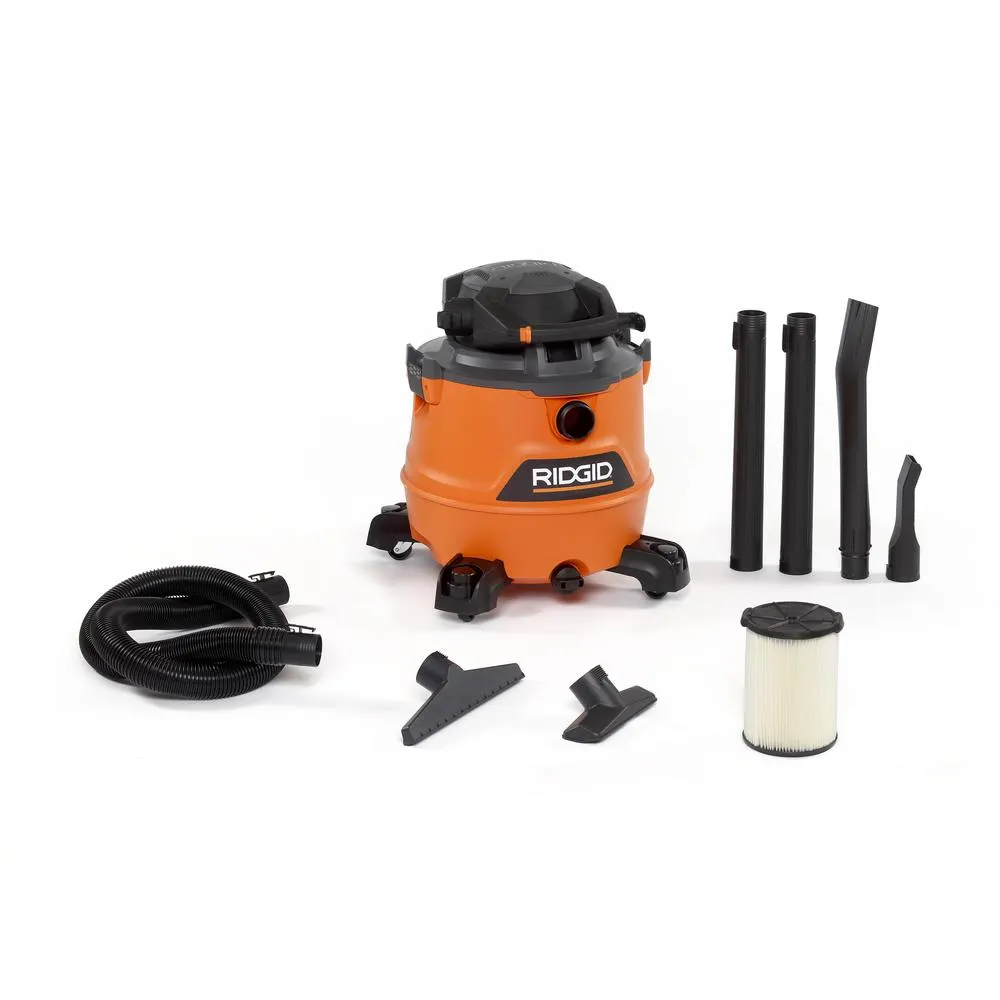
RIDGID HD1600 16-Gallon NXT Shop Vacuum
The HD1600 earns the top position through a combination of capacity, performance, and long-term value that none of the other picks can match at the same price. Its 16-gallon drum, 6.5 peak HP motor, and 161 CFM suction handle dry debris, wet spills, and damp sawdust without switching accessories. RIDGID's lifetime warranty on the vac body is the strongest coverage in this category — most competitors offer one to three years — and the locking hose collar eliminates the frustrating mid-job hose pop that plagues cheaper vacuums. A detachable blower port turns it into a shop blower when needed, extending its usefulness beyond vacuuming.
- ✓ Lifetime warranty on the vac body is the best coverage in this lineup
- ✓ Locking hose collar prevents mid-use disconnections
- ✓ Detachable blower port doubles as a shop blower
- ✓ Large 16-gal tank and 161 CFM handle most residential and light-commercial cleanup
- ✗ 161 CFM trails the Craftsman's 177 CFM on high-volume debris
- ✗ At 24.5 lbs the drum is not light to carry up stairs or across a large site
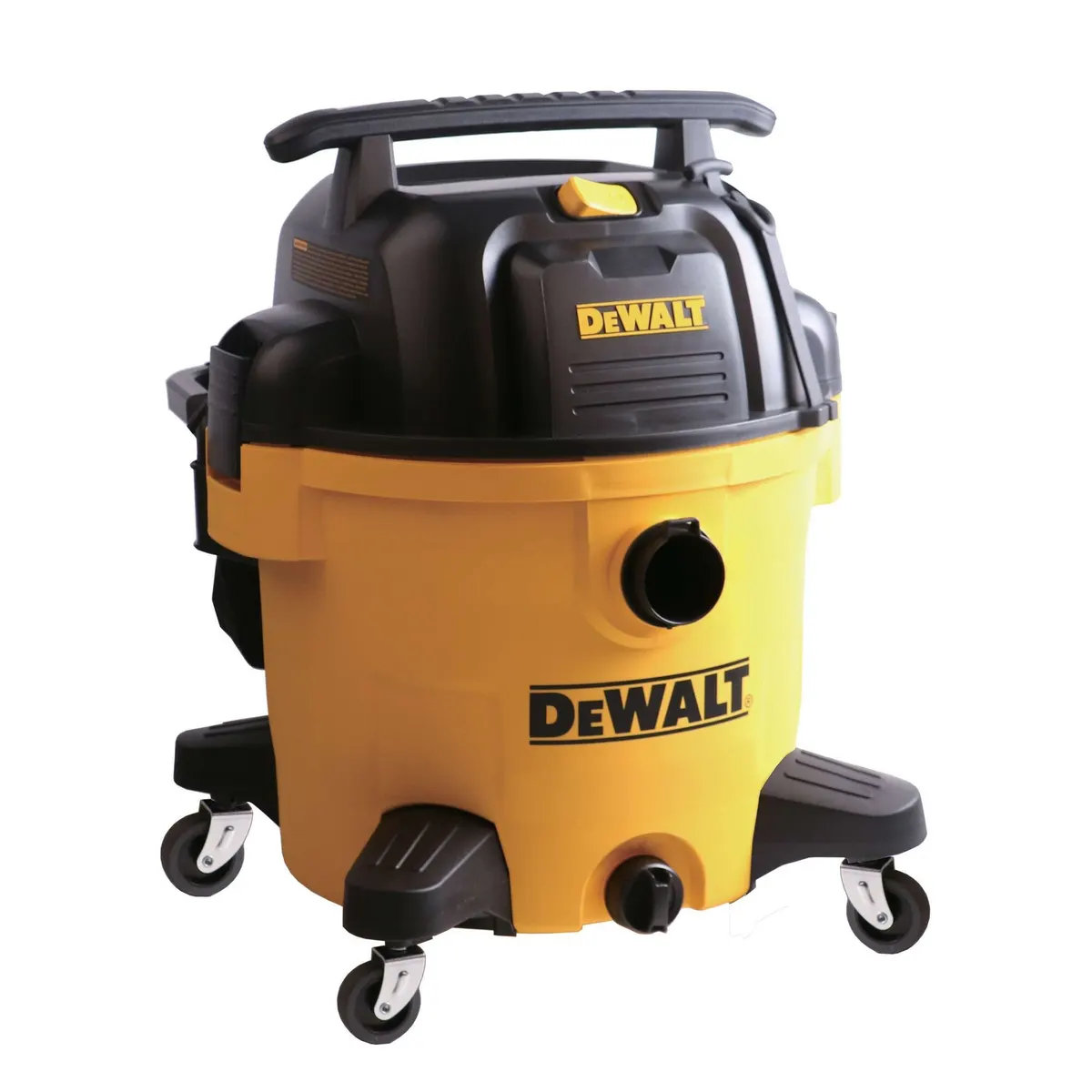
DeWalt DXV10P 10-Gallon Quiet Series Vacuum
The DXV10P stands out for its two-stage quiet motor, which runs noticeably lower in decibels than the other corded vacs in this guide — a meaningful advantage in attached garages, finished basements, or any space where noise carries. Its 10-gallon capacity and 90 CFM are lower than the two 16-gallon picks, but for the average homeowner who empties a vacuum after each project those numbers rarely pinch. At 27.78 lbs it is actually the heaviest pick here despite the smaller drum, but the tradeoff is a motor assembly built for long-cycle quieter operation.
- ✓ Two-stage quiet motor is the lowest-noise corded vacuum in this guide
- ✓ 5.5 peak HP and solid construction for continuous indoor use
- ✓ Compatible with HEPA filter upgrade for finer dust capture
- ✓ Good for attached garages and finished spaces where noise matters
- ✗ 90 CFM is the lowest suction output among the corded vacuums here
- ✗ 10-gallon drum fills faster when clearing large debris piles
- ✗ Heaviest pick despite the smaller tank at 27.78 lbs
We may earn a commission from this link.
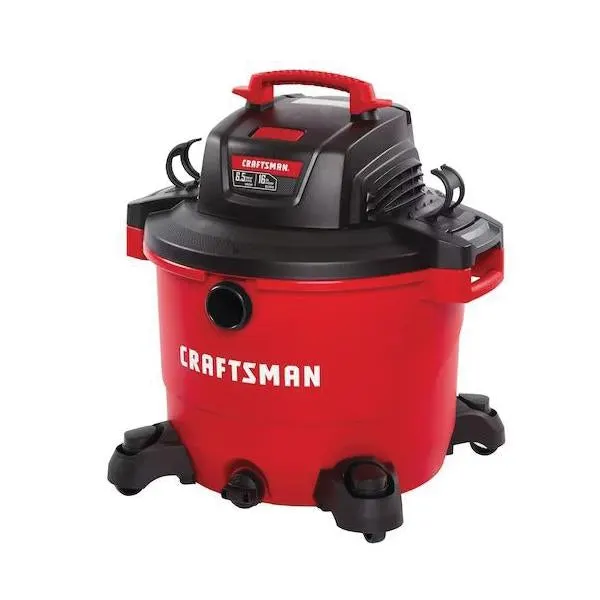
Craftsman CMXEVBE17595 16-Gallon Vacuum
The Craftsman leads this group in raw suction — 177 CFM is the highest figure here — which matters most when you are clearing large volumes of chips, shavings, or construction debris in a hurry. Its 16-gallon tank and 6.5 peak HP motor match the RIDGID on capacity and power, and at 26 lbs it sits squarely mid-range on weight. The weaker point is warranty coverage: Craftsman's standard limited warranty on vacuums trails RIDGID's lifetime coverage by a significant margin. For raw throughput on a budget, though, 177 CFM is hard to argue with.
- ✓ 177 CFM is the highest airflow in this guide, clearing large debris loads quickly
- ✓ 16-gal tank and 6.5 peak HP match the premium RIDGID on core capacity
- ✓ Available at Lowe's with frequent promotional pricing
- ✓ Mid-range weight at 26 lbs is manageable for most users
- ✗ Warranty coverage trails the RIDGID's lifetime policy
- ✗ No built-in blower port — the HD1600 adds that feature at a similar price
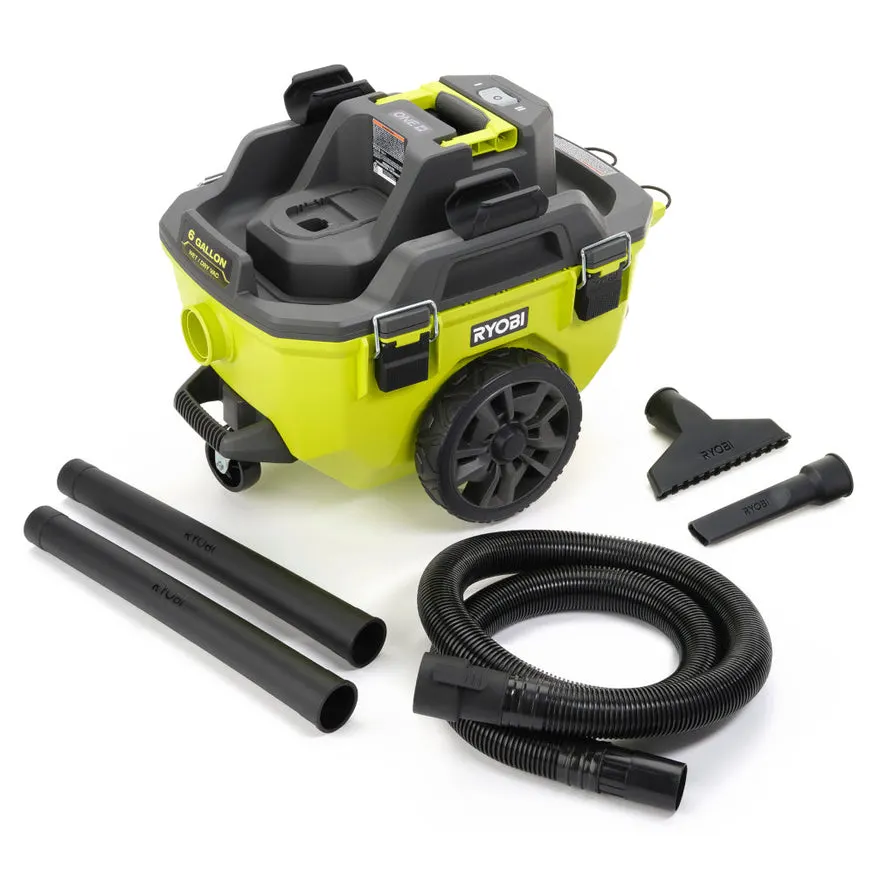
Ryobi PCL735B 18V ONE+ 6-Gallon Cordless Vacuum
The PCL735B is the only cordless shop vacuum in this guide, and its 18V ONE+ compatibility makes it a natural addition for anyone already using Ryobi tools. Its 6-gallon tank and 80 CFM suction are modest compared to the corded options, but cord-free operation opens up situations where dragging a cord is impractical — under a car, in a truck bed, or in a space without an accessible outlet. The built-in blower port is a welcome bonus, and the ONE+ platform means batteries you already own work immediately.
- ✓ Cord-free 18V ONE+ operation works anywhere a battery reaches
- ✓ Built-in blower port for blowing out tight spaces
- ✓ 6-gallon tank is compact and easy to carry to the work site
- ✓ Compatible with the entire ONE+ battery ecosystem — no new batteries needed
- ✗ 80 CFM is noticeably lower than the corded vacuums in this guide
- ✗ Sold as a bare tool — battery and charger sold separately
- ✗ 6-gallon drum fills quickly on large cleanup jobs
Who needs a shop vacuum
A shop vacuum is distinct from a household vacuum in one fundamental way: it is built to handle the debris that would destroy a carpet cleaner — sawdust, metal shavings, construction grit, wet spills, and the odd drywall screw. If you have a garage, a basement workshop, or a truck that collects job-site mess, a shop vacuum is a more practical tool than any household machine. The four models in this guide represent the range from corded high-capacity workhorses to a lightweight cordless option, covering the realistic needs of homeowners, hobbyists, and light-commercial users.
How these picks were chosen
The shortlist is drawn from detailed reviews of four shop vacuums that span the corded and cordless segments and cover the most common purchase scenarios. Rankings are based on a combination of CFM airflow, tank capacity, motor rating, warranty coverage, kit configuration, and the practical features — blower ports, hose locking, filter compatibility — that distinguish a good vac from a frustrating one. Where two models share similar specs, the tiebreaker is warranty and the features that affect everyday usability.
Capacity and airflow: the two numbers that matter most
Two specifications actually predict how well a shop vacuum does its job: tank capacity in gallons and airflow in CFM.
Tank capacity determines how often you stop to empty. A 16-gallon drum like those on the RIDGID HD1600 and Craftsman CMXEVBE17595 can accumulate a full floor sweep of sawdust before requiring attention. A 10-gallon drum like the DeWalt's fills faster but is lighter and easier to maneuver. The Ryobi's 6-gallon cordless tank is best thought of as a cleanup companion rather than a primary dust-collection solution.
CFM tells you how fast the vacuum moves air — and, by extension, debris — through the hose. Higher CFM pulls larger chips and wet debris reliably. The Craftsman leads at 177 CFM, the RIDGID follows at 161, and the DeWalt's 90 CFM is the smallest number but still adequate for household dust and spills.
RIDGID HD1600: why the lifetime warranty matters
Tool warranties are often afterthoughts, but on a machine that lives in a damp garage and gets banged around a workshop, the RIDGID HD1600's lifetime coverage on the vac body is genuinely meaningful. If the drum cracks, the latch breaks, or the motor housing fails, RIDGID replaces it — not a one- or two-year window but for as long as you own the vacuum. That changes the calculus on what looks like a modest price premium over the Craftsman. Add the locking hose collar and the detachable blower port and the HD1600 is the most complete package here.
When to choose the DeWalt DXV10P
Noise is a real-world constraint that the spec sheet rarely addresses directly. The DXV10P's two-stage quiet motor runs at a lower volume than a standard single-stage shop-vac motor, which matters if your workshop is in an attached garage adjacent to a living space, if you work early in the morning, or if you share a workspace where a screaming vac motor is disruptive. The 10-gallon tank and 90 CFM are trade-offs for that quieter operation, and they are reasonable ones for users who prioritize a calmer environment over maximum throughput.
Craftsman CMXEVBE17595: the raw throughput argument
For users who care primarily about clearing large debris volumes quickly, the Craftsman's 177 CFM is the strongest performance argument in this guide. Paired with a 16-gallon tank, it combines high flow with high capacity in a single machine. Lowe's pricing tends to make it competitive, and it is a reasonable choice when you do not need the HD1600's blower port or lifetime warranty and are optimizing purely for airflow. The warranty gap — Craftsman's standard limited coverage versus RIDGID's lifetime policy — is the main reason it ranks third rather than first.
Ryobi PCL735B: the case for going cordless
Cordless shop vacuums occupy a specific niche: jobs where no outlet is nearby or where dragging a cord creates a tripping hazard. Under-car work in a driveway, cleaning a truck bed, clearing chips from a portable workbench, or doing a quick sweep in a space before the extension cord is run — these are the PCL735B's natural moments. At 80 CFM it is not a replacement for a full-size corded vac, but paired with an existing ONE+ battery collection it adds genuine utility at a relatively low tool-only price.
A practical note on accessories and filters
Every vacuum here uses standard hose and accessory diameters compatible with a wide range of aftermarket tools — crevice nozzles, floor brushes, and dust-port adapters are interchangeable across most brands. Filter quality matters more than it is often given credit for: a worn or missing filter allows fine dust to pass through the motor, shortening its life. Replace paper filters when they show visible clogging or damage, and rinse foam filters periodically. For anyone working with fine dust from MDF, drywall, or tile, upgrading to a finer-pore filter is a worthwhile step regardless of which vacuum you choose.
Advertisement
Frequently asked questions
- What size shop vacuum do most homeowners need?
- A 10- to 16-gallon drum covers the vast majority of household and garage cleanup tasks. For occasional use — clearing sawdust after a weekend project, vacuuming a car interior, or cleaning up a spill — a 10-gallon model like the DeWalt DXV10P empties and stores easily. If you run longer sessions or clear larger debris volumes regularly, step up to a 16-gallon drum like the RIDGID HD1600 or Craftsman CMXEVBE17595 to cut down on emptying trips.
- Can a shop vacuum pick up water and wet messes?
- Yes — every model in this guide is a wet/dry vacuum rated for liquid pickup. The key is to remove the paper or foam filter before vacuuming liquids; most manufacturers include a separate foam sleeve or drum filter for wet use. After vacuuming water, rinse and dry the drum before switching back to dry operation to prevent mildew buildup.
- What does peak horsepower actually mean on a shop vacuum?
- Peak horsepower is a measurement taken at the motor's peak current draw — a brief spike, not a sustained output figure. It is useful as a relative indicator but should not be compared directly to a steady-state horsepower rating. CFM (cubic feet per minute) and sealed suction in inches of water lift are more practical measures of everyday suction performance, which is why CFM is highlighted for each pick in this guide.
- Do shop vacuums work with dust collectors or tool ports?
- Many shop vacuums can connect directly to a tool's dust port — routers, sanders, circular saws, and jigsaws often have a 1.25- or 2.5-inch port that mates with standard vacuum hose adapters. For cleaner operation, look for a vacuum with an auto-start feature (also called automatic tool activation) that powers on the vac when the connected tool starts. None of the picks in this guide have that feature built-in, but external auto-start switches are inexpensive add-ons.
- Should I buy a shop vacuum with a HEPA filter?
- A HEPA filter — or a vacuum compatible with a HEPA upgrade — is worth considering if you work with materials that produce fine or hazardous dust: MDF, treated lumber, tile, or drywall compound. The DeWalt DXV10P is the pick most amenable to HEPA filtration in this guide. For general sawdust, a standard foam or pleated cartridge filter captures enough for routine shop use.
- Is a cordless shop vacuum powerful enough for real workshop use?
- For light-duty and spot-cleaning tasks, the Ryobi PCL735B's 80 CFM is genuinely useful. It handles shavings from a hand plane, dust in a car interior, or cleanup around a workbench without needing an outlet. Where it falls short is sustained high-volume work — clearing a floor after a router session or emptying a large pile of chips is noticeably slower than a 161- or 177-CFM corded vacuum. Think of cordless as a complement to a corded vacuum rather than a full replacement.