
Ryobi PCL735B Review: 6-Gal 18V Cordless Wet/Dry Vac
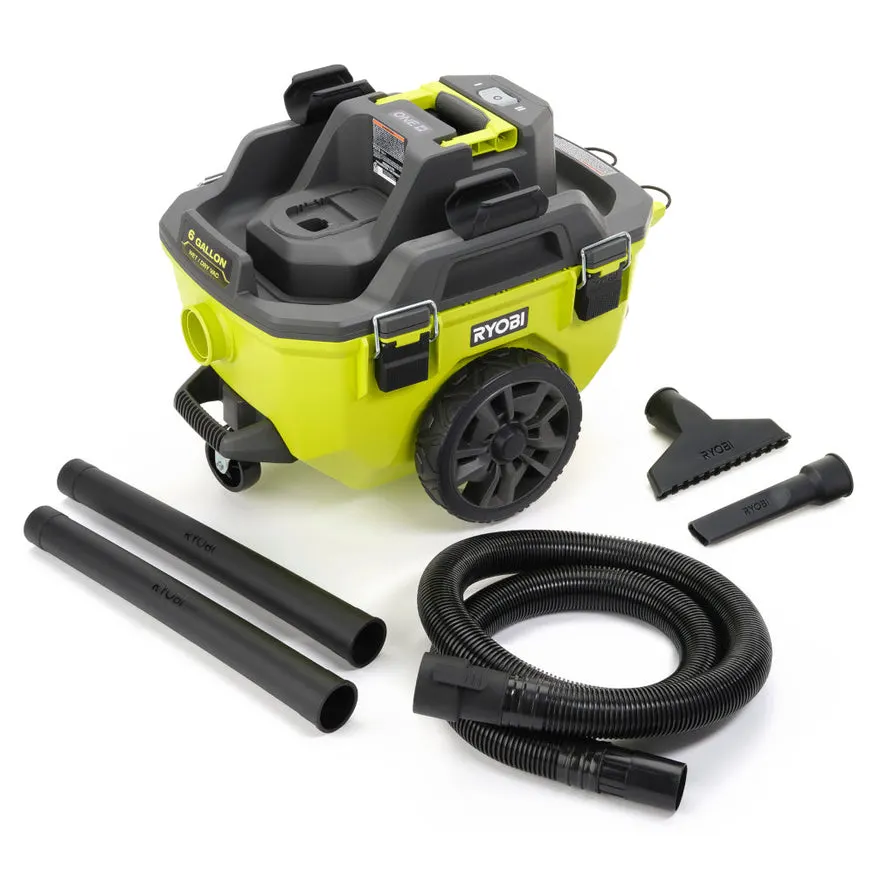
| capacity | 6 gallons |
|---|---|
| suction | 80 CFM / 36 in. water lift |
| hose | 1-7/8 in. x 7 ft. |
| battery | 18V ONE+ (not included with tool-only; PCL735K1 kit includes 1x 4Ah) |
| filter | Pleated cartridge filter (included); HEPA upgrade A32RF07 sold separately |
| weight | 25.2 lbs (tool only, no battery) |
| blower Port | Yes — built-in blower port |
| speed Settings | High / Low 2-speed switch |
| warranty | 3-year limited |
Pros
- No cord means no cord-management frustration around workbenches, vehicles, or outdoor areas where extension cords are a tripping hazard
- 80 CFM suction at the hose and 36 inches of water lift deliver more pickup power than the 6-gallon size suggests
- High/low speed switch lets you balance maximum suction against battery runtime depending on the task
- Blower port adds versatility — useful for clearing sawdust off bench surfaces without switching tools
- Compatible with all Ryobi 18V ONE+ batteries, a platform with over 300 tools — no extra battery investment for existing ONE+ users
Cons
- 6-gallon capacity requires much more frequent emptying than 16-gallon corded alternatives — a real inconvenience on large renovation cleanups
- Battery not included at $149 tool-only price; adding a 4Ah battery and charger kit brings the total to $199, making this one of the pricier shop vacs per gallon of capacity
- Runtime on a 4Ah battery is adequate for a single session but a second battery is advisable for longer cleanup jobs
- Battery adds weight — the 18V 4Ah pack adds roughly 1.7 lbs to the already 25.2-lb tool, making the loaded unit heavier than some 16-gallon corded vacs
The case for a cordless shop vac
The Ryobi PCL735B answers a specific question: what if you need to vacuum a vehicle interior, a detached workshop with no outlets, a patio, or a tight crawl space where running 50 feet of extension cord creates a tripping hazard or simply is not practical? For those scenarios, cord management on a standard shop vac is a genuine friction point, and the PCL735B eliminates it entirely.
Ryobi has built the PCL735B into the 18V ONE+ ecosystem, which means anyone who already owns Ryobi drills, circular saws, or lawn equipment likely has batteries that fit immediately in this vacuum. That zero-additional-battery-cost scenario makes the $149 tool-only price genuinely competitive with corded alternatives for the existing Ryobi owner. If you already have two or three 18V ONE+ batteries in rotation, the PCL735B is effectively a $149 shop vac.
Suction performance for a 6-gallon cordless machine
At 80 CFM and 36 inches of water lift, the PCL735B delivers more suction than its compact size and battery-powered operation might suggest. The two-speed switch is practically useful: high speed provides maximum pickup for heavy debris, and low speed extends battery runtime for lighter sustained cleanup sessions where maximum suction is not required.
Corded 5-to-6 gallon shop vacs in the $80–$100 range often deliver similar CFM figures, so the PCL735B is not meaningfully sacrificing pickup power relative to a corded small-capacity alternative. The generation-over-generation improvement — Ryobi claims 30% more suction than the previous PCL715B — is reflected in the 80 CFM figure and the 36-inch water lift specification.
The 1-7/8 in. hose diameter connects directly to most Ryobi and standard tool dust ports on circular saws, miter saws, and sanders. Extension wands are included to reach tighter areas and extend cleaning range beyond the 7-ft hose.
Battery and runtime realities
The honest limitation of any cordless shop vac is runtime. A 4Ah 18V battery powers approximately 20–30 minutes of sustained high-speed suction — adequate for clearing a vehicle interior, cleaning up after a single power tool session, or doing a post-project sweep of a compact workshop. For a full renovation cleanup spanning an hour or more of vacuum time, a second battery or recharge break is necessary, and planning accordingly avoids mid-session interruptions.
Owners who carry 6Ah or 9Ah Ryobi packs from outdoor power equipment — string trimmers, leaf blowers, mowers — will get substantially longer runtime from those higher-capacity cells. Any 18V ONE+ battery works without a compatibility concern, so upgrading runtime is as simple as using a higher-capacity pack.
Buyers new to the Ryobi system should note that the tool-only PCL735B at $149 does not include a battery or charger. The kit configuration that includes a 4Ah battery and charger runs approximately $199. Without an existing battery, the economics shift toward a corded 16-gallon machine that costs similar money and requires no ongoing battery investment.
Wheel design and mobility
The PCL735B's 8-inch all-terrain wheels are a meaningful improvement over the small hard-plastic casters on many shop vacs. The larger wheels roll over door thresholds, concrete cracks, and workshop floor transitions without catching. For a cordless machine that benefits from being moved to different areas and surfaces — indoors, outdoors, into a vehicle cargo area — this mobility makes practical sense.
The drum is also designed with a carry handle for single-handed transport between areas, which is more useful than it sounds when you are already carrying accessories or a battery charger.
Wet pickup and the HEPA filter upgrade
The PCL735B handles wet pickup using the same approach as corded shop vacs: replace the pleated dry cartridge with the foam wet sleeve (included) or remove the filter entirely for standing water. The 6-gallon drum fills quickly during wet pickup — roughly five gallons of water brings the drum close to capacity — so for basement flooding or vehicle water extraction, plan for frequent drain cycles.
For fine dust collection in woodworking or drywall finishing applications, Ryobi's A32RF07 HEPA filter is the necessary upgrade over the stock cartridge. The standard filter captures coarse particles but passes fine wood flour and drywall dust; the HEPA version captures down to 0.3 microns. If the vacuum is going to see regular sanding or routing work, budget the HEPA filter into the purchase.
How the PCL735B compares to the corded group
Against the RIDGID HD1600 — a 16-gallon corded machine at $150 — the comparison reduces to use case. The RIDGID holds 16 gallons, runs indefinitely from a wall outlet, offers a detachable blower, and carries a lifetime warranty. For garage and shop cleanup with an outlet nearby, the RIDGID is more capable in every capacity-related dimension. The PCL735B wins when cord freedom is genuinely necessary.
Against the Craftsman CMXEVBE17595 at $80–$100, the value gap in the corded machine's favor is even wider. The PCL735B justifies its higher price exclusively through cord freedom.
For the existing Ryobi 18V ONE+ owner with batteries already in rotation, the PCL735B at $149 is a sensible tool addition that provides cord-free cleanup across the full range of situations where extension cord management is genuinely inconvenient — vehicle cleaning, outdoor areas, detached outbuildings, and compact spaces without nearby outlets.
Advertisement
Frequently asked questions
- Can the Ryobi PCL735B pick up water?
- Yes — the PCL735B is a full wet/dry vacuum. For vacuuming water, swap the pleated dry cartridge for the foam wet filter sleeve (included in most configurations) or remove the filter entirely for standing water pickup. The drum captures liquid directly. After vacuuming water, drain the drum, allow the interior to dry, and reinstall the dry pleated cartridge before resuming dry debris collection.
- How long does the battery last on the Ryobi PCL735B?
- Runtime depends heavily on battery capacity and suction setting. On the high setting with a 4Ah 18V pack, expect roughly 20–30 minutes of continuous suction — enough for a typical post-project shop cleanup. On low setting, runtime extends to 40–50 minutes. A 6Ah battery further extends runtime. Having a second charged battery available is advisable for longer sessions.
- Is the Ryobi PCL735B better than the older PCL715B?
- The PCL735B delivers up to 30% more suction than the previous-generation PCL715B, improved all-terrain wheels, and better accessory storage. If you are upgrading from an older Ryobi cordless vac, the PCL735B is a meaningful step up in suction performance for the same 18V ONE+ battery platform.
- What battery comes with the Ryobi PCL735B kit?
- The tool-only PCL735B comes without a battery. The PCL735K1 kit configuration includes one 4Ah 18V ONE+ battery and a charger. If you already own Ryobi 18V ONE+ batteries from other tools, the $149 tool-only model is the correct choice; if you are new to the platform, the kit at $199 provides everything needed to start.
- Can I upgrade to a HEPA filter on the Ryobi PCL735B?
- Yes — Ryobi offers the A32RF07 HEPA filter as an upgrade for the PCL735B. The HEPA filter captures particles down to 0.3 microns, making the vacuum suitable for fine wood dust and drywall sanding applications where the standard cartridge would release fine particles back into the air. The standard A32RF06 cartridge filter is also available for replacement.
- How does the Ryobi PCL735B compare to corded shop vacs?
- The PCL735B's 6-gallon drum fills about three times faster than a 16-gallon corded vacuum like the RIDGID HD1600, and it costs more per gallon of capacity. The tradeoff is complete cord freedom. For cleanup tasks around vehicles, in areas without outlets, or where extension cord management is genuinely inconvenient, the cordless advantage is real. For garage or shop cleanup where an outlet is nearby, a corded 16-gallon vac is more practical.
Ready to buy the PCL735B?
We may earn a commission if you buy through these links, at no extra cost to you.