
The Best Miter Saws for Homeowners in 2026
A homeowner shopping for a miter saw faces a different set of trade-offs than a contractor: the saw may sit idle for months between projects, setup ease matters as much as cut speed, and paying for professional-grade durability often returns no benefit. This guide ranks four miter saws specifically for homeowner use — prioritizing price-to-feature ratio, ease of setup, and the kinds of cuts a home repair and remodeling project actually demands. The Metabo HPT C10FCGS is the entry-level benchmark that covers trim, molding, and framing with a dependable 5-year warranty at under $150. The Ryobi TSS103 adds a sliding carriage for wider crosscuts when you occasionally need them. The DeWalt DWS780 and Bosch GCM12SD are upgrade picks for homeowners whose projects have grown into something more serious.
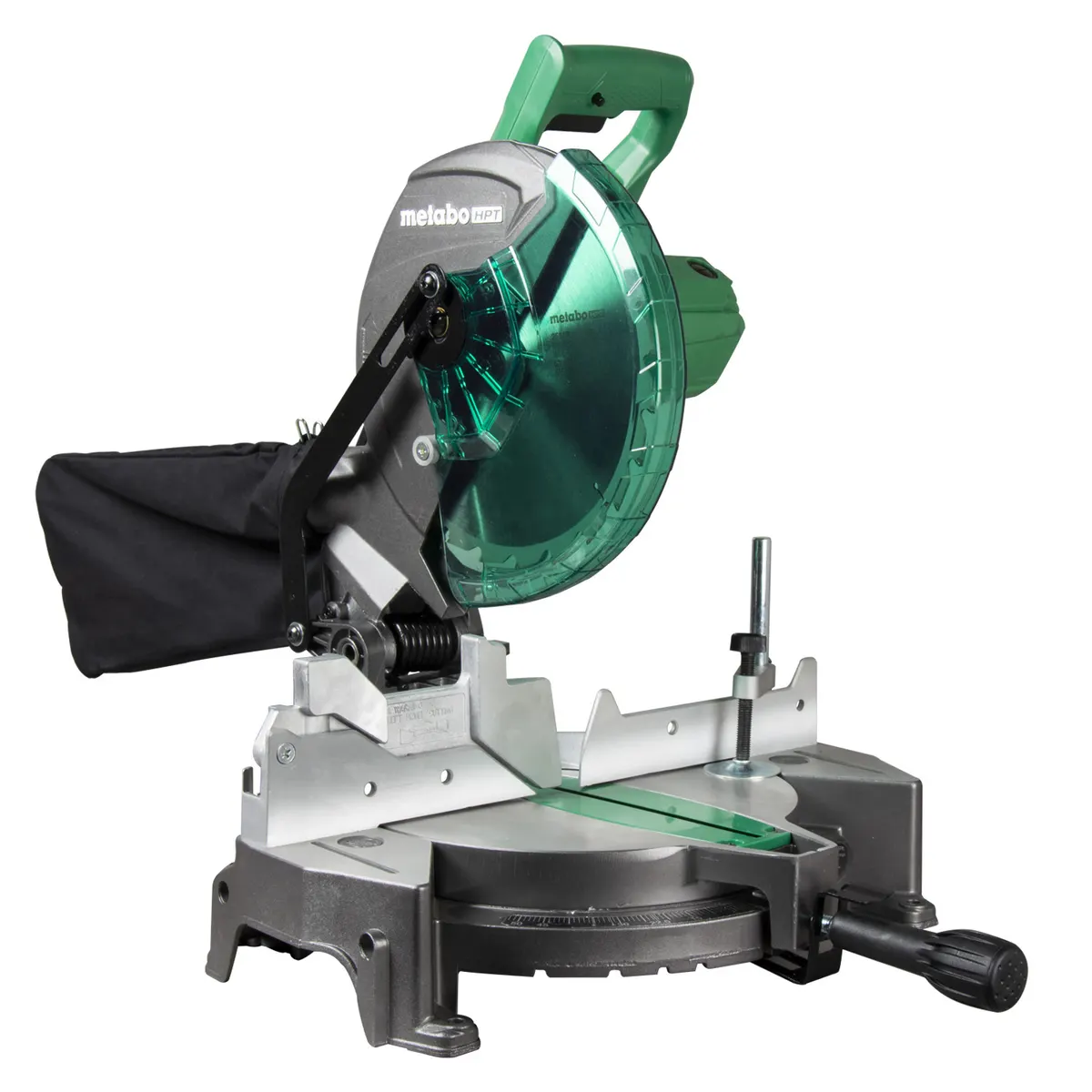
Metabo HPT C10FCGS 10" Compound Miter Saw
For a homeowner who needs to cut baseboard, door casing, crown molding, and occasional framing lumber, the C10FCGS does every one of those jobs and costs between $110 and $150 — less than any competing miter saw with a 5-year warranty. Its 15-amp motor turns the blade at 5,000 RPM, the miter range runs 0–52° in both directions, and the single-bevel design handles the compound angles that show up in crown molding without requiring the saw to tilt both ways. At 24.2 lbs it is light enough to carry between rooms. The saw that comes out once a season for trim work does not need to be expensive, and this one proves it.
- ✓ 5-year warranty is the longest of any saw in this guide — meaningful for occasional-use tools
- ✓ 15-amp motor at under $150 delivers genuine cutting power without a premium price
- ✓ 5,000 RPM blade speed and 0–52° miter range cover trim, molding, and framing angles
- ✓ 24.2 lbs makes it light enough to move between the garage and the job inside
- ✗ Single-bevel design requires flipping workpieces for opposing compound miter angles
- ✗ 10-inch blade limits crosscut capacity compared with 12-inch sliding saws
We may earn a commission from this link.
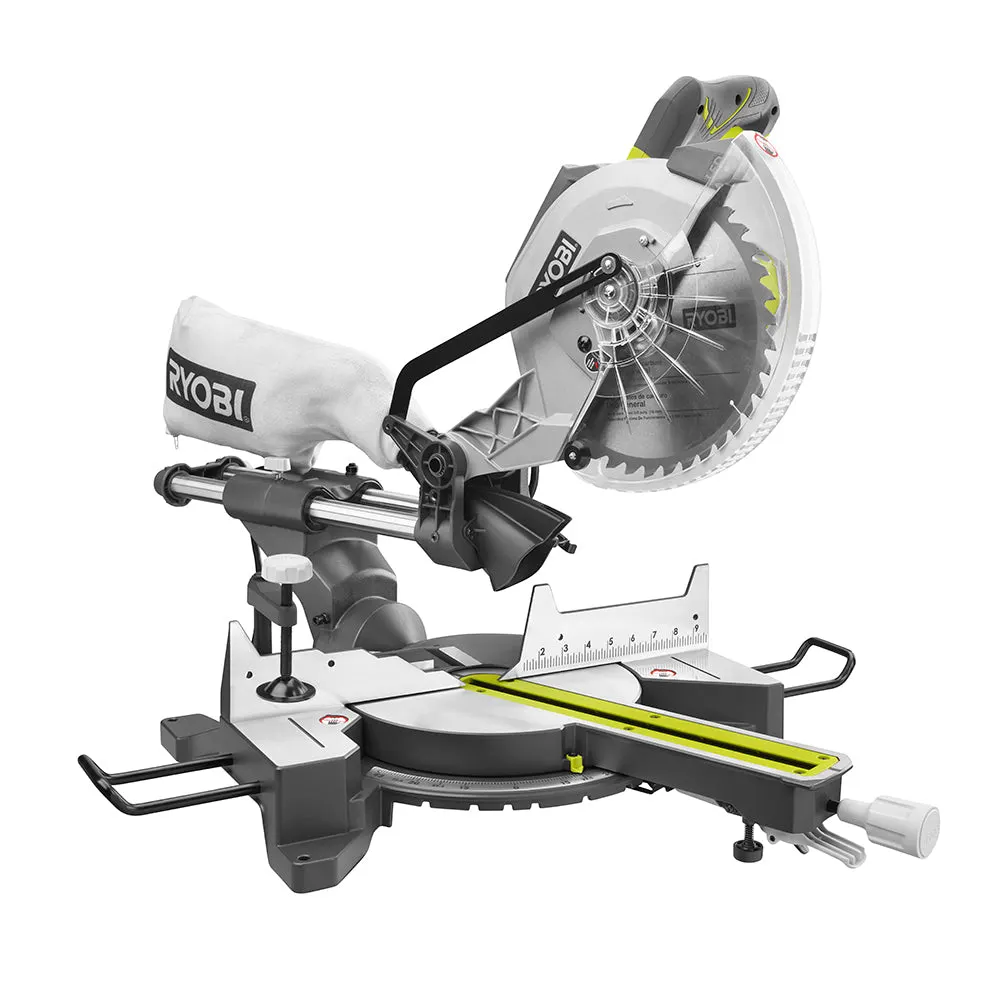
Ryobi TSS103 10" Sliding Compound Miter Saw
The TSS103 adds a sliding rail to the 10-inch compound format and stretches crosscut capacity to 12 inches — enough to rip down a standard 1x12 shelf board or cut through 4x4 posts without repositioning. The LED cutline indicator is one of the most useful features for a homeowner: instead of a laser that needs calibration, it casts a shadow on the workpiece that shifts with the blade's exact kerf, making accurate cuts achievable without marking a line on every board. At $249 to $299 it costs $100 to $150 more than the Metabo, and that premium is reasonable if your projects regularly involve wide stock or post material.
- ✓ Sliding carriage extends crosscut capacity to 12 inches — handles 1x12 boards and 4x4 posts
- ✓ LED cutline indicator requires no calibration and shows the actual kerf shadow
- ✓ 15-amp motor and 0–48° bevel capacity cover the full range of standard home-project angles
- ✓ Widely available at Home Depot with strong parts support for long-term ownership
- ✗ $249–299 price is roughly double the Metabo's entry price for features many homeowners will use infrequently
- ✗ Single-bevel design still requires workpiece flipping for opposing compound angles
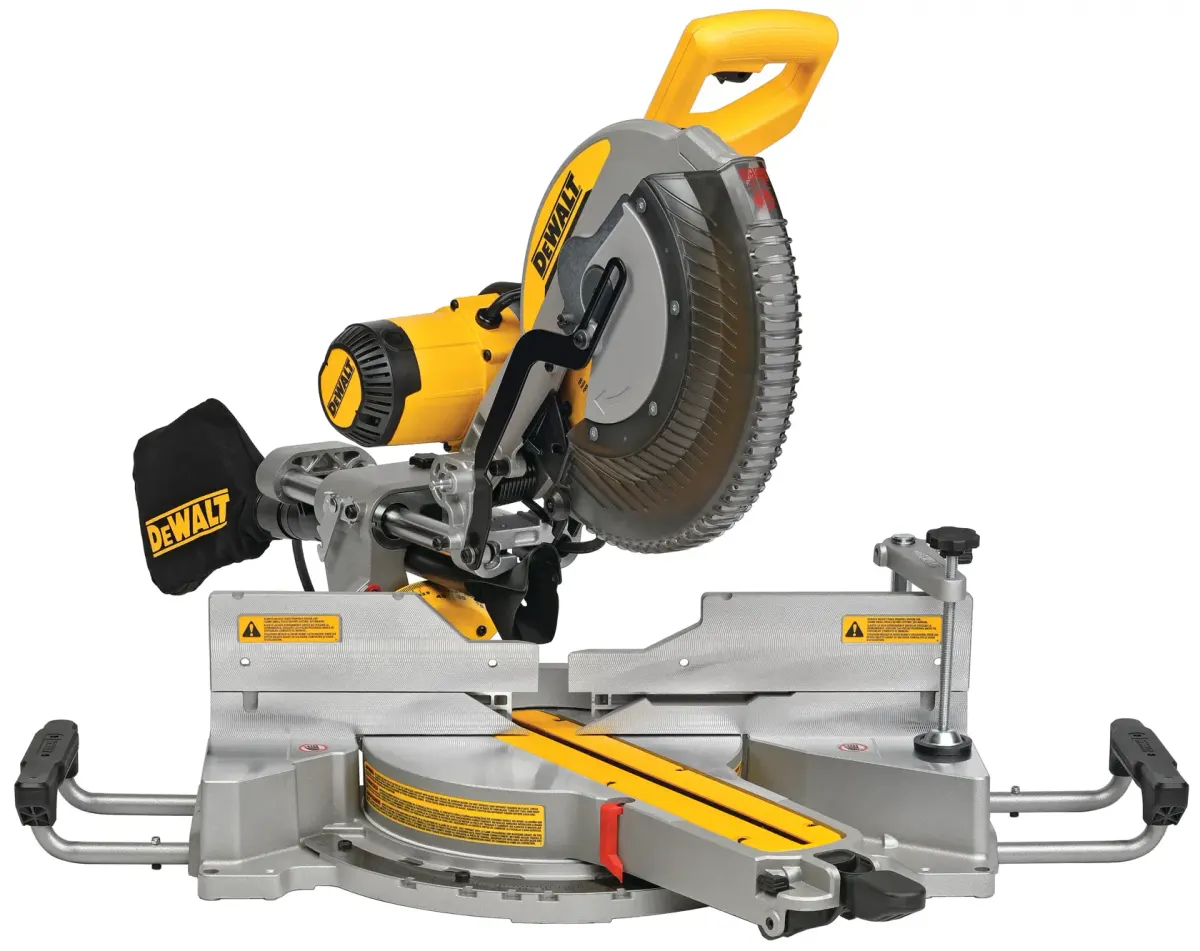
DeWalt DWS780 12" Sliding Compound Miter Saw
The DWS780 is the saw for the homeowner whose projects have grown into room additions, deck builds, or built-in furniture — work that demands wider crosscuts and repeatable precision over many cuts. Its 12-inch blade and dual-bevel tilt handle 2x14 stock at 90° and compound angles without flipping the workpiece, which matters when you are fitting crown molding at a cathedral ceiling or cutting stair stringers that alternate between left and right bevels. At $449 to $649, the price is a real step up, and it is only justified if the additional crosscut range and dual-bevel convenience will actually see use. For serious hobby woodworkers or homeowners with ongoing large projects, it is the right ceiling.
- ✓ 12-inch blade and sliding carriage cross-cuts up to 2x14 stock in a single pass
- ✓ Dual-bevel tilt eliminates the need to flip workpieces for opposing compound angles
- ✓ 60° right / 50° left miter range covers virtually every framing and trim angle
- ✓ 3,800 RPM with a 15-amp motor provides consistent power through dense material
- ✗ $449–649 is a significant investment for a saw used on occasional home projects
- ✗ Large footprint and weight require a dedicated bench or stand — not a saw you carry room to room
We may earn a commission from this link.
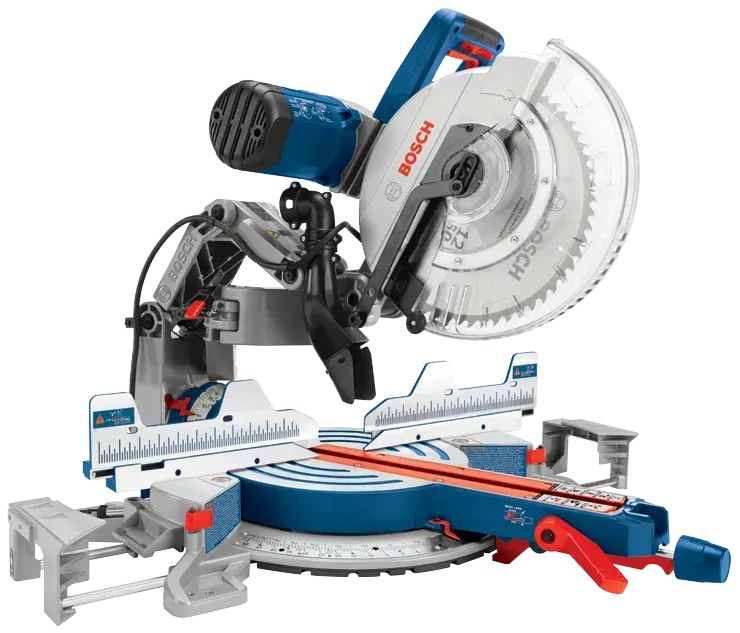
Bosch GCM12SD 12" Axial-Glide Miter Saw
The GCM12SD earns its rank because of one engineering choice that makes an unusual amount of difference for a garage or basement shop: its axial-glide arm swings in an arc rather than sliding on rails, so the saw requires no clearance behind the blade. A conventional 12-inch sliding saw needs 12 to 14 inches of wall clearance when the carriage extends; the Bosch needs none. In a small shop where the bench is against a wall, that difference is the entire reason to spend the extra $100 over the DeWalt. Add 52° left / 60° right miter angles, a 3-1/2 x 13-1/2 inch crosscut at 90°, and dual-bevel tilt, and it is the most capable saw in this guide — at a price to match.
- ✓ Axial-glide arm eliminates wall clearance requirements — fits against any wall in a small shop
- ✓ 3-1/2 x 13-1/2 inch crosscut at 90° is the widest cut capacity in this guide
- ✓ Dual-bevel with 52° left / 60° right miter range covers virtually every compound angle
- ✓ Solid, professional-grade build that holds calibration over years of use
- ✗ $549–649 is the highest price in this guide — hard to justify for purely occasional home projects
- ✗ 65 lbs is the heaviest saw here and requires a permanent dedicated station
Why homeowner priorities differ from contractor priorities
A contractor running a miter saw five days a week cares about motor longevity, fence calibration stability over thousands of cuts, and blade-change speed. A homeowner who pulls the saw out four times a year for a deck build or a trim repaint cares about different things: Is it easy to set up after sitting in the garage for six months? Does the warranty protect against the occasional awkward use? Does the price justify the infrequency of use?
This guide reranks the same four miter saws through a homeowner lens. The Metabo HPT C10FCGS moves to rank one not because it is the best miter saw overall, but because it is the best match for how most homeowners actually use a miter saw. The Bosch GCM12SD drops to rank four not because it underperforms, but because its $549-plus price and 65-lb weight are liabilities rather than assets for a garage shop that needs flexibility.
How this guide defines "homeowner use"
For the purposes of ranking, homeowner use means: projects completed a handful of times per year, a mix of trim work and light construction, a workspace that may be a garage, basement, or driveway, a modest budget for tools, and a preference for easy setup over maximum throughput.
None of the four saws reviewed here are bad choices for this use case. The differences are in how well each one fits the constraints above.
Trim and molding: the primary homeowner use case
The most common reason a homeowner buys a miter saw is trim. Door casing, window trim, baseboard, crown molding, chair rail — all of these require repeatable crosscuts at precise angles, and a miter saw makes these cuts faster and more accurately than any other tool at the same price.
For trim, you need: a reliable miter detent at 0°, 22.5°, 31.6°, 45°, and in some jurisdictions 52.5°; a bevel capacity of at least 45°; and a crosscut capacity of at least 3.5 inches of depth. Every saw in this guide meets these minimums. The differences that matter for trim are the cutline indicator (Ryobi's LED shadow wins here), the fence height, and the ease of making micro-adjustments at the detents.
Crown molding requires a compound angle — here is why it matters
Crown molding sits at a compound angle between the wall and the ceiling. To cut it accurately, you need either a compound miter saw (all four picks here qualify) that can tilt the blade and rotate the table simultaneously, or a flat-cut method using a flat crown jig.
For a homeowner who encounters crown molding once per project, the compound miter approach on any of these saws is faster and requires less jig-building skill. The dual-bevel designs on the DeWalt and Bosch are particularly convenient because you can cut matching inside and outside corner pairs without flipping the board — a minor but genuine time-saver on a job with 20-plus cuts.
The sliding carriage trade-off
A sliding carriage adds crosscut capacity — the TSS103 reaches 12 inches versus the C10FCGS's roughly 6-inch capacity at 90° — but it also adds length to the saw's footprint. A sliding saw typically needs to extend 12 to 14 inches behind the fence to reach full stroke, which rules out placing it directly against a wall.
The Bosch GCM12SD solves this with its axial-glide design, which swings the blade in an arc rather than sliding it on rails, requiring no clearance behind the machine. For a small shop where the bench must sit against the wall, the Bosch's space-saving design is a real functional advantage that justifies some of its price premium.
For everyone else, the Ryobi TSS103's conventional sliding rails work perfectly well as long as the bench has 14 inches of clearance behind it — easy to accommodate with a freestanding workbench.
Dust collection: what to realistically expect
No corded 10-inch or 12-inch miter saw has truly good dust collection. All four saws in this guide include a dust bag that captures some of the fine dust generated at the blade, but a meaningful fraction of fine particles still goes airborne. For a homeowner working in a garage with the door open, this is a nuisance. For someone working in a finished basement, it is a real concern.
The practical solution is to connect a shop vacuum to the saw's dust port rather than using the bag. The larger diameter hose on a shop vac captures far more material than the bag does. All four saws in this guide have compatible dust ports for standard shop-vac adapters.
Setup after storage
One aspect of miter saws that rarely gets attention in buying guides is how they behave after months in storage. Calibration can drift as temperature cycles cause the detent springs and locking levers to relax. Blade guards can become stiff if the pivot point is not lubricated.
The Metabo HPT C10FCGS and the DeWalt DWS780 both have straightforward calibration procedures documented in their manuals that a homeowner can execute with a square and a screwdriver in about 15 minutes. This matters more than it sounds for a tool that lives in a garage between spring and fall projects.
Matching the saw to the project
A quick decision tree for homeowners:
Mostly trim and molding, no large boards: The Metabo HPT C10FCGS at $110–150 is the answer. Its limitations only show up when the stock is wider than a 10-inch saw can handle, which most trim work never approaches.
Trim plus occasional 1x12 boards or 4x4 posts: The Ryobi TSS103 at $249–299. The sliding carriage earns its price the first time you need to cut a wide shelf board without repositioning.
Room additions, deck framing, built-ins — anything that generates dozens of cuts per project: The DeWalt DWS780 at $449–649. The dual bevel and 12-inch capacity change the work, not just the speed.
Small shop with a wall-mounted bench: The Bosch GCM12SD at $549–649. The axial-glide arm earns its price specifically in tight shops where the saw must go against a wall.
What you can safely ignore
Some miter saw features matter a lot for production work and very little for occasional home use. Blade-change speed — relevant if you swap blades multiple times per day — is a non-factor if you change your blade once a season. Electronic speed control matters on saws that see long production runs; for trim work with normal lumber it makes no perceptible difference. Laser guides, as noted in the FAQ, require calibration to stay useful; the LED cutline on the Ryobi is more reliable for a tool that may sit unused between projects.
Focus budget on the saw size and bevel type that match your actual project list, and you will not need to upgrade for a long time.
Advertisement
Frequently asked questions
- What size miter saw should a homeowner buy — 10 inch or 12 inch?
- A 10-inch saw covers the vast majority of homeowner cuts: trim, molding, door casing, framing lumber up to 2x8, and most shelf-board stock. The 12-inch models in this guide (DeWalt DWS780, Bosch GCM12SD) add crosscut capacity for wider boards and posts but cost significantly more and take up more bench space. Start with a 10-inch unless you already know your projects regularly involve stock wider than 8 inches.
- Do I need a sliding miter saw?
- If your projects stay within trim, molding, and standard framing lumber (2x6 and smaller), a non-sliding compound saw like the Metabo HPT C10FCGS handles everything with a smaller footprint and lower price. A sliding carriage becomes useful when you need to cross-cut 1x12 boards, 4x4 posts, or any stock wider than roughly 6 inches. The Ryobi TSS103 adds this capability for $100 to $150 more than the Metabo.
- What is the difference between single-bevel and dual-bevel?
- A single-bevel saw tilts in one direction only — say, 0–48° to the left. For compound angles on the opposing side, you flip the workpiece. A dual-bevel saw tilts both left and right, so you can cut matching compound angles without repositioning the board. For a homeowner cutting crown molding on both inside and outside corners, dual-bevel (as on the DeWalt DWS780 and Bosch GCM12SD) saves time and reduces measurement errors. For trim and basic framing, single-bevel is perfectly workable.
- How often will a homeowner actually use a miter saw?
- Usage patterns vary widely, but most homeowners report that a miter saw comes out during specific projects — a deck, a trim refresh, built-in shelving — and then sits idle between them. This is exactly the usage pattern that makes the Metabo HPT C10FCGS's 5-year warranty and low price so relevant: a saw that gets used 10 days a year benefits more from a long warranty than from premium motor longevity.
- Is an LED cutline indicator better than a laser guide?
- For most homeowners, yes. A laser guide projects a line that must be calibrated to the blade's kerf and can drift over time as the projector shifts. An LED cutline indicator like the one on the Ryobi TSS103 uses the saw's own illumination to cast a shadow that represents the actual blade path — no calibration required. The shadow-based system is more reliable and easier to use for anyone who does not want to maintain a precision-aligned laser.
- Can I use a miter saw for ripping boards lengthwise?
- No. A miter saw is designed for crosscuts — cutting across the grain — and for angled cuts. Ripping a board lengthwise requires a table saw or a circular saw guided by a fence. Attempting to rip on a miter saw is both unsafe and impractical because the throat width and blade travel are sized for crosscut work only.