
Metabo HPT C10FCGS Review: 10" Budget Miter Saw Worth It?
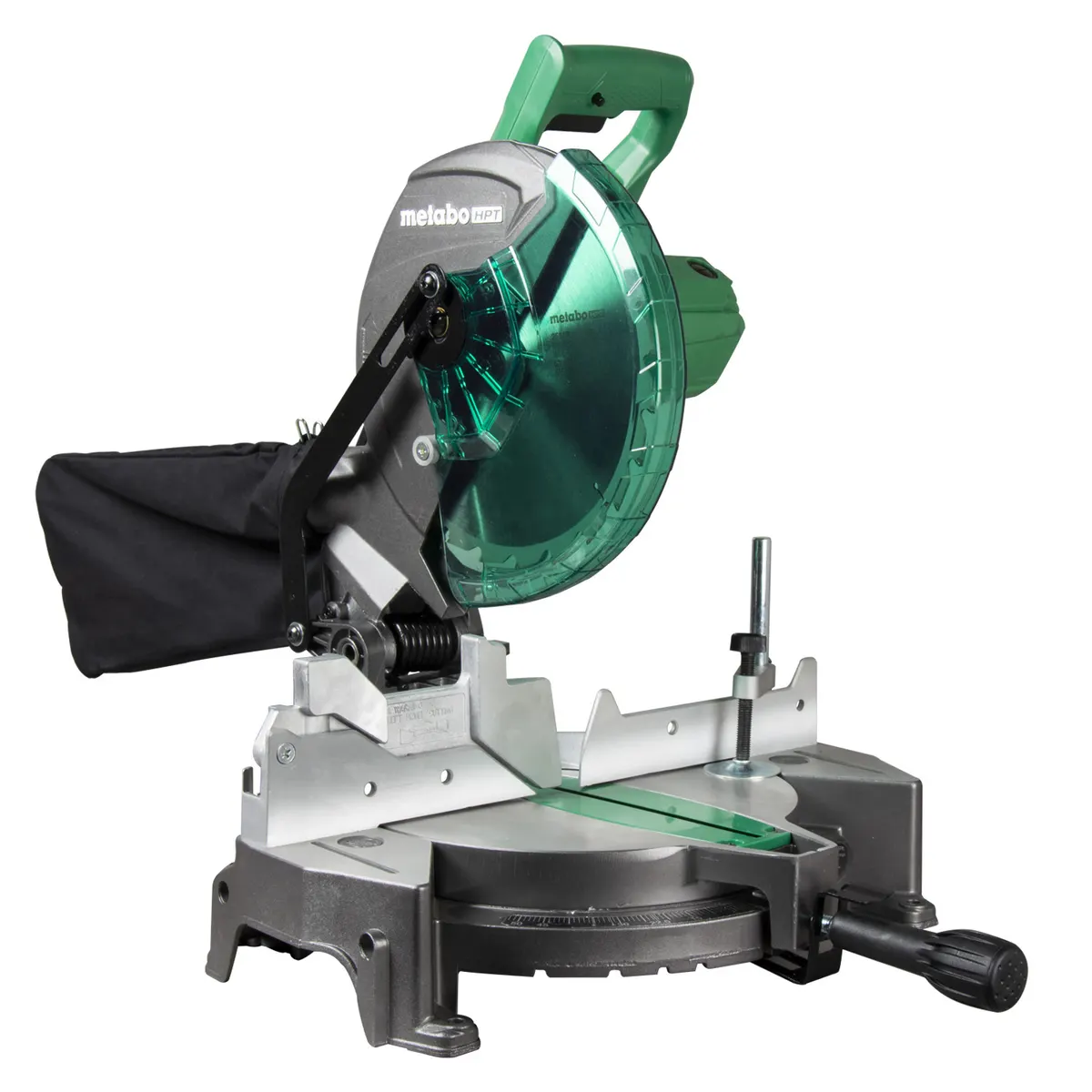
| blade Size | 10 in. (254mm), 5/8 in. bore |
|---|---|
| cross Cut At90 | Approximately 8 in. width on standard dimensional lumber |
| miter Range | 0–52° left and right |
| bevel Range | 0–45° left (single-bevel) |
| motor | 15 Amp, 5,000 RPM no-load, 1,950W output |
| weight | 24.2 lbs |
| power Cord | 6 ft. cord, 120V/60Hz |
| warranty | 5-year limited |
Pros
- 24.2 lbs makes it one of the lightest 10-inch compound miter saws available — genuinely portable by one hand for short distances
- 0–52° miter range is wider than many mid-range saws, covering door casing, base molding, and picture-frame miters without a strained stop
- 15-amp motor running at 5,000 RPM spins the blade at high peripheral speed for clean crosscuts in softwood and MDF trim
- 5-year warranty is one of the longest in the miter saw category at any price point
- Electric brake stops the blade quickly, improving both safety and production pace between cuts
Cons
- Non-sliding design limits crosscut capacity to approximately 8 inches at 90° — wide baseboard, crown molding, and 2×10 lumber require workpiece repositioning or belong on a sliding saw
- Single-bevel only; bevel tilts 0–45° to the left, meaning you must flip the workpiece to cut opposing compound crown angles
- 24-tooth blade in the box is a framing-grade tooth count that leaves rough crosscut edges on hardwood and painted MDF — a finish blade upgrade is recommended immediately for trim work
- Fence height is limited, reducing crown molding nested-cutting capacity compared to full-height-fence sliding saws
Setting expectations: what a $130 miter saw actually does
At $110–$150 street price, the Metabo HPT C10FCGS occupies the bottom tier of the miter saw market — roughly one-quarter the cost of the Bosch GCM12SD or DeWalt DWS780. That price gap reflects real design trade-offs: this is a non-sliding, single-bevel compound saw with a basic fence, a framing-grade blade, and a crosscut capacity that tops out around 8 inches. Understanding what that means practically is the starting point for deciding whether the C10FCGS is the right tool.
For the homeowner replacing door casing, adding window trim, and cutting base molding in standard profiles, those limitations rarely surface. Standard 3-1/4-inch door casing, 5-1/2-inch base molding, and 2×4 or 2×6 dimensional lumber all fall within the saw's capacity. The moment wider stock, crown molding production, or high-volume daily cutting enters the picture, the constraints become visible.
Weight as a genuine advantage
At 24.2 lbs, the C10FCGS is among the lightest 10-inch miter saws in production. For comparison, the Ryobi TSS103 — a 10-inch sliding saw — weighs approximately 28 lbs, and the Bosch GCM12SD reaches 65 lbs. That weight difference is felt immediately when carrying the C10FCGS from a vehicle to a worksite or up a flight of stairs.
For trim installers who set up a temporary chop station in each room, or homeowners who need a saw they can move from garage to backyard to basement without planning around weight, the C10FCGS's portability is a functional advantage that larger saws cannot match at any price.
Motor and cutting performance in context
The 15-amp motor runs at 5,000 RPM no-load — a high speed for a 10-inch saw that translates to a high blade tip velocity at the kerf line. Combined with a sharp blade, that speed produces clean crosscuts on softwood and MDF despite the included 24-tooth blade. The 24-tooth count is the weak link: those wide, aggressive gullets are designed for fast ripping and framing, not finish crosscutting. Replacing the bundled blade with a 60-tooth or 80-tooth thin-kerf crosscut blade is the single most impactful upgrade available for this tool.
The electric brake stops the blade in approximately 2–3 seconds after the trigger is released, compared to 8–12 seconds for saws without a brake. In a production crosscutting session — dozens of identical cuts at a fixed angle — that difference adds up noticeably in cycle time and in the reduced exposure window between cuts.
Miter range and detent quality
The C10FCGS's 0–52° miter range is a genuine positive at this price point. Many budget saws limit miter travel to 45° or 48°; the 52° range accommodates steeper picture-frame miters and unusual architectural angles. Detents are present at common angles, but the feel is noticeably less positive than the stainless-steel detent plates in the DeWalt DWS780 or Bosch GCM12SD — the C10FCGS's stops engage with a softer click that requires careful verification for precision work.
For repeated production cuts at 45° or 22.5°, the standard detents perform reliably. For cut angles between detents, the miter lock knob holds position adequately for a one-off cut but should be double-checked before starting a production run.
Single-bevel: the compound crown limitation
Crown molding installation is where the C10FCGS's single-bevel constraint becomes concrete. Compound crown miters require a specific combination of miter and bevel angles for each corner direction. On a dual-bevel saw, cutting a left-hand corner and a right-hand corner involves dialing in the compound angle and then flipping the bevel side. On the C10FCGS, cutting both corners requires flipping the workpiece itself — the molding must be repositioned against the fence to achieve the mirror-image compound angle.
For occasional crown installation, this is a manageable inconvenience. For a trim carpenter running crown in multiple rooms of a new build, it adds meaningful time and increases the margin for error. That operational cost is one of the primary reasons the C10FCGS belongs in a homeowner's shop rather than a professional trim van.
The 5-year warranty
Metabo HPT's 5-year limited warranty — the longest standard coverage in this product category — is a meaningful differentiator at the C10FCGS's price point. The DeWalt DWS780 carries a 3-year warranty; the Bosch GCM12SD covers 1 year. For a saw used on occasional weekend projects, the 5-year window provides coverage well into the useful service life of the tool.
Verdict
The C10FCGS is the right saw for a homeowner with a one-room trim job or an annual weekend project who wants a light, easy-to-store tool that crosscuts trim profiles accurately without investing $300–$650. Its 52° miter range, 15-amp motor, electric brake, and 5-year warranty provide genuine value at $130. The blade upgrade ($35–$55) is mandatory for finish work. The non-sliding, single-bevel design draws a clear line around the work it handles well — and the Ryobi TSS103 or the Bosch GCM12SD fill in above that line.
Advertisement
Frequently asked questions
- What is the crosscut capacity of the Metabo HPT C10FCGS?
- The C10FCGS is a non-sliding compound miter saw with a crosscut capacity of approximately 8 inches at 90° on standard 2× dimensional lumber. This covers door casing, standard base molding (3-1/4 to 5-1/2 inch profiles), and 2×6 lumber. For wider material — wide-profile baseboard, 2×10 lumber, or crown molding over 4 inches — a sliding compound saw like the Ryobi TSS103 or the Bosch GCM12SD is required.
- Is the Metabo HPT C10FCGS single or dual bevel?
- The C10FCGS is single-bevel only, tilting the blade from 0° to 45° to the left. For crown molding installation requiring opposing compound angles (a left-hand corner and a right-hand corner), you must flip the workpiece to cut the second compound angle rather than simply reversing the bevel direction. Dual-bevel saws like the Bosch GCM12SD and DeWalt DWS780 eliminate this repositioning step.
- Why is the C10FCGS so inexpensive compared to DeWalt and Bosch miter saws?
- The C10FCGS achieves its $110–$150 price through several design compromises relative to $500–$650 professional saws: it is non-sliding (no rail or Axial-Glide system), single-bevel only, uses a lighter-gauge construction, and ships with a 24-tooth framing blade rather than a finish blade. The result is a tool that handles the majority of homeowner trim jobs adequately while eliminating the cost drivers that push professional saws into the $500+ tier.
- Can I cut crown molding with the C10FCGS?
- Yes, with limitations. The C10FCGS can cut crown molding using the nested method — holding the molding against the fence at its spring angle and mitering with the saw's horizontal miter adjustment. However, the fence height limits the size of crown profile that fits cleanly in this position, and the single-bevel configuration requires workpiece repositioning for opposing compound cuts. For production crown work, a dual-bevel sliding saw is more practical.
- How does the 5-year warranty compare to other miter saws?
- Metabo HPT's 5-year limited warranty on the C10FCGS is the longest standard coverage in the corded miter saw category. DeWalt's DWS780 and the Bosch GCM12SD carry 3-year and 1-year limited warranties respectively. The 5-year coverage extends protection against defects through a full renovation project cycle and represents meaningful value insurance given the tool's low purchase price.
- What blade upgrade should I buy for the C10FCGS?
- Replace the bundled 24-tooth blade with a 60-tooth or 80-tooth thin-kerf crosscut blade before cutting finish trim. Freud's LU74M010 (80T) or Diablo's D1080X (80T) are popular upgrades in the $30–$55 range and transform the C10FCGS's cut quality on MDF, painted wood, and hardwood casing from rough to fine. The saw's 5/8-inch bore accepts standard 10-inch saw blades.
Ready to buy the C10FCGS?
We may earn a commission if you buy through these links, at no extra cost to you.