
The Best Cordless Reciprocating Saws of 2026
The best cordless reciprocating saw for most people in 2026 is the Milwaukee 2722-20 M18 FUEL Super Sawzall — it pairs a class-leading 1-1/4-inch stroke, selectable orbital action, and a POWERSTATE brushless motor that sustains speed in the heaviest demolition cuts. If you already own a battery platform, buy the saw that matches it; if you need a light tool for overhead or tight-space work, the DeWalt DCS386B and Ryobi PSBRS01B each serve specific niches.
Milwaukee 2722-20 M18 FUEL Super Sawzall
The 2722-20 is the fastest cordless reciprocating saw in this guide. Its 1-1/4-inch stroke removes more material per cycle than any competitor, and selectable orbital action accelerates framing cuts while preserving a clean straight-line mode for metal pipe. The POWERSTATE brushless motor sustains rated speed through nail-embedded demo lumber. At 8.8 lbs bare it is the heaviest option here, and the QUIK-LOK blade clamp is less user-friendly than DeWalt's lever system, but for pure cutting speed on a job site nothing in this class matches it.
- ✓ 1-1/4-inch stroke and 3,100 SPM produce the fastest cutting speed in this class
- ✓ Selectable orbital action speeds wood demo, can be turned off for clean metal cuts
- ✓ POWERSTATE brushless motor holds speed under heavy loads
- ✓ Five-speed dial plus variable trigger offers fine speed control
- ✗ At 8.8 lbs bare it weighs over a pound more than the DeWalt DCS386B
- ✗ QUIK-LOK blade clamp is awkward to access when shoe is extended
- ✗ Bare tool at $299 is the most expensive cordless option reviewed
DeWalt DCS386B FLEXVOLT Advantage Recip Saw
The DCS386B is the lightest full-size brushless cordless saw in this guide at 7.7 lbs bare, making it easier to handle on overhead cuts than the heavier Milwaukee. Its keyless lever-action blade clamp is the fastest in the group. The FLEXVOLT Advantage lets it accept 60V MAX FLEXVOLT batteries for a 50 percent power boost, though the standard 20V output is already capable for most tasks. The absence of orbital action is a real disadvantage in wood-heavy demolition, and the 1-1/8-inch stroke trails the Milwaukee's 1-1/4 inches.
- ✓ Lightest full-size brushless cordless saw at 7.7 lbs bare
- ✓ Keyless lever-action blade clamp is the fastest and most intuitive in this guide
- ✓ FLEXVOLT Advantage boosts power up to 50% with a 60V MAX battery
- ✓ Backed by the broad 20V MAX platform
- ✗ No orbital action — a disadvantage for wood demolition speed
- ✗ 1-1/8-inch stroke removes less material per cycle than the Milwaukee
- ✗ No rafter hook included
Ryobi PSBRS01B ONE+ HP Compact One-Hand Recip Saw
The PSBRS01B is a compact one-handed reciprocating saw designed for access, not production cutting. At 12.4 inches long and 3.6 lbs bare, it fits into wall cavities, between joists, and around plumbing where full-size saws cannot. The brushless motor is uncommon at this price point and provides good runtime. Its 5/8-inch stroke limits it to materials 2×6 and thinner; it is wrong for framing demolition but ideal for plumbing access, conduit cutting, and overhead pruning. Best for homeowners and tradespeople who already own ONE+ batteries.
- ✓ Extremely compact at 12.4 inches and 3.6 lbs — fits in tight spaces
- ✓ One-handed operation frees the other hand for stability
- ✓ Brushless motor improves runtime and efficiency
- ✓ Part of the broad 18V ONE+ platform
- ✗ 5/8-inch stroke is less than half of full-size saws — slow on thick wood
- ✗ Best for cuts through 2×6 and thinner; struggles with dense material
- ✗ No orbital action
- ✗ Bare tool only; battery and charger sold separately
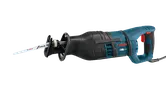
Bosch RS428 14-Amp Corded Recip Saw
The RS428 is the best corded reciprocating saw for buyers who do not want to invest in a battery platform. It delivers sustained 14-amp power with active vibration control that reduces operator fatigue during extended sessions. Constant orbital action gives fast wood cuts, though it cannot be switched off for metal work. At roughly $180 it costs less than any cordless saw reviewed here, and it includes everything needed to start cutting — no battery or charger to buy. For homeowners doing occasional demo near an outlet, it is the most cost-effective entry point.
- ✓ Sustained 14-amp corded power — no runtime concerns during long sessions
- ✓ Active vibration control reduces fatigue substantially
- ✓ Constant orbital action provides fast wood cuts
- ✓ Lower price than any cordless saw reviewed, with no battery/charger needed
- ✗ Corded — limits mobility and reach on job sites without nearby power
- ✗ Constant orbital action cannot be turned off, limiting metal-cut quality
- ✗ Heavier than cordless saws at 8.65 lbs, plus cord drag
- ✗ Lowest maximum SPM at 2,900
How we picked
This guide ranks four reciprocating saws — three cordless and one corded — grouped by their primary strengths so that whatever you prioritize, there is a clear winner. We did not run a controlled lab test, and we do not claim to have done so. Every claim here is built from published manufacturer specifications, kit configurations actually sold in the US, warranty terms, and consistent themes in owner reports. Where two tools are close, we lean on the numbers that affect day-to-day use: stroke length, weight, blade clamp design, orbital action availability, and battery platform depth.
The shortlist covers the dominant cordless platforms (Milwaukee M18, DeWalt 20V MAX, Ryobi ONE+) plus a corded alternative for budget-conscious buyers or those who do not want to commit to a battery system. These are the saws most people cross-shop, and ranking them against each other is more useful than padding the list with models rarely compared side by side.
What matters when you choose a reciprocating saw
Four things decide which of these is right for you, and they rarely all point at the same tool.
Stroke length and SPM together set cutting speed. Stroke length is the distance the blade travels per cycle. A 1-1/4-inch stroke (Milwaukee 2722-20) removes about 11% more material per stroke than a 1-1/8-inch stroke (DeWalt DCS386B, Bosch RS428). SPM determines how many cycles per minute; 3,100 (Milwaukee) versus 3,000 (DeWalt, Ryobi) or 2,900 (Bosch) shifts the gap further. The compact Ryobi PSBRS01B's 5/8-inch stroke cuts roughly half the material per cycle, explaining its much slower pace through thick lumber.
Orbital action accelerates wood cuts. By adding an elliptical component to the blade path, orbital action clears chips more aggressively and speeds up cuts in framing lumber and nail‑embedded demo material. The Milwaukee 2722-20 offers selectable orbital on/off — the best of both worlds. The Bosch RS428 has constant orbital action (always on, which is fine for wood but less ideal for metal). The DeWalt DCS386B and Ryobi PSBRS01B have no orbital action. If your primary work is wood demolition, orbital action is a meaningful productivity feature.
Weight and ergonomics determine fatigue over a full day. The DeWalt DCS386B at 7.7 lbs bare is the lightest full-size cordless saw here — that 1.1‑lb advantage over the Milwaukee 2722-20 at 8.8 lbs matters during overhead work. The Ryobi PSBRS01B at 3.6 lbs is in a separate class for confined-space access. Corded Bosch RS428 at 8.65 lbs plus cord drag adds fatigue in awkward positions.
Blade clamp design affects your tempo on the job. DeWalt's lever-action clamp is universally praised for speed and one-hand operation. Milwaukee's QUIK-LOK works well but is harder to access when the adjustable shoe is extended. The Ryobi's clamp is straightforward for occasional swaps.
Best overall cordless: Milwaukee 2722-20
The 2722-20 wins the top spot because it puts together the most complete package for a pro demo or remodeling crew. No other cordless saw in this guide matches its 1-1/4-inch stroke, 3,100 SPM, and selectable orbital action — a trio that delivers genuinely faster cuts in wood and nail-embedded material. The POWERSTATE brushless motor holds speed under load where a brushed or less aggressive motor would bog. The five-speed dial combined with a variable trigger gives fine control for materials from thin conduit to thick framing.
Its downsides are well-documented but do not overshadow its lead in cutting performance. At 8.8 lbs bare plus battery, it is heavy; overhead cuts tire the arms faster than the 7.7‑lb DeWalt. The QUIK-LOK blade clamp is less convenient than DeWalt's lever system. And the $299 bare-tool price means buyers new to M18 must add the cost of batteries and a charger. For professionals who already own M18 packs and need the fastest cordless saw, this is the straightforward choice.
Best for light weight and platform: DeWalt DCS386B
The DCS386B is the smart choice for users who prioritize all-day comfort and already own DeWalt 20V MAX batteries. At 7.7 lbs bare, it is over a pound lighter than the Milwaukee — a difference you feel on every cut above shoulder height. The keyless lever-action blade clamp is genuinely faster than the Milwaukee's for in‑cut blade swaps, and the FLEXVOLT Advantage means you can drop in a 60V MAX battery for a 50% power boost when needed.
The trade-offs are real: no orbital action (so wood cuts are slower than the Milwaukee, though adequate for most jobs), a shorter 1-1/8-inch stroke, and no rafter hook. For a plumber cutting pipe all day or an electrician working through conduit, the lack of orbital action is irrelevant — the light weight and excellent blade clamp are concrete benefits. For a demo crew gutting framed walls, the Milwaukee will be faster.
Best compact for tight spaces: Ryobi PSBRS01B
The PSBRS01B is not a full-size reciprocating saw and should not be compared as one. It is a compact, one-handed access tool designed for cuts inside walls, between joists, or overhead where a full-size saw physically cannot go. At 12.4 inches long and 3.6 lbs, it reaches into cavities and around plumbing that the Milwaukee and DeWalt cannot fit. The brushless motor is a pleasant surprise at this price; it sips power from ONE+ batteries and runs far longer than a brushed alternative would.
Its 5/8-inch stroke means it is roughly half as fast as a full-size saw through thick wood. Cutting a 2×12 requires multiple passes and patience. For PVC pipe, copper tubing, conduit, thin metal studs, and small branches, it works quickly and cleanly. Buy it as a second saw for access cuts, not as your primary demo tool.
Honorable mention (corded): Bosch RS428
The RS428 is the corded outlier in a cordless guide, included because it remains the best value-for-performance option for homeowners and budget‑conscious users who do not want to invest in a battery platform. At roughly $180, it costs less than any cordless saw here — and that is the complete tool, no battery or charger required. Its active vibration control is a genuine ergonomic advantage during extended demo sessions, and the constant orbital action makes it fast through wood.
The downsides of corded operation are obvious: limited to reach of an extension cord, not usable on a job site without power, and the cord itself is a trip hazard. The constant orbital action cannot be turned off, which means metal cuts are rougher than with a straight-line saw. But for someone doing occasional demolition near an outlet, the RS428 is the most cost‑effective reciprocating saw in this guide.
How to read these rankings
The ranks are not a strict best-to-worst order — they are a map. The Milwaukee is first because it is the fastest cutting cordless saw for pro demo use, but if you own DeWalt packs the DCS386B is your number one for its lighter weight and better blade clamp. If you work in tight spaces, the Ryobi PSBRS01B is the only tool that can reach. If your budget is tight and you have power nearby, the corded Bosch RS428 delivers the most cuts per dollar. Start from what you already own and the type of cutting you actually do; match the award label, and the right pick falls out quickly.
Advertisement
Frequently asked questions
- What is the best cordless reciprocating saw in 2026?
- For maximum cutting speed and power, the Milwaukee 2722-20 M18 FUEL Super Sawzall is the top choice, with a 1-1/4-inch stroke and selectable orbital action. If you already own DeWalt 20V MAX batteries, the DCS386B offers a lighter weight and faster blade changes. For tight-space access, the Ryobi PSBRS01B compact one-hand saw fills a unique niche.
- Do I need orbital action in a reciprocating saw?
- Orbital action accelerates cutting in wood and fibrous materials by adding an elliptical path to the blade motion. If you primarily cut framing lumber or do demolition work, orbital action is a genuine time-saver. For metal pipe, conduit, and clean cuts, straight-line mode is preferred. The Milwaukee 2722-20 offers selectable orbital on/off; the DeWalt DCS386B and Ryobi PSBRS01B lack orbital action entirely.
- What stroke length do I need in a reciprocating saw?
- Longer stroke lengths remove more material per cycle, resulting in faster cuts. For heavy demolition, a 1-1/4-inch stroke (Milwaukee 2722-20) is ideal. For general-purpose use, 1-1/8-inch (DeWalt DCS386B or Bosch RS428) works well. Compact saws like the Ryobi PSBRS01B have a 5/8-inch stroke, which is adequate for thin materials but slow on thick lumber.
- Should I buy a corded or cordless reciprocating saw?
- Choose cordless if you need mobility, work in structures without power, or already own a battery platform. Choose corded if you want the lowest cost per cut, need sustained runtime without charging, and work near an outlet. The Bosch RS428 offers corded power and vibration control at a lower price than any cordless saw in this guide.
- How does blade clamping affect use?
- A fast, one-hand-operable blade clamp saves time when switching blades mid-task. The DeWalt DCS386B's lever-action clamp is the fastest and most intuitive. The Milwaukee 2722-20's QUIK-LOK clamp works well but is harder to access when the shoe is extended. The Ryobi PSBRS01B has a simple lever clamp suitable for its compact size.
- Which batteries work with these cordless saws?
- The Milwaukee 2722-20 uses M18 REDLITHIUM batteries; a 5.0Ah or larger HIGH OUTPUT pack is recommended for full performance. The DeWalt DCS386B accepts 20V MAX and 60V MAX FLEXVOLT batteries; a 5.0Ah 20V pack provides adequate power, while a FLEXVOLT battery unlocks boosted output. The Ryobi PSBRS01B uses 18V ONE+ batteries; a 3.0Ah or larger pack gives best runtime.