
Bosch RS428 14-Amp Reciprocating Saw Review: Corded Precision Meets Demo Muscle
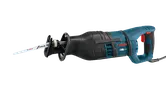
| power Source | Corded, 120V AC |
|---|---|
| amperage | 14 A |
| stroke Length | 1-1/8 in. |
| spm | 0–2,900 SPM (variable trigger) |
| orbital Action | Constant orbital (always on) |
| weight | 8.65 lbs |
| length | 18.4 in. |
| vibration Control | Active counterbalance with anti-vibration handle |
| warranty | 1-year limited |
Pros
- Runs at full power as long as the cord is plugged in — no battery charge anxiety during extended gut-outs or multi-hour demo sessions
- Constant orbital action with a variable speed trigger produces some of the smoothest, fastest wood cuts available at this price point
- Bosch's Vibration Control counterbalance system measurably reduces operator fatigue compared to saws without active vibration damping
- At roughly $180 street price it costs less than any cordless saw in this comparison, with no battery or charger to add
- Tool-free keyless blade clamp swaps blades quickly; the D-handle grip fits a wide range of hand sizes
Cons
- Corded — limits reach and usability in structures where power is off during renovation, where extension cords are a trip hazard, or where no outlet is nearby
- Orbital action is constant with no straight-line mode option; this is acceptable for most work but ideal metal-cutting technique calls for straight-line action
- At 8.65 lbs it is heavier than the cordless DCS386B (7.7 lbs); cord drag adds additional effort in awkward positions
- 2,900 SPM is the lowest maximum speed in this group, though the constant orbital action partially compensates in wood-cutting applications
Corded versus cordless: still a real choice
The default assumption in 2026 is that cordless has replaced corded for most tasks, and for many reciprocating saw applications that is true. But the Bosch RS428 makes a genuine argument that corded still wins in a specific and common scenario: extended demolition work done near an outlet, where runtime is not a variable and every dollar saved on the tool itself can go toward better blades, safety equipment, or a second tool.
At roughly $180, the RS428 costs less than any of the cordless saws in this comparison — and that price includes the complete, fully functional tool. No battery. No charger. No platform investment. Plug it in and it runs at full rated power until the work is done.
Vibration control as a genuine differentiator
Bosch's Vibration Control system is the RS428's most technically distinctive feature. Reciprocating saws generate significant vibration — the reciprocating blade mass is inherently unbalanced, and without intervention that energy transmits directly to the operator's hands, wrists, and arms. Over a one-hour demolition session the accumulated fatigue is substantial; over a full workday it contributes to conditions like white finger and repetitive strain injury.
Bosch counters this with a two-part system: an internal counterweight that opposes the blade's reciprocating motion, canceling a large fraction of the unbalanced force, and a second isolation layer in the handle assembly that absorbs what gets through. Bosch claims approximately two-thirds reduction in vibration versus a standard reciprocating saw. The claim is directionally accurate based on user feedback — operators consistently describe the RS428 as substantially smoother in hand than competing corded saws without active damping. For anyone doing multiple hours of demo work, this difference is not abstract.
The orbital action trade-off
The RS428 uses constant orbital action — the blade always follows an elliptical path that slaps material on the forward stroke and clears chips on the return. This is excellent for wood cutting: the RS428 is fast through framing lumber, nail-embedded demo material, and rough cuts in composite boards.
The limitation is that orbital action cannot be switched off. Cutting metal pipe, conduit, rebar, and sheet metal is technically possible with the RS428, but optimal metal cutting technique calls for straight-line blade travel to minimize chatter and extend blade life. The Milwaukee 2722-20 handles this by making orbital action selectable. The DeWalt DCS386B uses only straight-line action. The RS428's always-on orbital is not disabling for occasional metal cuts, but it makes a difference in productivity and blade wear during high-volume metal work.
Cutting performance in real applications
In wood and demolition lumber, the RS428 is genuinely competitive with the cordless Milwaukee and DeWalt. Constant orbital action and 14 sustained amps produce fast, aggressive cuts through 2×6 and 2×10 framing lumber. Nail-embedded demo wood does not slow the RS428 significantly — the corded motor sustains full amperage regardless of load, unlike a battery that loses voltage under heavy discharge.
In metal pipe and conduit, the RS428 cuts cleanly enough for production plumbing and electrical work, though the cut surface is rougher than what a straight-line saw produces at matching TPI. Slowing the trigger speed to reduce orbital ellipse amplitude helps with thin-wall material.
In PVC and light plastic, the RS428 is excellent — fast, clean, and controllable.
Value proposition versus cordless
The direct comparison to cordless is nuanced. A Milwaukee 2722-20 bare tool at $299 plus a 5.0Ah M18 battery at around $100 totals $400 before a charger. The RS428 at $180 includes everything needed to start cutting immediately. For a homeowner who does not own any M18 or 20V MAX tools, the RS428 is the more rational financial decision for occasional demo use — a second-generation buyer on an established cordless platform should buy the appropriate cordless saw instead.
The RS428's corded nature also means the tool never gets "left uncharged" the day before a big project. It is always at full power when plugged in, with no warm-up or charge check required.
Who the RS428 is and is not for
The RS428 is the correct choice for homeowners tackling renovation projects near existing outlets, for budget-conscious tradespersons doing the majority of work in a single-location shop or structure, and for anyone who wants effective vibration control at an accessible price. It is not the correct choice for crews working in structures without power, for mobile job sites where cord management is a safety issue, or for users who already own a strong cordless platform and simply need a reciprocating saw to complete it.
For the right buyer the RS428 represents one of the best dollar-per-cut values available anywhere in the reciprocating saw category. The combination of sustained 14-amp power, active vibration damping, variable speed, and constant orbital action in a well-built corded package is difficult to match at twice the price.
Advertisement
Frequently asked questions
- Can the Bosch RS428 switch to straight-line cutting mode?
- No. The RS428 uses constant orbital action — the blade always follows an elliptical path. This is excellent for wood cutting and accelerates demolition work in framing and composite materials, but it is less ideal for metal pipe and conduit where straight-line action produces cleaner cuts. For regular metal cutting, the Milwaukee 2722-20 with orbital-off mode or the DeWalt DCS386B's straight-line-only design are better choices.
- How does the RS428's vibration control work?
- Bosch uses a counterbalance system that opposes the blade's reciprocating motion with an internal counterweight, reducing the vibration transmitted to the handle by approximately two-thirds compared to a standard reciprocating saw. A second anti-vibration isolation system in the handle further dampens what gets through. During long cutting sessions this difference is felt — fatigue accumulates significantly faster in saws without active vibration damping.
- Does the Bosch RS428 come with blades?
- The RS428 ships with a carrying bag but typically without blades in the standard package. Bosch sells blade assortment sets separately, and the clamp accepts any T-shank or universal-shank blade from third-party manufacturers including Lenox, Diablo, and Milwaukee.
- How does the RS428 compare to the Milwaukee 6523-21 Super Sawzall corded saw?
- The Milwaukee 6523-21 corded Super Sawzall runs at 15 amps vs the Bosch's 14 amps and offers selectable orbital action versus the RS428's constant orbital. The Milwaukee is slightly more powerful and more versatile for mixed wood and metal work. The Bosch counters with its superior vibration control system and lower price. For pure demolition the Milwaukee edges ahead; for comfort during long sessions the Bosch's vibration damping is a genuine advantage.
- What is the RS428's maximum SPM and how does that compare to cordless models?
- The RS428 reaches 2,900 SPM at maximum trigger, which is the lowest ceiling of the four saws reviewed here. The Milwaukee 2722-20 reaches 3,100 SPM and the DeWalt DCS386B and Ryobi PSBRS01B both hit 3,000 SPM. The RS428's constant orbital action and sustained corded power compensate for the lower SPM ceiling in wood cutting, but in pure metal cutting where straight-line cutting at maximum speed is preferred, the higher-SPM cordless saws hold an advantage.
- Is the Bosch RS428 good for a homeowner or occasional user?
- Yes — the RS428 is one of the best choices for a homeowner who wants a capable, durable reciprocating saw without committing to a battery platform. At roughly $180 it costs less than any cordless option reviewed here, requires no battery investment, and delivers professional-grade vibration control and variable-speed cutting that makes the tool easy to control for less experienced users.
Ready to buy the RS428?
We may earn a commission if you buy through these links, at no extra cost to you.