
Ryobi RY142300 Review: Best Mid-Range Electric Pressure Washer
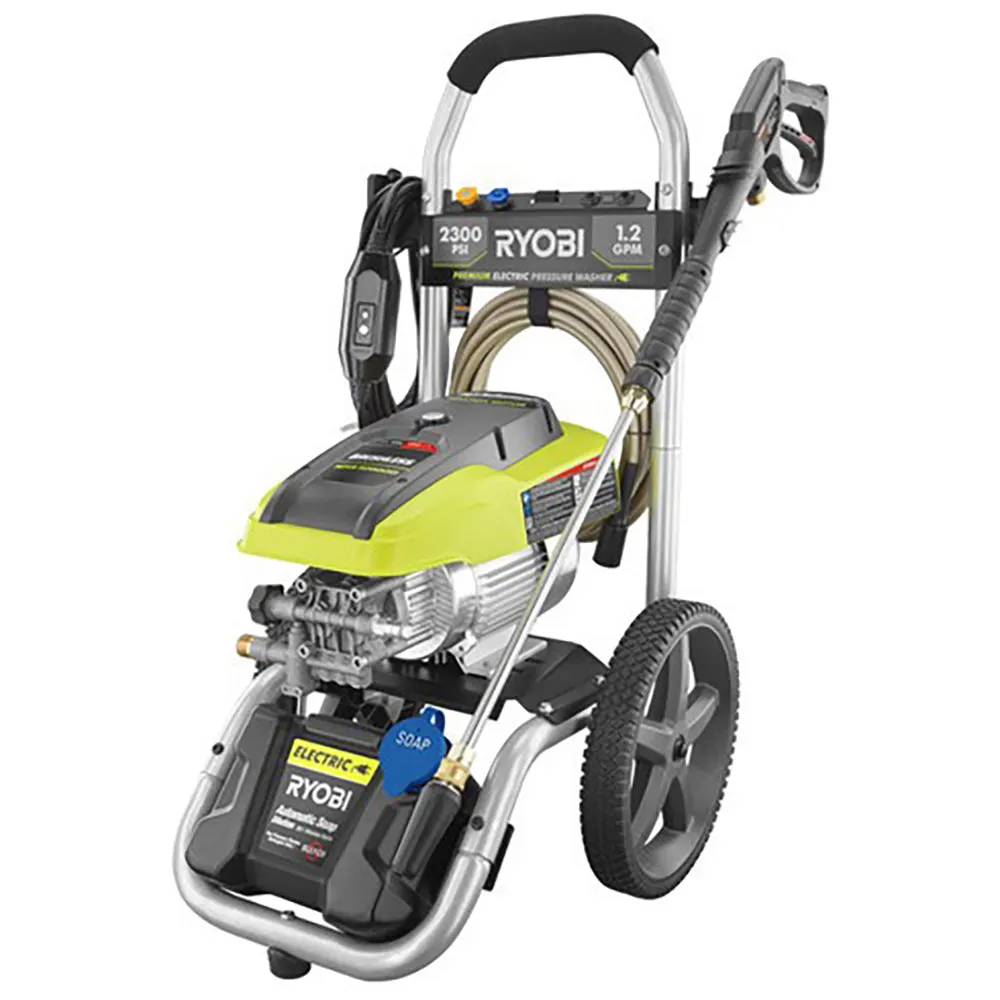
| psi | 2,300 PSI (max) |
|---|---|
| gpm | 1.2 GPM |
| motor | 13-amp brushless electric induction motor |
| pump Type | Axial cam |
| hose Length | 25 ft. non-marring high-pressure hose |
| cord Length | 34.5 ft. GFCI power cord |
| nozzles | Quick-connect 0°, 15°, 25°, 40°, and turbo nozzle (5 total) |
| weight | 49.3 lbs |
| warranty | 3-year limited |
Pros
- Brushless induction motor runs cooler and quieter than universal-motor rivals and should outlast them significantly
- 2,300 PSI combined with the included turbo nozzle covers concrete driveways, wood decks, and siding in one session
- 25-foot non-marring high-pressure hose reaches across most residential driveways without moving the machine
- On-board detergent tank lets you apply soap and rinse in the same pass without a separate sprayer
- Hand-truck design with solid wheels rolls across uneven surfaces and stores upright in narrow spaces
Cons
- 1.2 GPM is on the low end for 2,300 PSI — rinsing large areas takes longer than on machines with 1.6+ GPM
- No surface cleaner attachment included; you will want to add one for large concrete sections
- At roughly 49 lbs it is heavier than lighter corded electric competitors like the Craftsman CMEPW1700
Who the Ryobi RY142300 is built for
The RY142300 occupies the sweet spot of the residential corded-electric market: enough pressure to tackle real cleaning jobs without the fuel, fumes, and maintenance overhead of a gas machine. At 2,300 PSI and 1.2 GPM it generates 2,760 cleaning units — a meaningful step above the 2,000-CU entry-level class and well positioned for a homeowner who wants a single pressure washer that handles driveways, decks, siding, and vehicles without switching machines.
The brushless induction motor is the standout specification at this price tier. Most electric pressure washers under $300 use universal (brush-type) motors, which are cheaper to build but generate more heat, more noise, and wear out faster under sustained load. The RY142300's brushless motor runs noticeably cooler during extended use and should maintain consistent output over many more hours of life — an important consideration for a machine you will pull out every spring and fall for years.
Pressure output and real-world cleaning
At 2,300 PSI, the RY142300 clears residential concrete driveways and patios effectively with a 25-degree nozzle. Surface mold, road grime, and year-old algae streaks come off in a single slow pass, though heavily oil-stained concrete (a parking spot that has seen years of leaks) may need a second pass plus a degreaser pre-treatment. For comparison, the lower-priced Craftsman CMEPW1700 (1,700 PSI) takes longer on the same driveway and does not clear embedded stains as cleanly.
On wood decks and fences, the 40-degree nozzle at 12 to 18 inches of standoff is the correct setup. The machine strips loose paint, algae, and grey weathering from cedar and pressure-treated pine without significantly raising grain — provided you keep the wand moving and spray parallel to the grain direction. Never use the turbo nozzle on wood; the concentrated rotating stream will cut visible stripes into the surface.
For vehicle washing, the 40-degree nozzle at 18 or more inches of standoff is safe on modern factory paint. Swirl marks and paint damage from consumer-grade pressure washers almost always result from holding the wand too close or using the wrong nozzle tip, not from the PSI rating alone.
The turbo nozzle included in the kit delivers a spinning 0-degree stream that the company estimates provides 50 percent faster cleaning on concrete compared to a fixed-angle tip. On a long driveway this makes a real difference in session time.
Design and ease of use
Ryobi built the RY142300 around a hand-truck frame rather than the flat-base design used by lighter, cheaper machines. The upright posture means the unit stores in a narrow corner of the garage and rolls easily over curbs and rough pavement. The two solid wheels are not pneumatic, which means no flat tires, but also means slightly more vibration on cobblestone.
The on-board detergent tank is a genuine convenience feature. Rather than mixing soap in a bucket and dipping a siphon hose, you fill the reservoir, snap in the black soap nozzle, and apply cleaner at reduced pressure directly from the machine. When done, swap to a rinsing nozzle and flush the soap off without touching anything else.
The 34.5-foot GFCI power cord reaches the nearest outlet from most driveway and backyard positions, but homes with detached garages or very long driveways may need a 10-gauge extension cord — use nothing lighter to avoid voltage drop and tripping breakers. The 25-foot high-pressure hose extension is generous for this class.
Limitations to know before buying
At 1.2 GPM, the flow rate is the main constraint. Flow determines how quickly you rinse a surface after the pressure lifts dirt. On a large driveway you will spend more time rinsing than you would with a 1.6 or 2.0 GPM machine at comparable pressure. If you are cleaning a 1,000-square-foot commercial space regularly, the low GPM will feel like a bottleneck.
The machine weighs 49.3 lbs, which is heavier than smaller corded electrics. The hand-truck design offloads most of that weight, but lifting the unit into a truck bed or carrying it up stairs is a two-handed job.
Paint stripping and heavy concrete etching are outside this machine's range. For those tasks, a gas machine like the DeWalt DXPW3425E with its 3,400 PSI and 2.5 GPM at 8,500 cleaning units is the appropriate tool.
Value assessment
At $200–$250, the RY142300 is priced higher than the Craftsman CMEPW1700 but well below the EGO HPW3200 kit and the DeWalt DXPW3425E. What you get for the premium over the Craftsman is 600 more PSI, a brushless motor, a longer hose, and the on-board detergent system. For a homeowner who cleans a full driveway, deck, and exterior siding at least twice a year, that premium pays back in time saved and machine longevity.
Final verdict
The Ryobi RY142300 is the strongest corded-electric value in the 2,000-to-2,500 PSI class for residential buyers. The brushless motor, adequate hose length, on-board soap tank, and turbo nozzle make it a complete kit that covers most homeowner cleaning tasks. Its low GPM and moderate weight are real trade-offs, but neither disqualifies it for its intended use. If you have an accessible outdoor outlet and want a corded-electric that outperforms its price bracket, the RY142300 is the right call.
Advertisement
Frequently asked questions
- What surfaces can the Ryobi RY142300 clean safely?
- The RY142300 at 2,300 PSI handles concrete driveways and patios (25-degree nozzle), wood decks and fences (40-degree, 12–18 inches standoff), composite siding, outdoor furniture, and vehicles (40-degree, 18 inches minimum standoff). Avoid the 0-degree nozzle on wood, painted surfaces, and vehicle paint — it will cause damage.
- Is the Ryobi RY142300 strong enough for a concrete driveway?
- Yes. At 2,300 PSI and 1.2 GPM the RY142300 produces 2,760 cleaning units, which is adequate for residential concrete with normal dirt and mold buildup. For heavily oil-stained or very large driveways, adding the optional surface cleaner attachment speeds coverage substantially and reduces streaking.
- How do I use the built-in detergent tank on the RY142300?
- Fill the on-board detergent reservoir with pressure-washer-compatible soap, then switch to the soap nozzle (the black 65-degree tip). The machine draws detergent into the stream at reduced pressure for safe application. After a 5-to-10 minute dwell time, swap to the 25-degree or 40-degree nozzle and rinse.
- Can the Ryobi RY142300 be used to wash a car?
- Yes, with the right technique. Use the 40-degree white nozzle, maintain at least 18 inches of standoff, and keep the wand moving. At 2,300 PSI the risk of paint damage is real if you use an aggressive nozzle or hold the wand too close. The turbo nozzle and 0-degree nozzle should never be used on a vehicle.
- Why is the RY142300 brushless and why does it matter?
- Brushless induction motors use electromagnets instead of carbon brushes to generate rotation, eliminating the wear parts that eventually burn out in universal-motor washers. The result is a motor that runs cooler, runs quieter, draws more consistent power under load, and typically lasts several times longer than a brush-type equivalent at the same price tier.
- How does the RY142300 compare to the EGO HPW3200?
- The RY142300 is a corded electric that needs an outlet and a long extension cord to reach its cleaning range; the EGO HPW3200 is battery-powered and works anywhere without a cord. The EGO reaches 3,200 PSI peak versus 2,300 PSI on the Ryobi, but the EGO requires two 56V batteries that add significant cost. The Ryobi is the better value if you have access to an outdoor outlet.