
Ryobi RS290G Review: Budget 5-In ROS That Covers the Basics
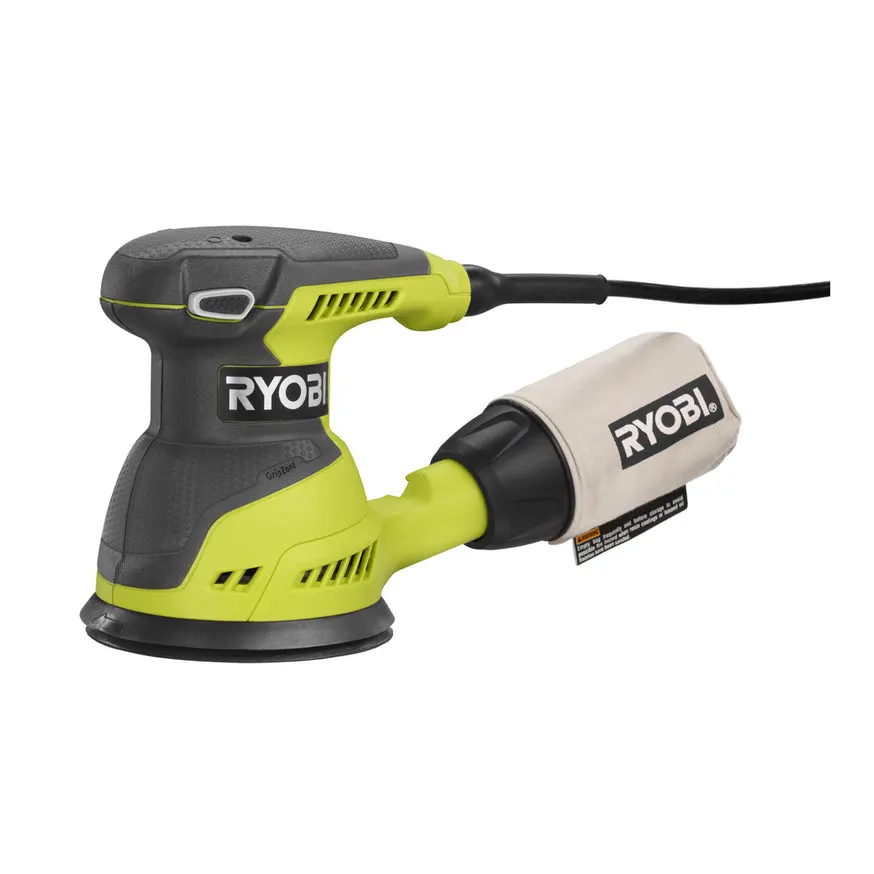
| amperage | 2.6 AMP |
|---|---|
| speed | 12,500 OPM (single speed) |
| pad Size | 5 in. hook-and-loop |
| weight | 3.5 lbs |
| cord Length | 6 ft. |
| dust Collection | Dust bag included; port not directly compatible with standard vacuum hoses without adapter |
| power Source | Corded 120V AC |
| warranty | 3-year limited |
Pros
- Priced at $49–$69 — the lowest entry cost for a 5-inch random-orbit sander from a brand with broad US retail availability and warranty support
- Single-speed 12,500 OPM is fast enough for general-purpose stock removal and sanding through a standard grit sequence on wood and drywall
- Hook-and-loop pad accepts any standard 5-inch sanding disc — no proprietary paper format locks you into premium pricing
- Spin-control braking reduces pad gouging at startup, a feature usually reserved for higher-priced tools
- Kit includes sander, dust bag, and 3 sanding sheets — ready to use without additional purchases at under $70
Cons
- No variable-speed control; fixed 12,500 OPM is too fast for gentle between-coat scuffing and delicate veneer work
- Corded 6-foot cord is short for a stationary-power tool — adds friction in large workspace sanding sessions
- Dust bag fills rapidly and the collection port is not compatible with standard vacuum hose fittings without an adapter sold separately
Setting expectations correctly
Buying decisions get easier when a tool is clear about what it is. The Ryobi RS290G is a fixed-speed, corded, 5-inch random-orbit sander at $49–$69. That price point is the lowest available for this tool type from a major US brand with retail presence and warranty service, and that is exactly where its value proposition begins and ends.
Understanding this context prevents two common mistakes: buying the RS290G expecting professional results on fine furniture finishing, or dismissing it entirely when all you need is a capable random-orbit sander for the projects most homeowners actually do.
Performance on common DIY tasks
At 12,500 OPM, the RS290G removes material quickly. On bare pine furniture — sanding rough lumber from 80 through 120 grit before painting — the RS290G covers ground steadily without burning the wood. On painted trim work being stripped of latex paint before repainting, the RS290G with 80-grit paper makes the job manageable. On drywall compound in patch repairs, the fixed high speed is if anything an advantage for fast leveling cuts before finishing passes.
The spin-control braking feature — which slows the pad at startup to reduce the initial surface contact gouge — is a practical inclusion at this price. Budget tools without this feature start spinning at full speed the moment they contact the surface, which creates a circular gouge mark in soft materials and in partially dried coats. The Ryobi's spin control reduces this, though it does not fully replicate the sophisticated pad brake in tools like the Makita BO5041.
Where fixed speed creates real limits
The single speed of 12,500 OPM is the RS290G's only substantive technical limitation compared to mid-tier tools. On bare wood heading through a standard grit sequence, fixed high speed is irrelevant — you want removal and 12,500 OPM delivers it. The limit shows up in two specific situations.
First, between finish coats: scuff-sanding a dried polyurethane or lacquer coat with 220 or 320 grit to improve adhesion for the next coat requires a gentle touch. At 12,500 OPM, even light pressure removes material aggressively, increasing the risk of cutting through the coat to bare wood. Variable-speed tools that can dial down to 4,000–6,000 OPM give you the margin for careful between-coat work. The RS290G does not.
Second, on veneer: thin wood veneer over substrate tolerates very limited sanding depth. A fixed high-speed tool requires strict control of time and pressure to avoid sanding through. Variable-speed tools at low OPM extend the margin of error. For veneer work and fine furniture finishing, the RS290G is the wrong tool — move to the Makita BO5041.
Dust collection
The included dust bag attaches to the collection port and captures a fraction of the fine dust generated during sanding. It fills quickly during aggressive passes and, unlike the DeWalt DWE6411K and Makita BO5041, the RS290G's dust port is not directly compatible with standard 1-1/4-inch shop vac hoses without a separately purchased adapter. For users who prioritize dust control — especially for indoor refinishing work where sanding dust contaminates fresh paint — this is a practical inconvenience.
For outdoor sanding, light garage work, or situations where a shop vac is not part of the workflow, the included bag handles the bulk of visible dust and the limitation is minor. Know before you buy whether vacuum compatibility matters for your setup.
The 6-foot cord in real workspace use
A 6-foot power cord is short for a stationary power tool. In a typical workspace — an extension cord from a garage outlet or house circuit to a workbench — the RS290G's cord requires an extension cord for most setups, which adds a cord management step that is not necessary with longer-corded tools. The Makita BO5041 also ships with a comparable cord length; this is not unique to Ryobi, but it is worth noting if you plan to move around a project or use the tool on a ladder for overhead sanding.
Who should buy the RS290G
The RS290G is the right sander for a specific, well-defined buyer: someone starting out with power tools, or someone who needs an affordable random-orbit sander for occasional use on projects where fine finishing quality is not the primary goal. Furniture painters who will be covering the surface with opaque paint, property managers prepping surfaces between tenants, and DIYers who sand a handful of times per year are all well-matched to this tool.
For users who are going to finish clear-coated hardwood furniture, sand veneer, or invest in a tool that will see regular sustained use over multiple seasons, the $60 step up to the Makita BO5041's variable speed and pad brake is money well spent. The RS290G's 3-year Ryobi warranty is solid for the price tier, but the brushed motor and consumer-grade construction reflect the price point honestly.
Summary
The Ryobi RS290G rates 3.8 out of 5 as a capable, affordable random-orbit sander that delivers exactly what it promises at the budget tier. It sands adequately at high speed, it uses standard hook-and-loop discs, it includes a dust bag, and it costs less than anything comparable from a major brand. Its fixed speed and dust-port compatibility limitation are real constraints — not flaws in execution but characteristics of the design that determine whether this is the correct tool for a given buyer.
Advertisement
Frequently asked questions
- Does the Ryobi RS290G have variable speed?
- No. The RS290G runs at a fixed 12,500 OPM with no variable-speed dial. This single-speed design keeps the price low and is adequate for general stock removal and preparation sanding. If you need slower speed for finish coats, veneer, or delicate surfaces, the Makita BO5041 (4,000–12,000 OPM variable) is the correct choice.
- What kind of sandpaper does the RS290G use?
- The RS290G uses standard 5-inch hook-and-loop sanding discs. Any major brand disc — 3M, Norton, Mirka, Diablo — is compatible. The hook-and-loop backing lets you swap grits in a few seconds without adhesive or paper clamps. The sander ships with 3 sheets of assorted grit sandpaper included.
- Can I connect the RS290G to a shop vacuum?
- The RS290G includes a dust bag and a dust port, but the port size is not directly compatible with standard 1-1/4-inch shop vac hoses without a universal adapter. If dust collection is important for your work, check whether your shop vac's hose fits before purchasing, or budget for an adapter. The Makita BO5041 and DeWalt DWE6411K both include vacuum adapters in the box.
- How durable is the RS290G for regular use?
- The RS290G is designed for homeowner-grade use rather than sustained professional sanding. For occasional projects — refinishing a piece of furniture, prepping a deck surface, sanding cabinet doors before painting — it is adequately durable. For repeated daily use over multiple months, the brushed motor and lower-cost construction are more likely to show wear than the brushless motor and sealed bearings in a Makita BO5041.
- Is the Ryobi RS290G good for sanding drywall?
- Yes, for spot repairs and small-area drywall sanding the RS290G works well. The 5-inch round pad handles circular blending of joint compound patches, and the 12,500 OPM removes compound efficiently. For large-area ceiling and wall drywall sanding, a dedicated drywall sander with a long handle and vacuum collection is more practical — but for patch work, the RS290G is a reasonable budget option.
- How does the RS290G compare to spending $60 more on the Makita BO5041?
- The Makita BO5041 adds variable speed (4,000–12,000 OPM), a pad brake, a vacuum adapter in the box, and a more robust motor construction. For users who sand occasionally on straightforward projects, those features are not necessary and the RS290G is the practical choice. For users who finish wood regularly, work with veneer or finish coats, or plan sustained use over seasons, the BO5041's added capability is worth the premium.
Ready to buy the RS290G?
We may earn a commission if you buy through these links, at no extra cost to you.