
Milwaukee 2737-20 M18 FUEL Jigsaw Review: 3,500 SPM Cordless
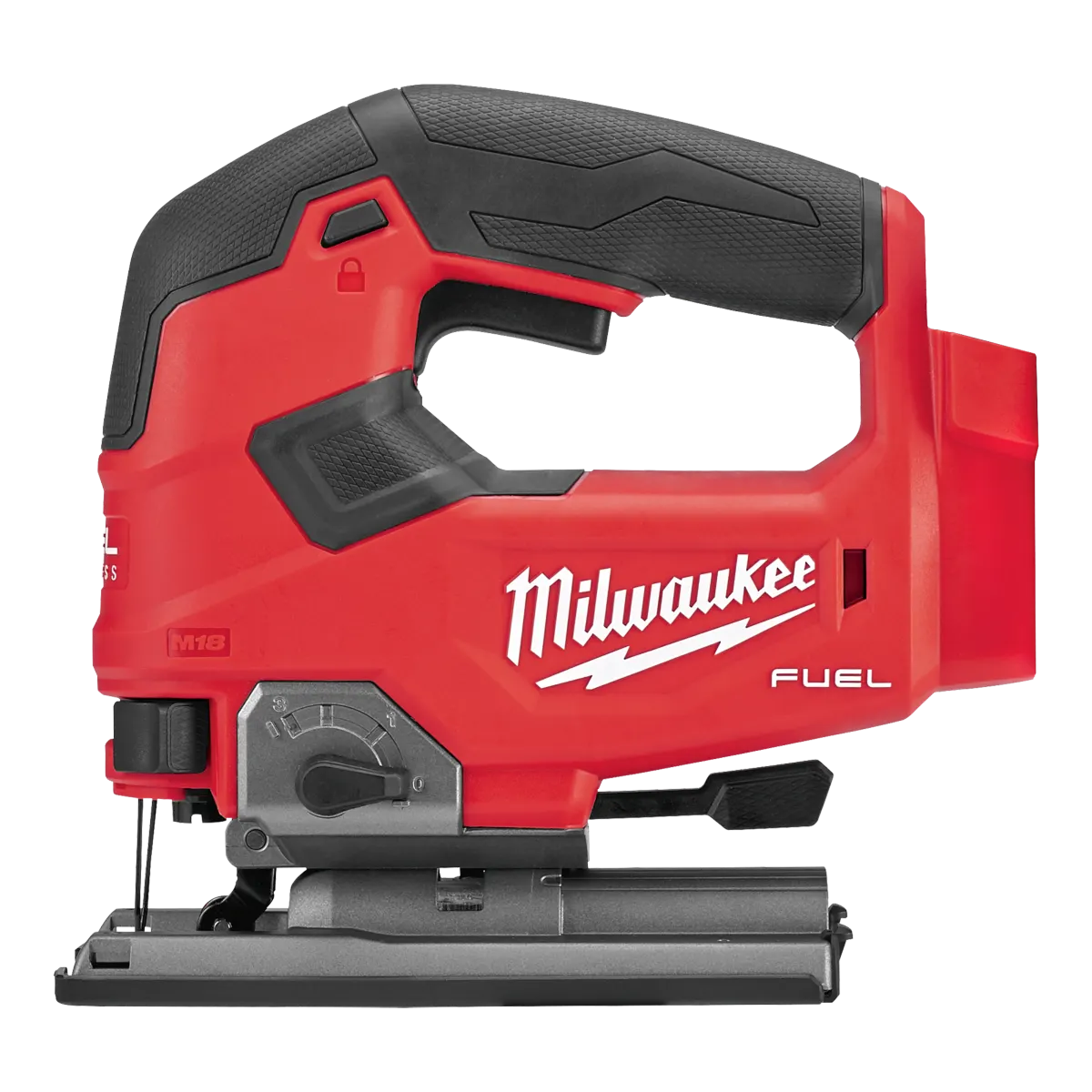
| voltage | 18V M18 FUEL (battery not included) |
|---|---|
| motor | POWERSTATE Brushless |
| no Load S P M | 0–3,500 SPM (variable) |
| stroke Length | 1 inch |
| orbital Settings | 4-position orbital action |
| bevel Capacity | 0°, 15°, 30°, 45° (toolless positive stops) |
| blade Compatibility | T-Shank (Quik-Lok toolless clamp) |
| weight | 5.8 lbs with 5.0Ah battery |
| cutting Capacity | 5-1/2 in. wood with specialty blade |
Pros
- 0–3,500 SPM is the highest no-load blade speed in this category — outpaces the Bosch JS365 and DeWalt DCS334B on material removal rate in thick stock
- POWERSTATE brushless motor sustains speed under load in ways that brushed cordless tools and some corded competitors cannot match
- Quik-Lok toolless blade clamp changes T-shank blades with one hand and keeps fingers clear of the blade collar
- 4-position orbital action with positive stops provides precise control over cut aggressiveness across material types
- Backed by the full M18 platform — over 270 tools share the same battery, so owners with existing M18 packs add a capable jigsaw at bare-tool cost
- On/off blower switch lets you disable the dust blower when using a vacuum for interior finish work
Cons
- Sold as a bare tool — adding a 5.0Ah M18 battery and charger pushes total cost well above the corded Bosch JS365 kit
- At 5.8 lbs with a 5.0Ah pack, the 2737-20 is one of the heavier jigsaws in this group — the weight advantage over corded is mostly negated once a heavy pack is attached
- D-handle grip is not ideal for plunge cuts into the middle of a panel — some users prefer the barrel-grip 2737B-20 for those tasks
- Premium M18 FUEL pricing means this is not the tool to grab if occasional jigsaw work is all you need
The performance case for the Milwaukee 2737-20
The Milwaukee M18 FUEL 2737-20 is the D-handle version of Milwaukee's flagship cordless jigsaw. It sits at the top of the cordless jigsaw market on a single measurable spec: 3,500 SPM, which is higher than the Bosch JS365 corded (3,100 SPM), the DeWalt DCS334B (3,200 SPM), and the Ryobi PCL525B (3,000 SPM). That number reflects what a POWERSTATE brushless motor and Milwaukee's voltage management delivers on a 5.0Ah M18 pack.
This is a bare-tool purchase. Street price sits around $175–$200 depending on retailer; once you factor in the cost of an M18 battery and charger if you don't already own one, the total investment runs $270–$350 for a complete setup. That math only makes sense if you are already on the M18 platform — which, given that Milwaukee's platform counts over 270 tools, is a realistic scenario for many professionals and serious DIYers.
Cutting performance across materials
In wood, the POWERSTATE motor does not care whether you are running the saw at light load in 1/2-inch plywood or driving through 2-inch hardwood. Speed holds consistent under load, which matters on long curves where a hesitating saw causes the blade to deflect and the cut to wander. At orbit setting 3 or 4, the 2737-20 removes material in dimensional lumber at a rate that matches or beats the Bosch JS365 corded despite running on battery power.
In laminate and veneered materials, orbit 0 and a fine-tooth reverse blade give you a clean face cut with minimal tearout — the brushless motor's torque consistency prevents the blade from chattering at slow feed rates, which is where cheaper motors produce rough edges.
In metal and composites, the 2737-20 with a bi-metal blade cuts mild steel sheet, thin structural shapes, and fiber-cement with equal competence. The variable-speed trigger's precision at the low end (around 500 SPM) is useful for metal starts where a fast blade can skitter off the material before the cut is established.
Blade system and practical handling
The Quik-Lok blade clamp is one of Milwaukee's genuine differentiators. Pull a lever, swap the blade one-handed without touching the blade body, release the lever. After a long cut, the blade collar gets hot; one-handed changes that keep fingers clear of the hot area are not a luxury. The system accepts all standard T-shank blades.
Bevel adjustment hits 0, 15, 30, and 45 degrees with positive stops — the saw drops into each detent precisely and locks without play. For repeated bevel cuts at the same angle, this is faster and more reliable than a friction-lock bevel system.
The on/off blower switch is worth noting for interior finish work. Woodworking near finished surfaces where blown sawdust is problematic? Disable the blower and connect a shop vac to the optional dust extraction attachment. The default-on blower is effective for keeping the cut line visible on most work.
Weight and ergonomics in context
The 2737-20 weighs 4.85 lbs as a bare tool. Attach a 5.0Ah M18 pack — the recommended battery for full performance — and total weight reaches 5.8 lbs. That is heavier than the Bosch JS365 corded tool at 5.35 lbs and significantly heavier than the DeWalt DCS334B, which runs about 4.62 lbs bare. The D-handle configuration works well for standard tabletop and horizontal cutting; users who do a lot of vertical plunge cuts or overhead cuts frequently prefer Milwaukee's barrel-grip 2737B-20, which positions the hand more directly above the blade.
Value assessment
For an M18 FUEL user already owning M18 batteries, the 2737-20 is a straightforward high-performance addition at bare-tool cost. For a new buyer building a cordless system, the platform depth of M18 makes the investment rational — you are not just buying a jigsaw but joining a tool ecosystem. Against the Bosch JS365, the Milwaukee costs more and needs a battery but delivers 400 more SPM and cordless freedom. Against the DeWalt DCS334B, the two are closely matched on SPM with the Milwaukee having a slight speed edge and a more established high-capacity battery ecosystem. Against the Ryobi PCL525B, the 2737-20 is in a different performance tier — more power, better blade system, and longer battery platform depth, at roughly 2.5 times the price.
Practical notes on blade selection and setup
Like all jigsaws, the 2737-20 rewards using the correct blade for the material. The Quik-Lok clamp accepts the full T-shank blade universe, so Milwaukee's own blade sets, Bosch T-shank blades, and Diablo bi-metal blades all fit. For the FUEL motor's higher SPM, a quality blade tolerates the higher stroke frequency better than thin economy blades that flex and wander at 3,000+ SPM. In metal cutting particularly, a name-brand bi-metal blade runs noticeably straighter at the 2737-20's speeds than a generic blade. Keep a small set: one 6 TPI for rough lumber, one 10 TPI for general wood, one 20 TPI for plywood finish cuts, and one bi-metal for metal and composites. That four-blade kit costs under $20 from any major blade manufacturer and covers every realistic jigsaw task.
Final verdict
The Milwaukee 2737-20 sits at 4.7 as the highest-performing cordless jigsaw in this group. Its POWERSTATE motor, 3,500 SPM, and Quik-Lok blade system represent genuine advantages that professional users can feel in extended cutting sessions. The bare-tool-only format and premium price keep it from being a universal recommendation, but for the M18 user who needs the best cordless jigsaw available, there is no clearer choice.
Advertisement
Frequently asked questions
- Does the Milwaukee 2737-20 come with a battery?
- No — the 2737-20 is a bare tool with no battery or charger included. If you are already on the M18 platform, any M18 battery runs the saw. If you are starting from scratch, the 2737-21 kit includes a 5.0Ah battery, charger, and case at a higher price; alternatively, buy the 2737-20 and a starter battery pack together, which often costs less than the kit.
- What is the difference between the Milwaukee 2737-20 and the 2737B-20?
- Both are M18 FUEL jigsaws with identical motors and cutting specs. The 2737-20 has a D-handle grip, which suits most horizontal and general-purpose cuts. The 2737B-20 uses a barrel-grip format that positions the hand directly over the cut line — preferred for plunge cuts, detailed profile work, and overhead cuts. The barrel-grip version typically costs $10–$20 more.
- How does 3,500 SPM compare to other jigsaws?
- The 2737-20's 3,500 SPM is the highest in this comparison — the Bosch JS365 corded reaches 3,100, the DeWalt DCS334B hits 3,200, and the Ryobi PCL525B tops out at 3,000. In practice, 400 extra strokes per minute in thick hardwood or stacked plywood translates to noticeably faster cuts. The difference is less pronounced in thin material where feed rate, not blade speed, is the limiting factor.
- Can the Milwaukee 2737-20 use a rip fence or circle-cutting guide?
- Yes — Milwaukee offers an accessory parallel guide and circle-cutting attachment compatible with the 2737-20's base plate. These guides attach via the fence channels on the sides of the shoe and allow repeatable straight cuts and consistent-radius circle cuts. For occasional straight cuts, a clamped straightedge works just as well and costs nothing.
- Is the Milwaukee 2737-20 good for cutting tile or fiber-cement?
- With a carbide-tipped T-shank blade, the 2737-20 cuts fiber-cement siding, cement board, and similar composite materials effectively — a major advantage on renovation projects where mixed materials are common. Tile requires a diamond-grit blade and very slow feed rate; the 2737-20 handles it, but a dedicated tile saw is faster. Always use a dust mask when cutting cement-based products.
Ready to buy the 2737-20?
We may earn a commission if you buy through these links, at no extra cost to you.