
Makita XFD131 18V Cordless Drill Review (2026)
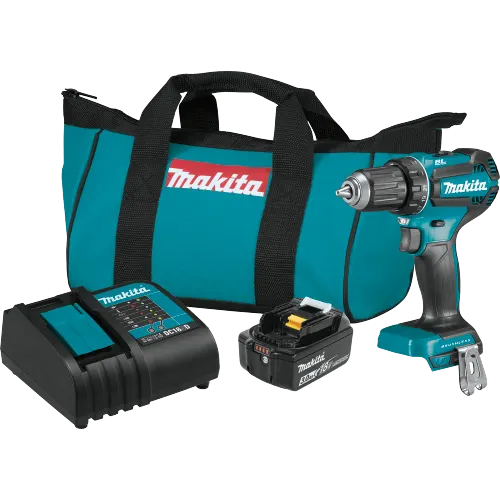
| voltage | 18V (LXT lithium-ion) |
|---|---|
| motor | Brushless |
| max Torque | 440 in-lbs |
| speed | 0–500 / 0–1,900 RPM (2-speed) |
| chuck | 1/2 in. keyless ratcheting, all-metal |
| weight | 3.8 lbs with 3.0Ah battery |
| battery | Kit includes one 18V LXT 3.0Ah battery + 30-min rapid charger |
| warranty | 3-year limited (tool, battery, and charger) |
Pros
- 440 in-lbs of max torque is plenty for a compact drill — handles deck screws and 1-inch spade bits without bogging
- Kit ships with a 3.0Ah battery and a 30-minute rapid charger, so you get real runtime out of the box
- Light at 3.8 lbs with the battery installed, with a short head that fits between studs and inside cabinets
- Two-speed all-metal transmission with a 1/2-inch ratcheting chuck that grips round-shank bits well
- Backs onto the enormous Makita 18V LXT platform — over 300 tools share the same battery
- Dual LED lights flank the chuck and kill the shadow your hand normally casts on the bit
Cons
- 440 in-lbs trails the Milwaukee 2904 (1,400 in-lbs) and even the DeWalt DCD800 on stubborn lag bolts
- No belt hook included on most kit configurations — you add one or clip the rare-earth holster aftermarket
- Top no-load speed of 1,900 RPM is lower than the DeWalt and Milwaukee, so it bores large holes a touch slower
- Premium pricing — the kit usually costs more than a comparable Bosch GSR18V-400 kit
Who the Makita XFD131 is for
The Makita XFD131 sits in the sweet spot of the cordless drill market: a full-size compact brushless driver-drill that is light enough to use overhead all day but strong enough to bore 1-inch holes and sink long structural screws. The spec sheet shows 440 in-lbs of max torque, a two-speed transmission topping out at 1,900 RPM, and a weight of 3.8 lbs with the 3.0Ah battery installed. That combination tells you exactly who this tool is aimed at — the remodeler, electrician, cabinet installer, or serious homeowner who wants one drill that does almost everything without becoming a wrist-killer.
If you already own Makita 18V LXT batteries, this is close to an automatic recommendation. The LXT platform is the broadest cordless lineup on the market, with well over 300 tools sharing the same pack, so buying the XFD131 as a bare tool or kit slots straight into an existing fleet.
Build quality and ergonomics
Makita has refined this body shape over several generations, and it shows. The grip is slim with a rubber overmold that fills the palm without forcing your fingers wide, which matters when you are torquing screws for hours. The all-metal 1/2-inch ratcheting chuck closes down hard on round-shank bits and has not loosened under heavy hammer-free driving in owner reports. Balance is the standout: with a 3.0Ah pack the tool sits neutral in the hand rather than tipping backward, a real advantage over heavier high-torque drills.
The head length is short enough to work between 16-inch on-center studs and reach into base cabinets, though it is not as stubby as a true sub-compact like the XFD061. Twin LEDs sit on either side of the chuck collar, which is smarter than the single under-trigger light most rivals use — two lights cancel the shadow your hand throws across the bit. Owners consistently report the belt clip is an afterthought; many kits omit it, and you will likely add one.
Drilling and driving performance by material
In wood, the XFD131 is genuinely strong for its size. Spade bits up to an inch and self-feed bits in the smaller sizes pull through softwood framing without stalling, and the low-gear 500 RPM range gives the control you want for big fasteners. The two-speed transmission lets you flip to high gear for fast pilot holes and small twist bits.
In metal, the brushless motor holds speed under load, and the 1,900 RPM top end is adequate for twist drilling steel up to about 1/2 inch with sharp bits, though the DeWalt DCD800 and Milwaukee 2904 spin faster (2,000 and 2,100 RPM respectively) and clear large holes a little quicker.
For driving, this is where the XFD131 shines for everyday work. The 440 in-lbs rating sinks 3-inch deck screws, drives lag screws up to moderate sizes, and handles a full day of cabinet and drywall fastening without fuss. The clutch is precise and repeatable, so you can dial in a setting and trust it across a box of fasteners. The honest limit is heavy structural work — large lag bolts and ledger screws are where you feel the gap to the 1,400 in-lb Milwaukee.
Battery and charging
The kit configuration is a real selling point. Where many competitors bundle a pair of 2.0Ah packs, the XFD131 ships with a single 3.0Ah LXT battery and Makita's rapid charger that reaches full in roughly 30 minutes. In practice that 3.0Ah cell delivers a long working session on a single charge, and the fast charger means downtime is minimal if you cycle two packs. Step up to a 5.0Ah or 6.0Ah LXT pack and runtime climbs further, at the cost of a heavier, more nose-heavy tool. The whole LXT line uses Makita's Star Protection electronics, which guard against overload, over-discharge, and overheating.
Value versus the other three drills
Against the DeWalt DCD800, the Makita is the lighter, better-balanced tool with a more useful included battery (3.0Ah versus DeWalt's two 2.0Ah packs in the DCD800D2). The DeWalt spins slightly faster at 2,000 RPM and is marginally lighter as a bare tool at 2.82 lbs, but the platforms are a wash — pick the battery system you already own.
Against the Bosch GSR18V-400, the Makita has the torque edge (440 vs 400 in-lbs) and the larger included battery, but the Bosch is usually cheaper and carries Bosch's longer 5-year tool warranty against Makita's 3 years. For a first-time buyer on a budget, the Bosch is the value play; for platform breadth and the bundled 3.0Ah pack, the Makita justifies its premium.
Against the Milwaukee 2904, it is no contest on raw power — the Milwaukee's 1,400 in-lbs and hammer mode put it in a heavier-duty class entirely. But the 2904 is a bare tool (no battery), is heavier, and costs more once you add an M18 pack. The XFD131 is the smarter pick if you want a complete, light, do-everything kit rather than a high-torque specialist.
Final verdict
The Makita XFD131 earns its 4.5 rating by being the most balanced complete kit of this group. It is not the most powerful drill here — the Milwaukee 2904 owns that — but it pairs genuinely useful 440 in-lb torque with a light, well-balanced body, a 3.0Ah battery, and a 30-minute charger in the box. For anyone on or joining the Makita 18V LXT platform, it is one of the easiest cordless drill recommendations on the market. The only buyers who should look elsewhere are heavy structural fasteners who need the Milwaukee's grunt, and absolute budget shoppers who will be better served by the Bosch GSR18V-400.
Advertisement
Frequently asked questions
- Is the Makita XFD131 a hammer drill?
- No, the XFD131 is a driver-drill, not a hammer drill — it has no percussion mode. For occasional masonry work you would want Makita's XPH-series hammer drill or a dedicated rotary hammer. The XFD131 is built for drilling wood and metal and driving fasteners.
- What battery comes with the XFD131 kit?
- The XFD131 kit ships with one 18V LXT 3.0Ah lithium-ion battery and a rapid charger that tops it off in about 30 minutes. That 3.0Ah cell is a meaningful upgrade over the 2.0Ah packs bundled with many competing kits and gives noticeably more screws per charge.
- How much torque does the Makita XFD131 have?
- The XFD131 produces 440 in-lbs of maximum torque. That is strong for a compact brushless drill and covers the vast majority of fastening and hole-drilling jobs, though heavy users driving large lag screws will find the Milwaukee 2904 (1,400 in-lbs) substantially stronger.
- Will old Makita 18V batteries work with the XFD131?
- Yes, any genuine Makita 18V LXT lithium-ion battery works in the XFD131 — the platform is fully backward compatible across the LXT line. Older 1.5Ah and 3.0Ah star-protection packs run fine; newer 5.0Ah and 6.0Ah cells simply add runtime and weight.
- Is the Makita XFD131 worth it in 2026?
- Yes, the XFD131 remains a strong buy in 2026 if you are on or buying into the Makita LXT platform. It is light, well-built, and the included 3.0Ah battery and fast charger justify its price. Shoppers who own no Makita tools yet should weigh the cheaper Bosch GSR18V-400 kit.
- What is the difference between the XFD131 and XFD061?
- The XFD061 is Makita's slightly lighter sub-compact driver-drill with a shorter head and lower torque, while the XFD131 is the full-size compact with 440 in-lbs of torque and a more robust transmission. Choose the XFD061 for the lightest possible tool and the XFD131 when you want more grunt.
Ready to buy the XFD131?
We may earn a commission if you buy through these links, at no extra cost to you.