
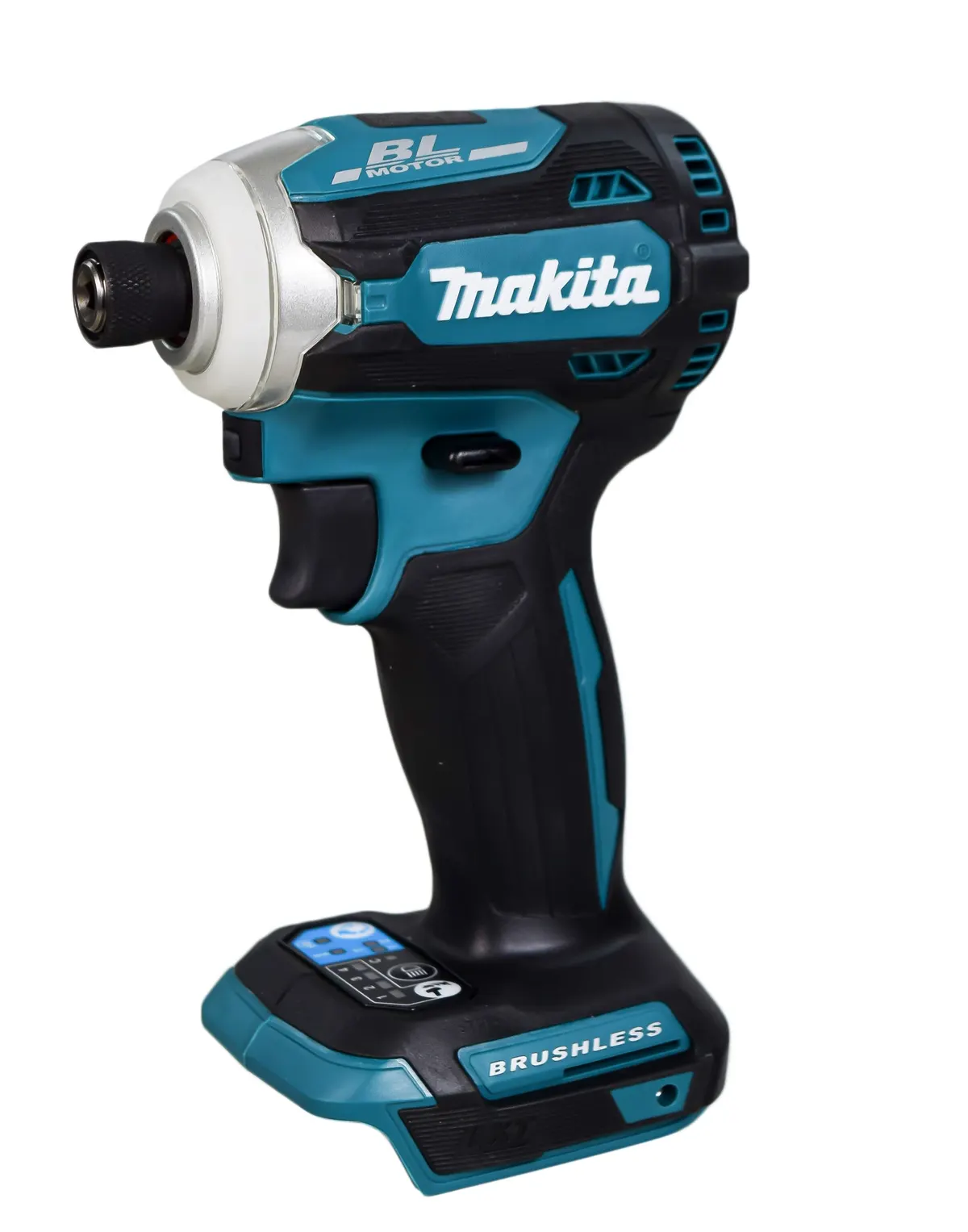
Makita XDT16Z 18V LXT Impact Driver Review: 4-Speed Precision
| voltage | 18V (LXT lithium-ion) |
|---|---|
| motor | Brushless |
| max Torque | 1,600 in-lbs |
| speed Settings | 4-speed: 0–1,100 / 0–2,100 / 0–3,200 / 0–3,600 RPM |
| impact Rate | 0–1,100 / 0–2,600 / 0–3,600 / 0–3,800 IPM |
| weight Bare Tool | 1.9 lbs (bare tool) |
| weight With Battery | 2.9 lbs (with 2.0Ah battery) |
| length | 4.6 in. |
| collet | 1/4 in. hex quick-change |
| warranty | 3-year limited (tool) |
Pros
- 1,600 in-lbs of torque — competitive with Milwaukee and DeWalt flagship models in this voltage class
- Four-speed Quick-Shift Mode automatically selects the optimal speed-torque balance for each fastener, reducing cam-out on smaller screws
- Bare tool weighs just 1.9 lbs, with a 4.6-inch head length that fits comfortably in tight framing bays
- Tightening Mode (T-mode) downshifts before final tightening to prevent thread stripping — a real advantage on delicate materials
- Slots directly into the Makita 18V LXT ecosystem, sharing batteries with over 300 cordless tools
- 3,800 IPM top impact rate delivers quick, confident fastening in dense hardwood and structural lumber
Cons
- Bare-tool price of $195+ is steep against the DeWalt DCF887B at $149 — LXT battery holders pay the premium for platform loyalty
- Four-speed selector can feel redundant compared to DeWalt's streamlined 3-mode system on casual worksites
- No battery or charger included at the bare-tool price — plan to spend more for the kit if you are starting the LXT platform
Four Speeds and Why They Matter
Most cordless impact drivers ship with two or three speed modes. Makita's XDT16Z offers four — and that difference is more than a spec-sheet footnote for anyone driving a wide variety of fasteners in a single workday. The four-speed Quick-Shift Mode covers 0–1,100 RPM and 0–1,100 IPM at the bottom end (precision mode for delicate trim screws) and 0–3,600 RPM and 0–3,800 IPM at the top (structural fastening territory). Between those poles sit two intermediate settings that cover cabinet hardware, metal framing screws, and deck screws without requiring constant recalibration of hand pressure.
The 1,600 in-lbs of maximum torque positions the XDT16Z firmly in the professional tier. That figure is competitive with the DeWalt DCF887B (1,825 in-lbs) and the Bosch GDX18V-1800CN (1,800 in-lbs), and meaningfully above budget 18V options that typically land between 1,200 and 1,400 in-lbs. For most residential construction, remodeling, and finish carpentry, 1,600 in-lbs is more than sufficient — it sinks 3-inch structural screws, drives 5/16-inch lag bolts into ledger boards, and handles self-tapping metal screws through light steel framing without bogging.
Compact Body, Professional Balance
At 4.6 inches from chuck face to back of motor, the XDT16Z is among the shortest 18V impact drivers available. That head length matters in framing — it fits comfortably into 16-inch on-center stud bays and clears cabinet face frames where longer tools bind. With a 2.0Ah battery installed the tool weighs 2.9 lbs, light enough for extended overhead fastening without excessive fatigue.
The rubberized grip tapers toward the front of the handle, which Makita designed to allow a tighter, more secure hold during sustained one-handed use. Owners consistently note that the balance point shifts slightly rearward compared to older brushed models, which reduces wrist torque during repetitive driving. The LED light array on the front of the motor housing illuminates the workpiece without casting the prominent shadow produced by under-trigger single-bulb designs.
Tightening Mode: The Precision Differentiator
Among the XDT16Z's software-driven features, T-mode (Tightening Mode) stands out as the one most likely to change how a carpenter works day-to-day. When activated, T-mode monitors the fastener's resistance curve and automatically downshifts the rotational and impact speed in the final stage of driving, seating the screw firmly without overtightening. On composite decking — a material notorious for cracking under overdriven screws — this feature alone can save a tradesperson from costly callbacks. It also reduces stripping on cam-out-prone Phillips head screws in finished surfaces.
The Assist Mode is a secondary benefit: it starts each fastener at minimum speed and only opens up to full power once the thread has engaged the material. Cross-threading and stripped starts are noticeably less common with this mode enabled, which adds up on high-volume fastening days.
Battery Platform and Runtime
The XDT16Z is a bare tool — batteries and charger sold separately. That is appropriate for the large number of tradespeople already running Makita 18V LXT, who likely own multiple packs already, but it represents a real cost barrier for new buyers. The LXT platform's depth is a genuine advantage: over 300 compatible tools ranging from circular saws to oscillating multi-tools share the same cells, which means each battery purchase amortizes across a wide fleet.
Runtime figures with a 3.0Ah pack are strong. Owners driving standard deck screws through softwood framing commonly report 400 or more screws per charge at medium speed settings — enough for a full decking session on a typical residential deck before swapping packs.
How It Stands Against the Competition
The XDT16Z's principal rival in the premium 18V tier is the DeWalt DCF887B, which delivers 1,825 in-lbs (225 in-lbs more) and a slightly longer 5.3-inch head for around $149 bare. The DeWalt's edge is raw torque and a lower entry price. The Makita answers with a shorter, lighter body, the four-speed Quick-Shift intelligence, and T-mode precision — features that matter more in finish carpentry and precision fastening than in heavy structural work.
Against the Bosch GDX18V-1800CN Freak, the XDT16Z gives up the Bosch's dual-chuck versatility (the Freak accepts 1/4-inch hex bits and 1/2-inch sockets without an adapter) but delivers a significantly shorter and lighter package. The Freak is the better choice for mechanics and plumbers who drive both fasteners and bolts with one tool; the XDT16Z is the better choice for carpenters and electricians who stay predominantly in the hex-shank bit world.
Verdict
No other 18V impact driver matches the XDT16Z's combination of compact dimensions, 1,600 in-lbs of torque, and the genuinely useful Quick-Shift Mode and T-mode electronics. A 4.6 rating reflects a tool that is excellent for its intended audience — Makita LXT users and precision-focused tradespeople — but acknowledges that its bare-tool price commands a loyalty premium, and that the DeWalt and Bosch options offer more raw torque at similar or lower cost for buyers who prioritize those metrics.
Advertisement
Frequently asked questions
- What makes the XDT16Z's Quick-Shift Mode different from a standard variable-speed trigger?
- Standard variable-speed triggers adjust RPM based on how hard you squeeze; Quick-Shift Mode reads the load electronically and automatically steps between the four speed ranges to find the best torque-to-speed balance for that fastener and material. The practical result is better control at the start of a screw and more efficient driving in the power range — you do not need to modulate trigger pressure as carefully.
- Does the XDT16Z accept round-shank drill bits?
- No — like all standard impact drivers, the XDT16Z uses a 1/4-inch hex quick-change collet that only accepts hex-shank bits. Round-shank twist bits and spade bits require a universal hex-shank adapter. For regular drilling tasks, a dedicated drill/driver is the better choice.
- How does the XDT16Z compare to the older XDT14Z?
- The XDT16Z represents a significant upgrade over the XDT14Z. It adds Quick-Shift Mode intelligence and a fourth speed setting, increases max IPM from 3,600 to 3,800, and sheds a few tenths of a pound. Both use the same 18V LXT batteries, so existing platform owners can upgrade the driver while keeping their existing packs.
- Is the XDT16Z worth the premium over the Makita XDT13Z?
- For tradespeople doing varied fastening work — from small trim screws to 3-inch structural screws in the same session — the XDT16Z's four speeds and Quick-Shift intelligence are worth the extra cost. For straightforward repetitive fastening where you always use the same fastener type, the simpler and cheaper XDT13Z is adequate.
- What is the T-mode (Tightening Mode) on the XDT16Z?
- T-mode automatically slows the driver just before a fastener reaches full tightening, reducing the impact force to a gentler final seated position. This prevents thread stripping in soft woods, cracking composite decking, and over-driving drywall screws. It activates automatically when the motor senses the fastener resistance curve typical of a screw approaching its seating point.
- Which Makita batteries give the best results with the XDT16Z?
- The 4.0Ah and 5.0Ah LXT batteries provide the best balance of runtime and weight for most jobs. The 2.0Ah compact packs keep the tool at its lightest (2.9 lbs total) and work well for light-duty or overhead work where arm fatigue matters. The 6.0Ah high-capacity pack maximizes runtime but pushes total weight above 3.5 lbs.
Ready to buy the XDT16Z?
We may earn a commission if you buy through these links, at no extra cost to you.