
Makita RT0701C Review: Best Compact Trim Router
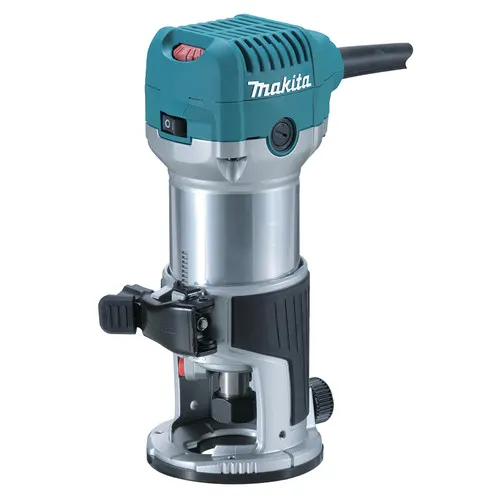
| motor Power | 1-1/4 HP (6.5 amps) |
|---|---|
| speed Range | 10,000–30,000 RPM variable |
| collet | 1/4 in. (included); 3/8 in. collet available separately |
| base Type | Fixed base with quick-release cam lock |
| depth Adjustment | Rack-and-pinion micro-adjust |
| weight | 3.9 lbs |
| cord Length | 8 ft |
| warranty | 1-year limited |
Pros
- Variable speed from 10,000 to 30,000 RPM is the widest range in this class, giving you genuine low-speed control for larger bits and high-speed precision for fine work
- Electronic speed control maintains constant RPM under load — no bogging down mid-profile the way budget trim routers do
- Quick-release cam lock on the motor housing lets you set depth and swap between the fixed base and optional plunge or tilt bases in seconds
- At 3.9 lbs, it is notably light for its power output and runs comfortably one-handed for laminate flush-trim work
- Rack-and-pinion depth adjustment is smooth and repeatable, with clear markings that hold their setting reliably after locking
Cons
- Accepts only 1/4-inch shank bits — no 1/2-inch collet option on the base tool, which limits you to smaller-diameter profiles
- Brushed motor will wear faster than brushless competitors over heavy production use; plan on periodic brush replacement after several hundred hours
- No LED work light, which competitors at this price tier have started adding
- Dust collection port is a small-diameter stub — you need the optional dust extracting attachment (195559-1) for any real dust management
Why the RT0701C sets the compact router benchmark
Makita's RT0701C has been the compact router that other manufacturers measure against for the better part of a decade, and understanding why clarifies what this class of tool is actually for. A compact router is not a shrunken version of a full-size router — it is a specialized tool built around one-handed control, light weight, and speed range fine enough to handle the thin materials and close tolerances of laminate trimming and decorative edge work. The RT0701C's 10,000-to-30,000 RPM variable speed range is the widest in this class, and it is the number that matters most.
Why does RPM range matter on a compact router? Because the correct bit speed depends on bit diameter. A 1-inch flush-trim bit should spin around 20,000 RPM; a 3/8-inch roundover bit can run at full speed; a large 1/4-inch-shank cove bit wants to slow down. A router locked at 30,000 RPM all the time burns bit edges, leaves scorch marks on hardwood, and vibrates. The RT0701C's electronic speed control also maintains that chosen speed under load — when the bit bites, the motor compensates rather than bogging.
Build quality and handling
The motor housing is a single-piece cast aluminum cylinder. It does not flex, it does not rattle, and after years of use in cabinet shops it still draws praise for its consistency. The quick-release cam lock is the defining ergonomic advantage over competitors: you twist a lever rather than threading a locking ring, and the motor drops out of the base cleanly. That matters when you are switching between a fixed base for edge profiling and an optional plunge base for mortise work.
At 3.9 lbs, the RT0701C runs comfortably in one hand for extended laminate sessions. Grip the base, index your thumb against the workpiece edge, and feed with consistent pressure — it does not fatigue your hand the way heavier tools do. The rack-and-pinion depth adjustment is a specific design choice: where cheaper compact routers use a threaded ring that tends to drift, the rack-and-pinion locks positively and reads clearly under shop lighting.
Performance by application
Laminate flush-trimming is the RT0701C's core use case and where it is cleanest. A sharp 1/4-inch flush-trim bit at 24,000–26,000 RPM produces a glass edge on plastic laminate with no chipping. The consistent speed under load means the cut does not change as you work through an inside corner where the cut depth momentarily varies.
Decorative edge profiling in wood — roundovers, chamfers, small ogee profiles — is equally strong. The variable speed lets you tune RPM to the specific profile and material. Softwood pine runs faster than maple or walnut; hard exotic woods benefit from a slower, more deliberate speed that avoids burning.
Template routing with a guide bushing works well within the RT0701C's 1/4-inch shank limitation. For light template work — duplicating shelf pin hole patterns, routing decorative inlets — the precision depth control is a real asset. For deep template routing or mortises that require multiple passes, a plunge base addition (sold separately or in the CX3 kit) extends its reach considerably.
The collet limitation
The one genuine structural constraint is collet size. The RT0701C accepts 1/4-inch and 3/8-inch shanks only. That eliminates the entire catalog of 1/2-inch shank bits: large roundovers (over 1/2-inch radius), raised panel cutters, large cove bits, drawer lock bits. If your routing needs include any of these profiles, the RT0701C is the wrong tool. Buy the Bosch 1617EVSPK instead. For buyers whose work stays in edge profiling, laminate, and template routing with standard-diameter bits, the limitation rarely matters in practice.
Value and competition
At around $159, the RT0701C sits at the top of the trim router price tier but below any mid-size full-function router. The Bosch Colt PR20EVS competes directly; the two tools are close enough that platform loyalty is a reasonable tiebreaker. The DeWalt DCW600B adds cordless freedom but costs nearly $100 more for the bare tool and requires a 20V MAX battery. For shop use where an outlet is always available, corded is the more rational choice — and the RT0701C's speed control advantages over a bare cordless router are meaningful for the workmanship of the cut.
Final assessment
The RT0701C earns its long-standing reference status by executing its core job — variable-speed compact routing with precise depth control — more completely than any direct competitor at the price. The 10,000-to-30,000 RPM span, the cam-lock base system, and the rack-and-pinion adjuster are all purposeful engineering decisions, not features added for the spec sheet. Buyers who need 1/2-inch shank capability need a different tool; the Bosch 1617EVSPK or a mid-size router is the right answer for those profiles. Everyone else gets a compact router that will outlast multiple competing models and continue to deliver consistent, precise cuts across years of edge work.
Advertisement
Frequently asked questions
- Can the Makita RT0701C use 1/2-inch shank bits?
- No. The RT0701C accepts 1/4-inch shank bits only, with an optional 3/8-inch collet available separately. For 1/2-inch shank bits and larger profiles, you need a mid-size router such as the Bosch 1617EVSPK or Makita's own RP0900K.
- Does the RT0701C work with a router table?
- Yes, with the right adapter. Makita sells a router table base (196094-2) specifically for the RT0701C, and several third-party router tables include compatible inserts. The compact size and consistent speed control make it a solid table-router choice for light to medium profiling work.
- What is the difference between the Makita RT0701C and RT0700C?
- The RT0701C includes a straight guide and edge guide accessories in the box; the RT0700C is the bare motor without accessories. Both use the same motor, same speed range, and the same base system. The RT0701C is the better value for most buyers.
- How does the RT0701C compare to the Bosch Colt PR20EVS?
- Both are 1-1/4 HP corded compact routers at comparable prices. The Makita spans 10,000–30,000 RPM versus the Bosch Colt's 16,000–35,000 RPM; the Makita's wider low-end range is more useful for large-diameter bits, while the Bosch spins slightly faster at the top. The Makita's build quality and depth-adjustment mechanism edge out the Bosch in most independent assessments.
- Is the RT0701C a laminate trimmer or a router?
- It is a compact router, sometimes called a trim router. It performs the same tasks as a dedicated laminate trimmer — flush-trimming laminate edges, rounding over countertop profiles — plus broader routing tasks like edge profiling in wood and light template work. It is more capable than a single-speed laminate trimmer, with variable speed and a wider bit selection.
- What accessories are available for the RT0701C?
- Makita sells a plunge base, tilt base, offset base, dust extracting attachment, router table base, and a three-base combo kit (RT0701CX3). The quick-release cam system makes switching between bases the work of seconds, which is a genuine advantage over routers where base changes require tools.
Ready to buy the RT0701C?
We may earn a commission if you buy through these links, at no extra cost to you.