
Makita BO5041 Review: Corded 5-In ROS with Wide Speed Range
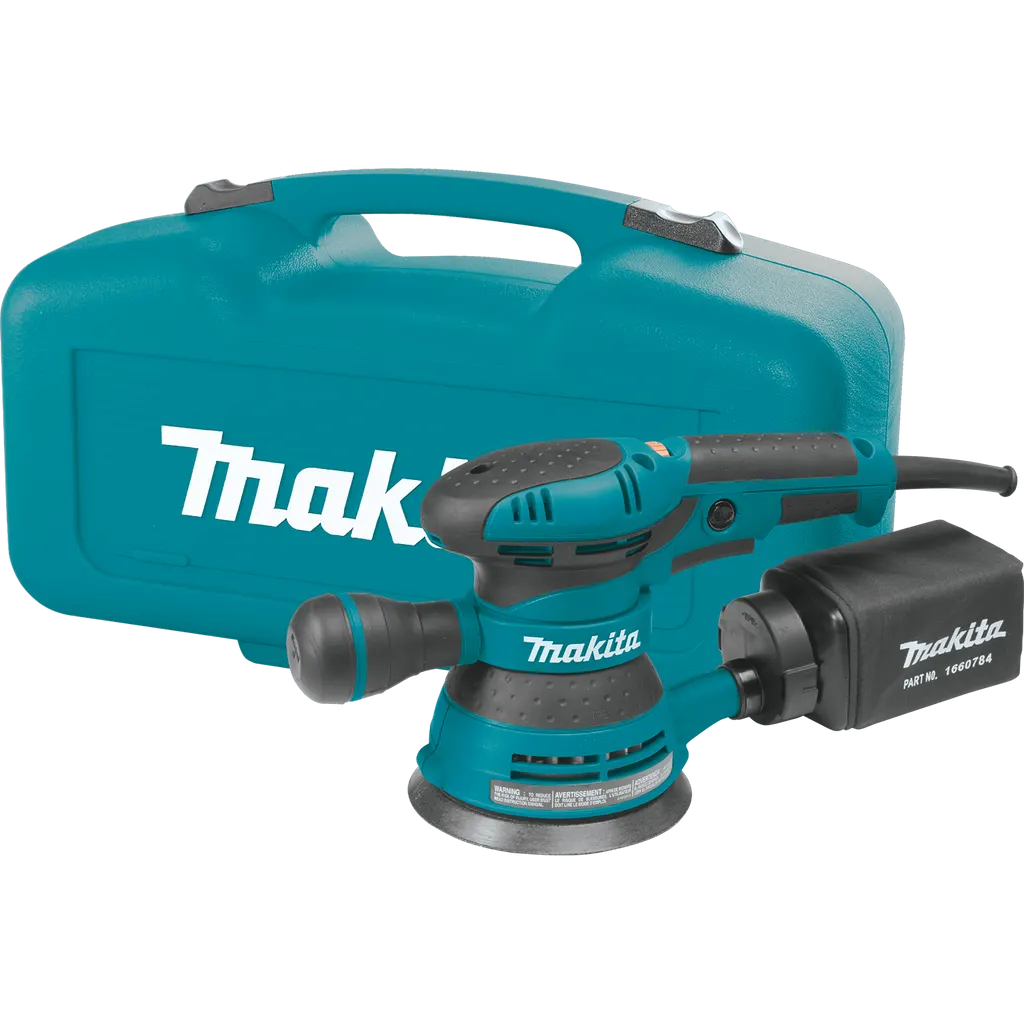
| amperage | 3.0 AMP |
|---|---|
| speed | 4,000–12,000 OPM variable |
| orbit Diameter | 1/8 in. (3.2 mm) eccentric |
| pad Size | 5 in. (127 mm), 8-hole hook-and-loop |
| weight | 3.1 lbs |
| dust Collection | Through-the-pad 8-hole system; vacuum port adapter and dust bag included |
| power Source | Corded 120V AC |
| warranty | 1-year limited |
Pros
- 4,000–12,000 OPM variable range is the widest in its class — the low end handles veneer and finish coats that competitors' 8,000 OPM floors cannot safely reach
- 1/8-inch orbit produces a fine, consistent scratch pattern well-matched to furniture and cabinet finishing without swirl risk
- Pad brake system reduces surface gouging at start-up and shutdown, protecting surfaces when the pad decelerates
- Adjustable D-handle plus top palm grip gives a stable two-hand grip option for controlled flat-surface work
- Through-the-pad 8-hole dust collection with vacuum port adapter and included dust bag — effective collection without any add-on required
- At 3.1 lbs it is lighter than most corded 5-inch random-orbit sanders, reducing fatigue on extended finishing sessions
Cons
- Corded — the 6-foot cord limits range and requires cord management in a shop; no cordless version shares these specs
- Single fixed orbit diameter of 1/8 inch; cannot switch to a more aggressive 3/32-inch orbit for faster material removal
- Higher price than the Ryobi RS290G for a corded tool, though the wider speed range and pad brake justify the premium for finishing-focused work
The BO5041's defining advantage: speed range
Makita's BO5041 has been a reference standard in the 5-inch corded random-orbit sander category for good reason. Its defining specification — a 4,000 to 12,000 OPM variable-speed range — remains the widest available among mainstream tools in this class, and that range matters in ways that only become clear when you push a sander into demanding finishing work.
At 12,000 OPM, the BO5041 handles fast stock removal on bare wood: flattening dried filler, blending patch lines, and stepping through grits from 80 to 150. Drop the dial to 4,000 OPM and the same tool becomes a precision instrument for scuff-sanding between finish coats where any faster pass risks cutting through. The ability to dial that range in one tool, without changing the machine, is a practical convenience most competitors sacrifice.
By comparison, the DeWalt DCW210B cordless sander starts at 8,000 OPM — already in the upper half of the BO5041's range. For general purpose finishing that gap rarely matters; for veneer work or finishing-coat sanding on furniture, it matters considerably.
Build and mechanical design
The BO5041 uses a Makita-built 3-amp motor with oversized sealed ball bearings for longevity. The 1/8-inch eccentric orbit is Makita's deliberate choice to prioritize finish quality over aggressive material removal. A larger orbit — say 5/32 inch — removes stock faster, but the scratch pattern coarsens and swirl risk increases. Makita's 1/8-inch orbit is conservative and finisher-friendly.
The pad brake is a feature often overlooked in spec comparisons but meaningful in shop use. When you switch the tool off, the pad brakes to a stop rapidly rather than freewheeling. Setting a spinning pad down on a workpiece while it decelerates causes circular gouges in the finish — the pad brake eliminates this by stopping the pad before it can do damage. Budget sanders without this feature require the user to hold the tool clear of the surface until it fully stops.
The grip is the BO5041's ergonomic differentiator. A D-handle at the rear pairs with a large palm pad on top, allowing a two-hand grip that increases control on flat broad surfaces. One-handed operation from the top grip works for tighter maneuvering. The rubber overmold on both contact points reduces vibration transmission to the hand.
Dust collection in practice
Through-the-pad collection is the most effective dust extraction approach for a random-orbit sander. Eight holes in the pad align with the abrasive disc's holes, pulling sanding dust into the pad backing and out through the collection port. The BO5041 includes a dust bag and a vacuum port adapter sized for standard shop vac hoses. In practice, vacuum hookup removes roughly twice as much fine dust as the bag alone — and fine dust obscures the surface enough to hide scratch lines that only become visible under the first coat of finish.
The dust bag fills quickly during aggressive passes on pine or MDF. If you plan extended sessions on raw wood, running the tool into a shop vac is a meaningful quality-of-life improvement and not just a dust-control nicety.
Performance across materials
On bare softwood, the BO5041 at 12,000 OPM with 80-grit removes mill marks rapidly, and stepping through 100, 120, and 150 grit at progressively lower OPM produces a surface ready for stain in a controlled, predictable sequence. The pad brake pays for itself here when moving the tool between pieces — no accidental pad contact with the workpiece during the deceleration phase.
On hardwood, the 1/8-inch orbit requires more passes to match the removal speed of a more aggressive tool, but the finish quality after 150 and 180 grit passes is superior: a finer, more uniform scratch that opens the grain evenly for stain absorption.
On finish coats, the 4,000 OPM setting — with 220 or 320 grit — scuffs the surface between coats with minimal risk of cutting through. This precision is the BO5041's strongest capability and the one most likely to matter in furniture and cabinet finishing where a cut-through requires a full strip-and-redo.
Comparing to the Ryobi RS290G and DeWalt DCW210B
The Ryobi RS290G is a fixed-speed 12,500 OPM tool at roughly $49–$69. It is excellent for users who need a capable, affordable corded random-orbit sander and do not require fine speed control. The BO5041 commands a $50–$80 premium for variable speed, the pad brake, and the vacuum adapter — features that pay back over dozens of projects but may be over-specified for occasional homeowner use.
The DeWalt DCW210B runs $99–$120 bare and adds cordless mobility and brushless motor efficiency, but its 8,000 OPM floor and lack of a pad brake distinguish it from the BO5041 in finishing applications. For platform owners and for work away from outlets, the DCW210B wins. For workshop-based finishing with a shop vac already running, the BO5041's wider speed range and pad brake tip the balance back to corded.
Summary
The Makita BO5041 rates a 4.6 out of 5 for its combination of the widest variable-speed range in class, mechanical pad brake, 1/8-inch finishing-quality orbit, and effective through-pad dust extraction. The 1-year warranty is shorter than DeWalt's 3-year coverage and is the most legitimate criticism of an otherwise mature, well-executed tool. For any workshop user who finishes wood regularly and wants one corded 5-inch random-orbit sander to cover the entire range from stock removal to finish-coat scuffing, the BO5041 is the correct choice.
Advertisement
Frequently asked questions
- What is the minimum OPM on the Makita BO5041?
- The BO5041's variable-speed dial goes down to 4,000 OPM at its minimum setting, which is the lowest available on a mainstream 5-inch random-orbit sander. That low floor is genuinely useful for scuff-sanding between clear-coat applications, sanding over veneer edges, and any surface where aggressive abrasion could cut through a thin substrate.
- Does the BO5041 have a pad brake?
- Yes. Makita includes a pad brake system that slows the pad on start-up and shutdown, reducing the risk of swirl gouges when you set the tool down on the workpiece or lift it off. This is a meaningful finishing-quality feature that budget sanders often omit.
- What is the orbit diameter on the BO5041?
- The BO5041 uses a 1/8-inch (3.2 mm) eccentric orbit, which produces a fine scratch pattern well-suited to furniture and cabinet work. A larger orbit like 3/32-inch removes material faster but leaves a coarser scratch; Makita's 1/8-inch choice prioritizes finish quality over removal speed.
- How does the BO5041 compare to the Ryobi RS290G?
- The BO5041 offers variable speed (4,000–12,000 OPM) versus the RS290G's fixed 12,500 OPM, a pad brake the RS290G lacks, and a through-pad dust system with a vacuum adapter. The RS290G costs about $50–$70 less. For occasional DIY use where sanding speed matters more than fine control, the RS290G is adequate. For consistent quality finishing work, the BO5041's wider speed range and pad brake make a real difference.
- Can I use standard 5-inch sanding discs on the BO5041?
- Yes. The 8-hole hook-and-loop pad accepts standard 5-inch discs from any major sandpaper brand — 3M, Norton, Mirka, Diablo, and others all make compatible discs. The 8-hole pattern aligns with the dust extraction holes for maximum dust capture through the pad.
- Is the Makita BO5041 still worth buying in 2026?
- Yes. The BO5041 remains one of the best corded 5-inch random-orbit sanders for finishing-focused work because of its wide 4,000–12,000 OPM range and pad brake — features that most competing tools in the price range still do not offer. The one area where it shows its age is the 1-year warranty, which is shorter than DeWalt's 3-year coverage.
Ready to buy the BO5041?
We may earn a commission if you buy through these links, at no extra cost to you.