
DeWalt DWE402 Review: 11-Amp Corded Angle Grinder
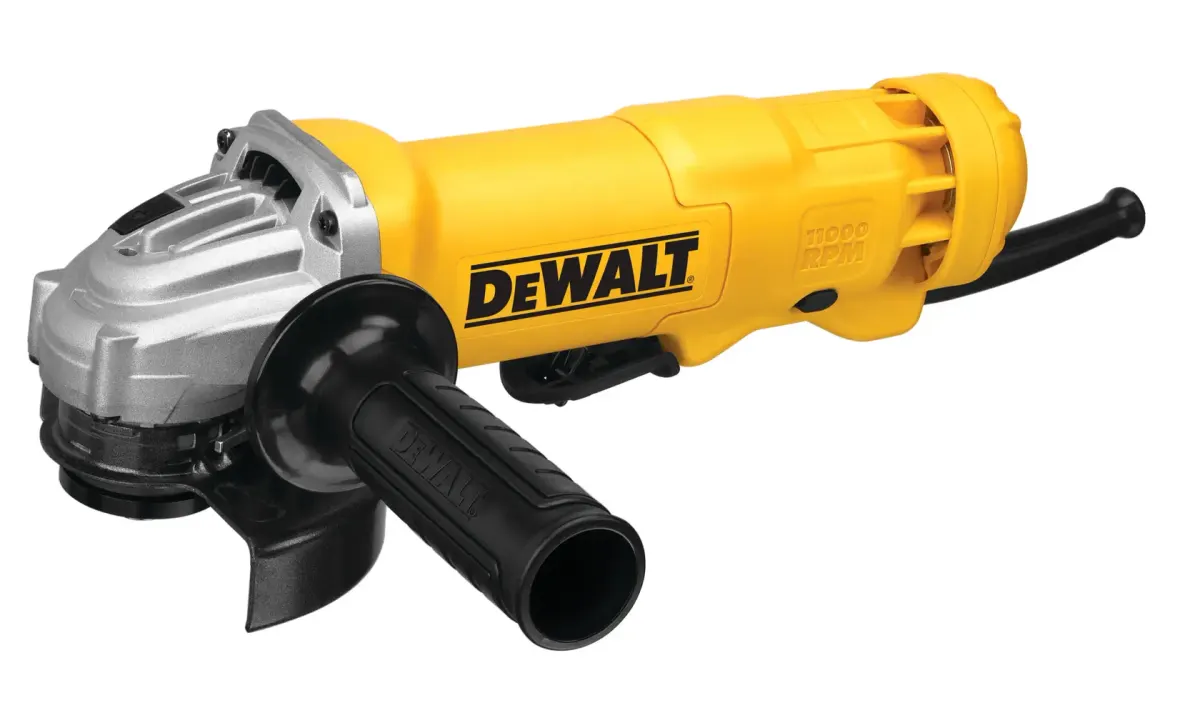
| motor Amps | 11.0 A (AC/DC) |
|---|---|
| no Load Speed | 11,000 RPM |
| disc Size | 4-1/2 in. (115 mm) |
| arbor | 5/8"-11 |
| switch Type | Paddle switch with safety lock-off |
| weight | 4.6 lbs |
| overall Length | 12 in. |
| warranty | 3-year limited, 1-year free service, 90-day satisfaction guarantee |
Pros
- 11-amp motor delivering 11,000 RPM puts this firmly in the upper tier of corded 4-1/2-inch grinders — more than enough grunt for sustained weld grinding and tile cutting
- Paddle switch with safety lock-off shuts the tool off the moment you release your grip, which is the safest switch design for a disc that can shatter at speed
- Quick-Change wheel release removes grinding discs without a wrench, cutting accessory swap time to under 30 seconds
- Dust Ejection System vents debris away from the motor intake, meaningfully extending brush life on dusty masonry or concrete work
- One-touch rotatable guard repositions without tools between grinding and cutting orientations
- At roughly $95–$100, it is the strongest corded grinder per dollar available from a tier-one brand at mainstream US retailers
Cons
- Weighs 4.6 lbs, heavier than the Makita GA4534 at 4.2 lbs — fatigue accumulates during extended overhead or vertical grinding
- Single-speed only — no variable speed dial, so polishing pads and wire wheels run at full 11,000 RPM unless you feather the paddle
- No electronic kickback detection; the paddle switch is a passive safety feature, not an active clutch
Why the DWE402 is still the corded benchmark
Corded angle grinders are a category where specifications translate directly to buying decisions, and the DeWalt DWE402's numbers are hard to argue with. An 11-amp motor spinning a 4-1/2-inch disc at 11,000 RPM places it in the top tier of single-speed corded grinders under $150. At the $95–$100 price point it typically occupies at Home Depot and Amazon, it is one of the most powerful corded grinders a DIYer or light tradesperson can buy without spending premium money on a specialty fabrication tool.
DeWalt has sold a version of this grinder for over a decade, and the refinements show. The Dust Ejection System — a channeled vent path that actively routes grinding dust away from the motor brushes — is a genuine durability improvement for anyone cutting masonry, concrete backer board, or tile. Brush replacements are expensive on a grinder that sees heavy use, and keeping grit away from the motor internals extends the service interval meaningfully.
Switch design and safety
The paddle switch is the feature that separates the DWE402 from budget grinders selling for $30–$50 at discount tool stores. A slide-on lock switch keeps the tool running if you set it down or drop it during a disc bind; the DWE402's paddle cuts power immediately when your grip relaxes. For a tool that can shatter a disc at 11,000 RPM, that distinction is not marketing language — it is a real difference in how the tool behaves in a worst-case scenario.
The safety lock-off prevents accidental startup when bumping the paddle while carrying or storing the tool. This matters for a tool that often lives in a truck bed or shop cart. What the DWE402 does not offer is active electronic kickback detection — the kind of clutch system that measures rotational acceleration and cuts motor power within milliseconds of a sudden bind. That technology appears on the Milwaukee 2880-20 and similar premium grinders. The DWE402 is a passive-safety tool: it relies on your grip and the paddle switch, not electronics, to manage kickback.
Motor output and real-world performance
In metal grinding, the 11-amp motor stays composed under load. Grinding weld seams on 3/16-inch steel plate, beveling bar stock, or removing rust from structural shapes are tasks the DWE402 handles without significant speed drop. The 11,000 RPM no-load speed bleeds down somewhat under load, as it does on any single-speed grinder, but the margin between stall and running speed is wide enough that most grinding tasks do not trigger overload.
In tile cutting, a 4-1/2-inch diamond blade on the DWE402 pulls through porcelain and ceramic with control, though you are working dry — this is not a wet-cutting setup. For cutting rebar or conduit with a standard metal cutoff wheel, the motor's power reserve means you are not fighting the tool to maintain progress.
For sustained grinding sessions, 4.6 lbs is not heavy by corded grinder standards, but it is heavier than the Makita GA4534 at 4.2 lbs. An hour of overhead grinding will make that difference noticeable. The grip diameter is standard — not as slim as the Makita's smallest-in-class barrel — but the rubber overmold absorbs vibration well enough for trade-length sessions.
Quick-Change wheel release
Accessory changes on corded grinders are an underrated source of workflow friction. The DWE402's tool-free Quick-Change release removes discs without the flange wrench that most budget grinders require. For a user swapping between a grinding disc and a flap disc multiple times in a session, that saves two to three minutes per change and eliminates the frustration of hunting for a dropped wrench. The one-touch rotatable guard follows a similar principle: repositioning without tools keeps the workflow moving.
Where the DWE402 falls short
Variable speed is the most meaningful missing feature. Flap discs for blending welds, wire wheels for rust removal, and polishing compounds for metal finishing all run better at lower RPM — typically 4,000–6,000 RPM rather than the DWE402's fixed 11,000. Running these accessories at full speed accelerates wear and can damage softer surfaces. If your work regularly includes finishing and polishing as well as aggressive grinding, a variable-speed grinder is worth the premium.
The weight delta versus the Makita is real but not disqualifying unless you are doing sustained overhead work. The absence of an electronic kickback clutch is the more significant limitation for users who will be doing frequent rebar or structural steel cutting, where disc binds are more common and more violent.
DWE402 versus the field
Against the Makita GA4534, the DeWalt has nearly double the motor amperage — 11 amps versus 6 — and is the clear choice for sustained heavy grinding. The Makita's lighter weight and slimmer grip favor it for precision finishing work or light tasks where the user wants minimal fatigue. For power output per dollar, the DWE402 wins.
Against the Milwaukee 2880-20 cordless, the DWE402 has the advantage of unlimited runtime and lower price. The Milwaukee brings electronic kickback protection and cordless freedom — genuinely valuable for outdoor and site work — but at $229 bare tool, it costs more than twice as much before you add a battery. For shop and garage use where an outlet is nearby, the DWE402's value case is strong.
Against the Ryobi PCL445B cordless, the corded DeWalt delivers more sustained power and higher no-load RPM, at the cost of the cord. The Ryobi is a budget entry into the cordless angle grinder category; the DWE402 is a professional-grade corded tool at a consumer price.
Final assessment
The DWE402 is the corded angle grinder that makes sense for anyone who grinds, cuts, and shapes on a regular basis and wants a tool that will last years without requiring premium investment. The 11-amp motor, paddle safety switch, dust ejection system, and tool-free accessories make it more refined than its price suggests. The lack of variable speed and electronic kickback protection are real limitations, but they are limitations you accept knowingly at this price, not oversights by DeWalt. For corded 4-1/2-inch angle grinding, this grinder sets the standard for the $100 price bracket.
Advertisement
Frequently asked questions
- Is the DeWalt DWE402 safe for cutting metal?
- Yes — the DWE402 is rated for cutting discs up to 4-1/2 inches on the 5/8"-11 arbor. For metal cutting, always install a thin cutting wheel (1/16 in.) designed for the application, keep the guard in place, and wear a full face shield. The paddle switch's automatic shutoff on release adds a meaningful margin of safety if the disc binds or shatters during a cut.
- What is the difference between the DWE402 and DWE402W?
- The DWE402W is functionally identical to the DWE402 but ships with the Type 27 wheel guard already installed and includes a grinding wheel. The base DWE402 is the bare grinder. Both share the same 11-amp motor, 11,000 RPM speed, paddle switch, and Quick-Change wheel release. Choose the DWE402W if you want a disc included out of the box.
- Does the DeWalt DWE402 have electronic kickback protection?
- No. The DWE402 relies on passive safety features: a paddle switch that cuts power when released and a wrench-free spindle lock. Active electronic kickback detection — which cuts motor power within milliseconds of a sudden disc bind — is found on higher-end models like the Milwaukee 2880-20. For occasional DIY use, the paddle switch provides adequate protection when technique is correct.
- Can the DWE402 be used with diamond blades for cutting concrete?
- Yes. A 4-1/2-inch diamond blade on the 5/8"-11 arbor fits the DWE402, and the 11-amp motor handles dry concrete cutting at shallow depth. For wet cutting, you need a grinder rated for wet use — the DWE402 is a dry-use tool. Always verify the blade's maximum RPM rating exceeds the grinder's 11,000 RPM before mounting.
- How does the DWE402 compare to the Makita GA4534?
- The DWE402 runs at 11 amps versus the GA4534's 6 amps, which translates to substantially more sustained cutting and grinding power under heavy load. The GA4534 is lighter at 4.2 lbs versus 4.6 lbs and has a smaller grip barrel, making it more comfortable for extended use. For heavy stock removal, the DeWalt's extra amperage matters; for precision work or lighter tasks, the Makita's ergonomics win.
- Is the DeWalt DWE402 worth buying in 2026?
- Yes — the DWE402 remains one of the best values in corded angle grinders. At around $95–$100, it delivers 11 amps and a proper paddle switch from a brand with full US dealer and warranty support. Competitors at the same price point rarely combine that motor rating with a safety-oriented switch and the Dust Ejection System. For corded 4-1/2-inch grinding, it is the benchmark to beat.
Ready to buy the DWE402?
We may earn a commission if you buy through these links, at no extra cost to you.