
DeWalt DCW210B Review: 20V Cordless 5-In ROS Unpacked
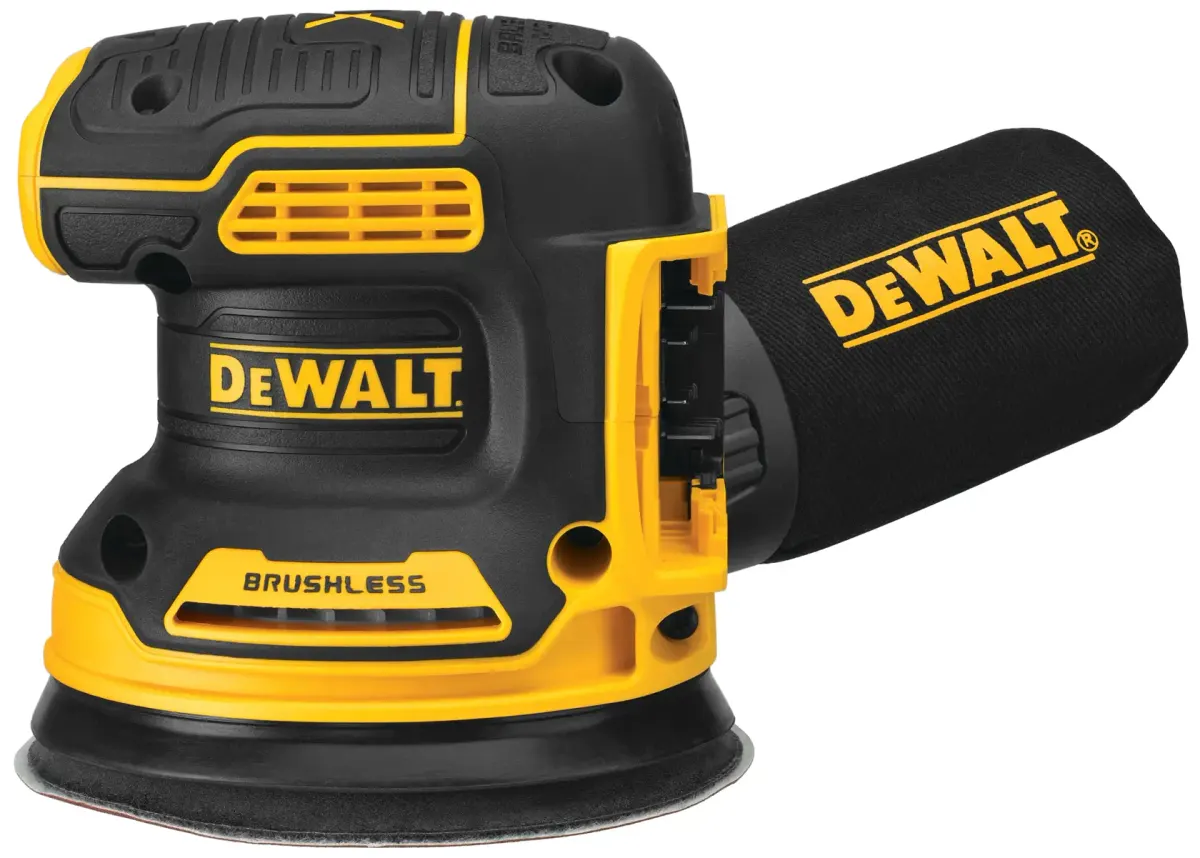
| voltage | 20V MAX XR (lithium-ion, battery not included) |
|---|---|
| motor | Brushless |
| speed | 8,000–12,000 OPM variable |
| pad Size | 5 in. (127 mm), 8-hole hook-and-loop |
| weight | 1.9 lbs (bare tool without battery) |
| dust Collection | One-handed locking dust bag; direct port for DWV010/DWV012 vacuums; 1-1/4 in. universal adapter |
| power Source | 20V MAX battery (sold separately) |
| warranty | 3-year limited (tool only) |
Pros
- Brushless motor and variable 8,000–12,000 OPM dial let you drop speed for delicate surfaces without losing pad stability
- At roughly 1.9 lbs bare, it is one of the lightest 5-inch cordless random-orbit sanders in the 20V class — ceiling and overhead work is noticeably less fatiguing
- Replaceable 8-hole hook-and-loop pad accepts standard aftermarket 5-inch discs, so paper cost stays low
- Dust port fits directly onto DeWalt's DWV010/DWV012 vacuums; universal 1-1/4-inch adapter included for other shop vacs
- Shares batteries with the entire DeWalt 20V MAX ecosystem — the same pack powers drills, saws, and lights
Cons
- Sold bare tool only — you must already own a 20V MAX battery and charger or budget an additional $50–$80 to complete the kit
- Single-speed fixed setting below 8,000 OPM is not available; the floor is higher than corded variable-speed rivals like the Makita BO5041
- Plastic dust bag fills quickly on aggressive material removal and captures less than a shop vac hookup
What the DCW210B is built for
DeWalt's DCW210B sits at the crossroads of the cordless revolution and the random-orbit sander category. It is a 5-inch brushless random-orbit sander on the 20V MAX XR platform, sold bare so you pair it with whatever battery capacity the job demands. At approximately 1.9 lbs without a battery, it is meaningfully lighter than most corded 5-inch sanders — which tend to land between 2.8 and 3.5 lbs — and that weight advantage pays dividends during overhead work, furniture finishing, and any task requiring extended one-handed control.
The target user is straightforward: the DeWalt 20V MAX platform owner who already has batteries and a charger from a drill, circ saw, or impact driver and wants to add sanding capability without buying a separate corded tool or a new battery system.
Variable speed and the brushless motor
The brushless motor in the DCW210B delivers consistent pad speed under varying material loads, which translates directly into more predictable scratch patterns. Where a brushed motor slows as paper loads up with dust, the brushless controller compensates and maintains pad velocity — the result is a more uniform finish with fewer swirl marks caused by pad stutter.
The variable-speed dial runs from 8,000 to 12,000 OPM. The 8,000 floor is appropriate for finish coats between clear coats, for sanding over veneer, and for surfaces where aggressive abrasion risks cutting through. The 12,000 ceiling handles fast bulk removal in bare wood preparation and blending dried putty patches. The range is narrower on the low end compared to the Makita BO5041's floor of 4,000 OPM — if you sand very fine or delicate work routinely, the corded Makita's wider range is the technical advantage.
Pad, paper compatibility, and dust collection
The pad is a 5-inch, 8-hole hook-and-loop design using the industry-standard layout shared by Bosch, Makita, Milwaukee, and most aftermarket paper suppliers. Replacing the pad when it wears is a tool-free task — the existing pad pulls off the hook-and-loop backer and a new one presses on. Paper cost is low because any major sandpaper brand will stock compatible 5-inch 8-hole discs.
Dust collection is the DCW210B's practical strength for indoor finishing work. The integrated port connects directly to DeWalt's DWV010 and DWV012 extractors, and the included universal adapter fits standard 1-1/4-inch shop vac hoses. Vacuum hookup captures the majority of fine dust at the source, which matters both for surface clarity — you can see your progress — and for respiratory safety. The included dust bag works in a pinch but fills in minutes during aggressive passes on bare wood.
Battery choice and runtime
Because this is a bare tool, battery selection is entirely in your hands. For occasional use around the house, a 2.0Ah compact battery keeps the overall tool weight low and provides 20–25 minutes of active sanding per charge. For longer sessions — refinishing a table or working through a set of cabinet doors — a 4.0Ah or 5.0Ah pack adds 5–10 ounces but doubles runtime to around 45 minutes between charges. The XR platform's battery electronics monitor temperature and voltage to prevent over-discharge, so there is no separate concern about running the battery flat on a long finishing pass.
Ergonomics and handling
The palm-grip body sits low with a rubber overmold grip that fills the hand without cramping it. DeWalt's low-profile height reduces the tool's tendency to rock on the pad during slow, deliberate passes — a characteristic that becomes important when sanding between finish coats where any rocking creates uneven burnishing. The power button is positioned for single-handed engagement, and the variable-speed dial clicks firmly between positions so it does not drift mid-job.
What the DCW210B does not do is shake excessively. Cordless sanders have historically vibrated more than corded tools at the same OPM because battery pack mass affects balance, but DeWalt's counterweight design keeps vibration at a tolerable level for extended sessions. Users with hand or wrist sensitivities will still want to take breaks on long sanding projects, but this is not a notably aggressive vibrator among 5-inch tools.
Value relative to alternatives
At $99–$120 as a bare tool, the DCW210B is not the cheapest 5-inch random-orbit sander. The Ryobi RS290G runs at $49–$69 with a cord and single-speed motor. The Makita BO5041 corded variable-speed costs around $129 with a dust bag included. What the DCW210B provides in return is cordless freedom and brushless motor efficiency for users already inside the DeWalt 20V ecosystem.
For someone starting from scratch with no DeWalt batteries, the math tilts toward the Makita BO5041 or the Ryobi RS290G — both deliver comparable pad performance at lower total cost. But for an existing 20V platform owner adding sanding to their tool inventory, the DCW210B's light weight and zero-cord convenience is a compelling proposition.
Final assessment
The 4.4 rating reflects the DCW210B delivering on the promise of a quality cordless random-orbit sander in the 20V MAX ecosystem. The brushless motor, variable speed dial, compatible 8-hole pad, and capable dust collection cover everything an intermediate to advanced finisher needs. The one legitimate limitation is the 8,000 OPM speed floor — the Makita BO5041 drops to 4,000 OPM for those who need truly gentle passes. Platform owners should consider this a near-automatic buy; platform newcomers should run the numbers on whether cordless convenience justifies the battery investment.
Advertisement
Frequently asked questions
- Does the DeWalt DCW210B come with a battery?
- No — the DCW210B is sold as a bare tool without a battery or charger. Any DeWalt 20V MAX lithium-ion battery works, including compact 2.0Ah packs and extended-run 5.0Ah packs. If you are new to the DeWalt platform, factor the cost of a starter kit (battery plus charger) into your budget.
- What OPM range does the DCW210B offer?
- The DCW210B has a variable-speed dial that adjusts from 8,000 to 12,000 OPM. The lower end suits final finishing passes and swirl-sensitive stains; the upper end is where you would run routine stock removal. There is no setting below 8,000 OPM, so extremely delicate surfaces may call for a corded tool with a wider range.
- Can I hook the DCW210B to a shop vacuum?
- Yes. The dust port accepts a 1-1/4-inch vacuum hose via the included universal connector (DWV9000), which fits most standard shop vacs. A direct attachment is also compatible with DeWalt's DWV010 and DWV012 dust extractors. Vacuum collection removes significantly more fine dust than the included bag alone.
- How does the DCW210B compare to the Makita BO5041 for corded use?
- The BO5041 is a corded tool with a wider OPM range (4,000–12,000) that costs about $129 and requires no battery investment. The DCW210B is lighter and cordless, making it the better choice for mobility or platform owners, but it requires a 20V MAX battery that adds cost if you do not already own one. Both sanders use 5-inch, 8-hole hook-and-loop pads and perform comparably on flat surfaces.
- What battery life can I expect sanding furniture with the DCW210B?
- With a 20V MAX 2.0Ah battery, expect roughly 20–25 minutes of active sanding on a medium-pressure pass before needing a recharge. A 4.0Ah or 5.0Ah battery doubles that to 45–50 minutes per charge cycle. Sanding softwood at medium speed draws less current than hardwood at full speed; battery life will vary with material, grit pressure, and OPM setting.
- Is the 8-hole pad on the DCW210B interchangeable with standard hook-and-loop discs?
- Yes. The 8-hole pattern is the most widely compatible layout in the 5-inch random-orbit market and aligns with discs from 3M, Norton, Diablo, Mirka, and most other major sandpaper brands. This is an important practical advantage over older tools with non-standard hole patterns that force you to buy proprietary paper.
Ready to buy the DCW210B?
We may earn a commission if you buy through these links, at no extra cost to you.