
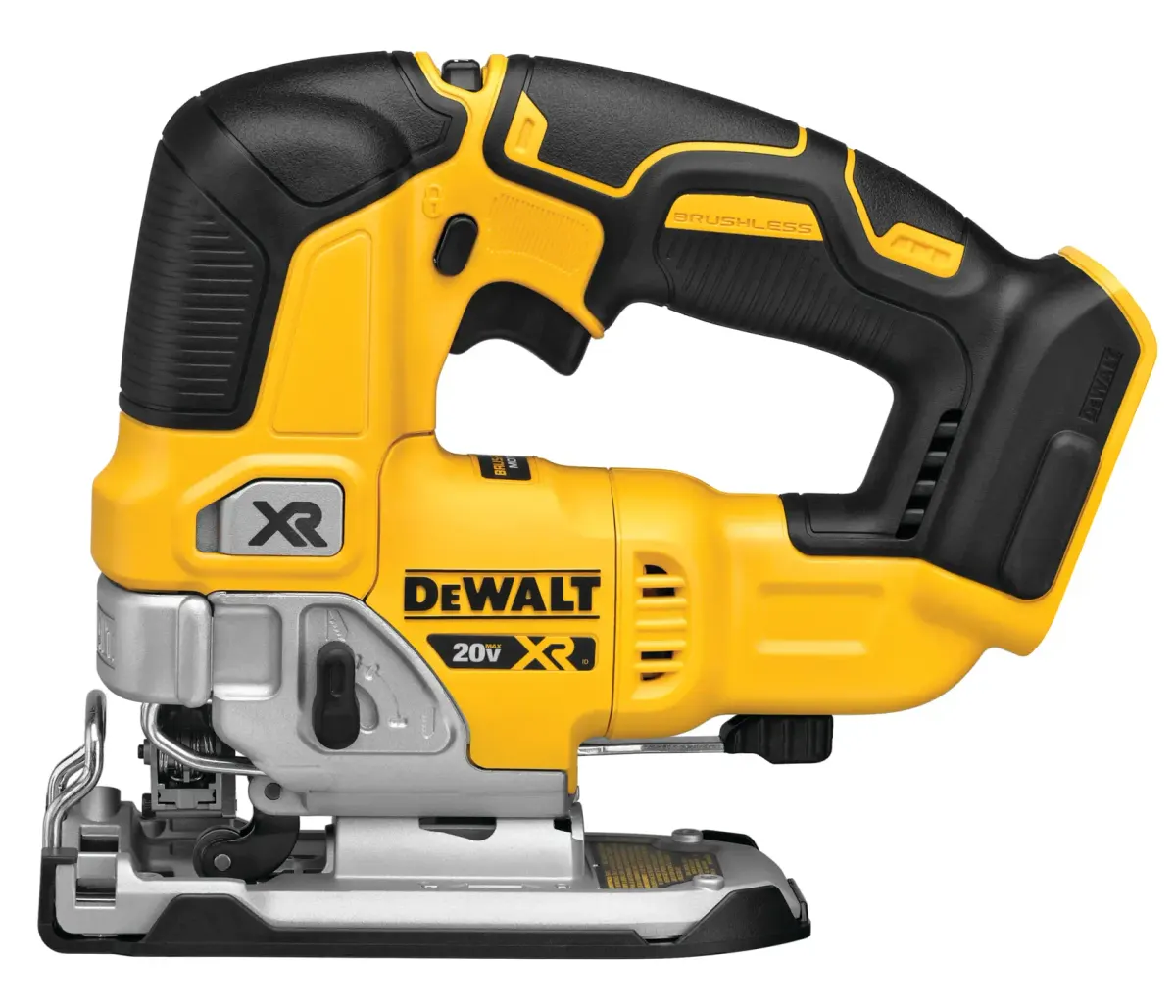
DeWalt DCS334B 20V MAX XR Jigsaw Review: Light and Fast
| voltage | 20V MAX (battery not included) |
|---|---|
| motor | Brushless XR |
| no Load S P M | 0–3,200 SPM (variable) |
| stroke Length | 1 inch |
| orbital Settings | 4-position orbital action |
| bevel Capacity | 0°, 15°, 30°, 45° (positive stops) |
| blade Compatibility | T-Shank (keyless tool-free clamp) |
| weight | 4.62 lbs (tool only) |
| cutting Capacity | 2 in. softwood; 3/8 in. mild steel |
Pros
- 4.62 lbs bare — the lightest jigsaw in this comparison, and that lightness translates to less fatigue on long detail cuts or overhead work
- 3,200 SPM no-load speed puts it ahead of the Bosch JS365 corded and close to the Milwaukee M18 FUEL without needing a corded power source
- 4-position orbital action with precise bevel detents at 0°, 15°, 30°, and 45° matches the precision of the Milwaukee
- Brushless XR motor delivers noticeably better runtime per charge than brushed cordless jigsaws — a meaningful difference on extended cutting sessions
- Keyless blade change system allows tool-free T-shank swaps comparable to any premium rival
- DeWalt 20V MAX platform breadth gives access to a wide range of compatible batteries and chargers
Cons
- Bare-tool only — 20V MAX battery and charger sold separately; total kit cost climbs if you are not already in the DeWalt ecosystem
- 2-inch maximum wood cutting capacity is lower than the Milwaukee's 5-1/2-inch rating — the DCS334B is not the tool for deep cuts in thick lumber
- Blower-only dust management with no vacuum port — not ideal for interior finish work where dust control matters
- Base plate lacks the premium aluminum construction of the Bosch JS365, though the stamped steel shoe is adequate for most work
DeWalt's lightest premium cordless jigsaw
The DeWalt DCS334B 20V MAX XR is the top-handle cordless jigsaw in DeWalt's brushless lineup. At 4.62 lbs bare, it is the lightest saw in this comparison — lighter than the Milwaukee 2737-20 by over a pound with equivalent battery attached and lighter than the Bosch JS365 corded. That weight distinction is real in daily use: a day of trim cuts, countertop openings, and flooring notches produces noticeably less wrist fatigue with the DCS334B than heavier alternatives.
Street price as a bare tool runs $105–$160 depending on promotions; the DCS334P1 kit with a 5.0Ah battery runs $180–$220. For existing DeWalt 20V MAX users, the bare tool is the obvious purchase — no other jigsaw in the 20V MAX lineup hits 3,200 SPM with a brushless motor at this weight.
Speed and motor characteristics
The XR brushless motor reaches 3,200 SPM at no load — meaningfully ahead of the Bosch JS365's 3,100 and behind the Milwaukee 2737-20's 3,500. Under load in typical materials (3/4-inch plywood, dimensional lumber, laminate), the gap between 3,200 and 3,500 SPM is not perceptible in cut time. The brushless motor's advantage over brushed cordless jigsaws shows in runtime: more of the battery's energy reaches the blade rather than dissipating as heat in motor brushes.
Variable-speed control through the trigger and a dial on top allows the full 0–3,200 SPM range. Slow-speed control at the low end of the range is precise — valuable for starting cuts in metal or navigating tight-radius curves where a fast blade amplifies steering errors.
Orbital action and bevel precision
Four orbital positions with the same 0°, 15°, 30°, and 45° bevel detents as the Milwaukee 2737-20. Setting 0 tracks curves in plywood and laminate with clean edges; settings 2–3 handle aggressive cuts in dimensional lumber at production speed. The detents for the bevel are firm — the shoe does not rock under cutting load once set, which matters for consistent angled cuts across a long workpiece.
The keyless blade change is straightforward and accepts all T-shank blades. Where Milwaukee's Quik-Lok is slightly slicker to operate single-handed, the DeWalt system is comparable in speed and keeps fingers clear of the blade collar.
Where the 2-inch wood capacity matters
The DCS334B's 2-inch maximum wood cutting capacity is the clearest limitation in this group. The Milwaukee 2737-20 is rated to 5-1/2 inches with specialty blades; the Bosch JS365 handles 3-1/2 inches. For the majority of DIY and light trade jigsaw tasks — plywood sheets, laminate flooring, trim boards, countertop cutouts in 3/4-inch material — 2 inches is more than sufficient. For finish carpenters cutting through thick stair treads, construction users cutting through thick framing with a specialty blade, or anyone routinely working in material over 1.5 inches, the Milwaukee is the correct choice.
Battery platform comparison
The 20V MAX platform is DeWalt's broadest cordless ecosystem, covering hundreds of tools from drills and saws to outdoor equipment. For users already owning 20V MAX batteries, the DCS334B fits straight into the fleet. Compared to Milwaukee's M18 platform, DeWalt 20V MAX batteries are generally available at slightly lower prices, which matters when you are building a two-battery rotation for extended work sessions.
Against the Bosch JS365, the DCS334B is faster, lighter, and cordless but needs a battery and costs more without the kit. Against the Milwaukee 2737-20, the DeWalt is lighter by about 1.2 lbs with battery attached and cheaper, but trades 300 SPM and deeper cutting capacity. Against the Ryobi PCL525B, the DeWalt is more expensive but offers measurably better motor, higher SPM, and brushless efficiency.
A note on dust management
The DCS334B's blower-only dust system is the one area where user feedback consistently points to a gap. The blower works well for outdoor and rough work, but for interior trim installations and finish carpentry where sawdust lands on finished floors, a vacuum connection would improve the tool. The Ryobi PCL525B shares this limitation; neither the Milwaukee nor the Bosch offers a dust port on their jigsaw. If dust extraction is critical, a tool-independent dust hood — available from third-party accessory makers — can be fitted around the blade area of any jigsaw.
Blade selection and practical tips
The DCS334B ships with one T-shank blade. For everyday work, a three-blade minimum covers most jobs: a 10 TPI blade for general dimensional lumber and plywood, a 20 TPI fine-tooth blade for finished plywood and laminate, and a bi-metal blade for sheet metal and fiber-cement. DeWalt's own T-shank blades are matched to the DCS334B's speed range and sized correctly for its blade clamp; Diablo and Bosch T-shank blades work equally well. At 3,200 SPM, blade quality matters more than on a slower tool — a thin or dull blade deflects in the kerf at high SPM, producing a bowed cut rather than a straight one. Replace blades when they start pulling or burning rather than cutting cleanly.
Final verdict
The DeWalt DCS334B lands at 4.4 — a well-balanced cordless jigsaw that wins on weight and is competitive on speed. Its lightweight body, brushless motor, and 20V MAX platform integration make it the natural jigsaw for DeWalt platform users. The 2-inch cutting capacity limit and bare-tool-only format hold it just below the Milwaukee 2737-20, but for the majority of cutting tasks a jigsaw is actually used for, the DCS334B does the job with less fatigue than heavier alternatives.
Advertisement
Frequently asked questions
- What battery does the DeWalt DCS334B use?
- The DCS334B runs on any DeWalt 20V MAX lithium-ion battery. A 5.0Ah 20V MAX pack provides the best balance of runtime and weight; a 2.0Ah pack reduces weight at the cost of shorter runtime. The DCS334B is not compatible with the older 18V NiCad or early 20V MAX first-generation packs. The DCS334P1 kit version bundles a 5.0Ah battery and charger if you prefer a complete package.
- How does the DeWalt DCS334B compare to the Bosch JS365?
- The DCS334B is cordless, slightly faster at 3,200 vs 3,100 SPM, and roughly 0.7 lbs lighter as a bare tool (though battery adds weight). The Bosch JS365 has a more robust die-cast aluminum base plate, never needs a battery, and comes as a complete kit with case for a similar or lower price. For sustained high-load cutting, the corded Bosch doesn't bog down; for jobsite mobility, the DeWalt wins. Both offer identical four-position orbital action.
- Can the DCS334B make plunge cuts?
- Yes — plunge cuts (starting in the middle of a panel without an edge start) are a standard jigsaw capability and the DCS334B handles them normally. Tilt the shoe forward onto the blade tip, run the saw at medium speed, and slowly lower the back of the saw until the blade penetrates the material and the shoe is flat. For hard materials, drill a starter hole first to reduce blade stress.
- What is the difference between the DCS334B and the DCS334P1?
- The DCS334B is the bare tool only — no battery or charger. The DCS334P1 is a kit that includes the same jigsaw plus a DeWalt 20V MAX 5.0Ah battery and rapid charger in a carrying case. If you already own DeWalt 20V MAX batteries, the DCS334B bare tool saves $60–$80 over the kit price. If you are starting a new battery platform, the DCS334P1 kit is the logical starting point.
- Is the DeWalt DCS334B good for cutting laminate flooring?
- Yes, with the correct blade. Use a fine-tooth (20 TPI or higher) T-shank blade with orbital setting at 0 for clean cuts in laminate flooring planks. Cutting face-down (laminate surface down) reduces tearout on the visible face, since jigsaw blades cut on the upstroke. A reverse-tooth blade cuts on the downstroke and can be used face-up, which is easier for layout. The DCS334B's light weight is an advantage for the repeated cross-cuts involved in a flooring installation.
Ready to buy the DCS334B?
We may earn a commission if you buy through these links, at no extra cost to you.