
DeWalt DCD800 20V MAX XR Cordless Drill Review (2026)
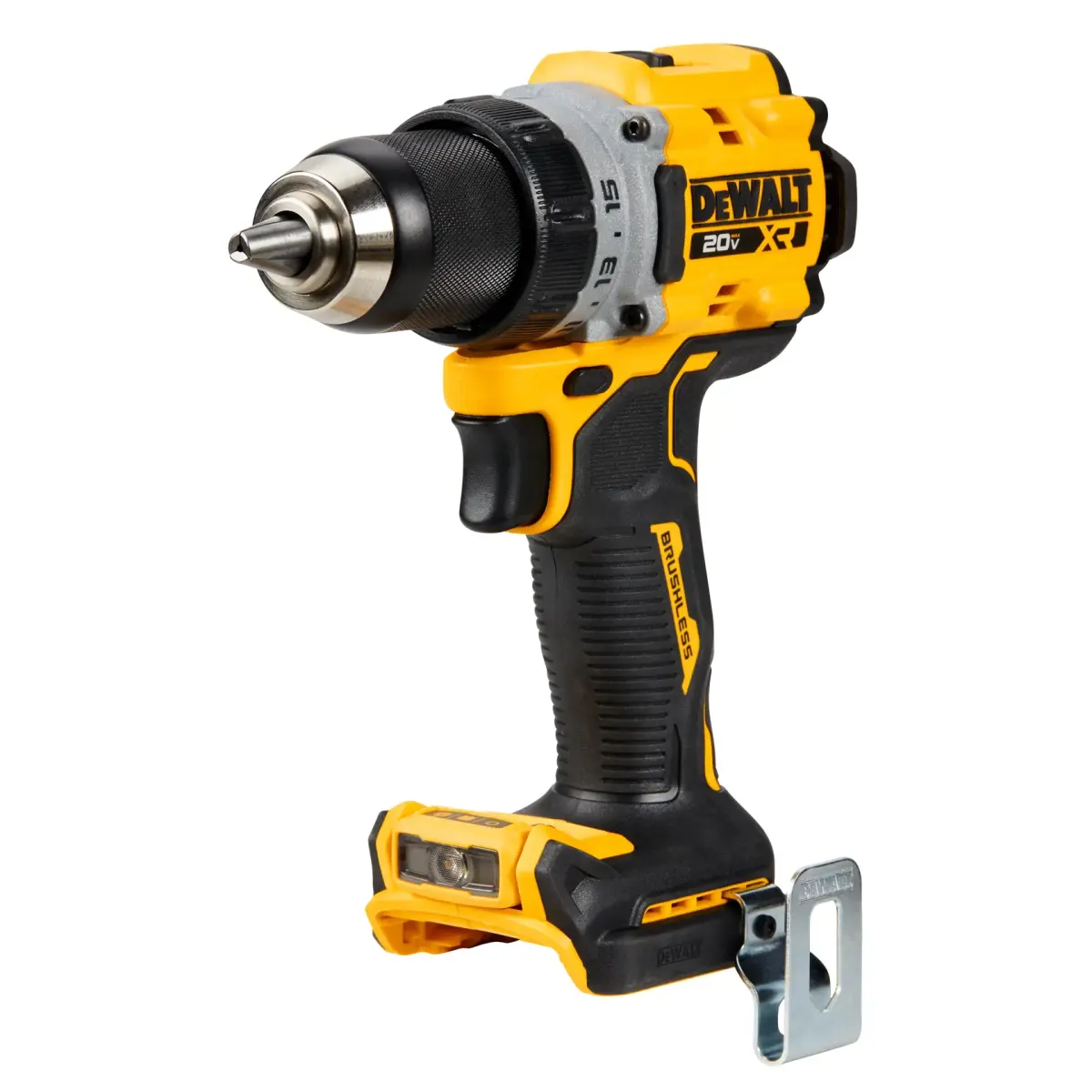
| voltage | 20V MAX (18V nominal), XR brushless |
|---|---|
| motor | Brushless |
| max Torque | Not published by DeWalt (UWO rating; ~40% over DCD791) |
| speed | 0–650 / 0–2,000 RPM (2-speed) |
| chuck | 1/2 in. metal ratcheting |
| weight | 2.82 lbs (bare tool) |
| battery | DCD800D2 kit: two 20V MAX 2.0Ah (DCB203) + DCB112 charger + bag |
| warranty | 3-year limited, 1-year free service, 90-day money-back |
Pros
- Roughly 40% more power output than the older DCD791 it replaced — strong for a compact
- Very light bare tool at 2.82 lbs and a short 6.37-inch head that gets into tight bays and boxes
- Fast 0–2,000 RPM top gear bores large holes quicker than the Makita XFD131's 1,900 RPM
- Three-mode, 3-position 70-lumen LED with a 20-minute spotlight shutoff is the best worklight in this group
- 1/2-inch metal ratcheting chuck and a precise 15-position clutch
- Backs onto the huge DeWalt 20V MAX platform shared across hundreds of tools
Cons
- DeWalt does not publish an in-lbs torque figure, which makes apples-to-apples comparison harder
- The DCD800D2 kit ships with two small 2.0Ah batteries rather than one larger pack
- Already superseded in DeWalt's lineup by the higher-output DCD801, so it is effectively last-generation
- No hammer mode — strictly a drill/driver, unlike the Milwaukee 2904 hammer drill
Who the DeWalt DCD800 is for
The DeWalt DCD800 is the compact workhorse of the 20V MAX XR line, built for the contractor or homeowner who already owns DeWalt batteries and wants a light, fast, well-balanced drill for everyday wood, metal, and fastening work. The numbers that define it are a 2.82 lb bare-tool weight, a short 6.37-inch head, a two-speed transmission running 0–650 and 0–2,000 RPM, and a brushless motor DeWalt markets as roughly 40% more powerful than the DCD791 it replaced. The number you will not find is an in-lbs torque figure, because DeWalt rates its North American drills in Unit Watts Out rather than torque — a quirk that makes cross-brand comparison frustrating.
This is a tool for the DeWalt-platform buyer first and foremost. If your jobsite or garage already runs on 20V MAX packs, the DCD800 slots in with zero friction and shares batteries with the broadest yellow-and-black lineup on the market.
Build quality and ergonomics
DeWalt nailed the compactness here. At 6.37 inches the head is among the shortest in this group — half an inch shorter than the DCD791 — and that pays off every time you work between studs, inside a panel, or up a ladder. The bare-tool weight of 2.82 lbs is the lightest in this comparison, lighter than the Makita XFD131's 3.8 lbs (measured with battery) and the Milwaukee 2904's near-5 lbs working weight. The grip is comfortable with a textured overmold, and balance with a 2.0Ah pack is excellent.
The standout feature is the worklight. DeWalt fitted a three-position, three-mode LED rated up to 70 lumens, including a spotlight mode with a 20-minute shutoff. It is genuinely the best light in this group — owners consistently report it doubles as a usable work lamp in a dark cavity. The 1/2-inch metal ratcheting chuck grips firmly and the 15-position clutch is crisp and repeatable.
Drilling and driving performance by material
In wood, the DCD800 punches well above its compact size. The low gear's 650 RPM gives strong control for large fasteners, and self-feed and spade bits pull through framing confidently thanks to the power bump over the previous generation. The 2,000 RPM high gear is a real advantage for fast pilot holes and small twist drilling.
In metal, that 2,000 RPM top end is the fastest of the three non-hammer drills here (the Makita tops out at 1,900), so it clears larger holes in steel a touch quicker with sharp bits. The brushless motor holds speed under moderate load without bogging.
For driving, the DCD800 is a confident everyday performer. It sinks 3-inch deck screws, drives cabinet and drywall fasteners without strain, and handles moderate lag screws. The catch is the missing published torque spec: in side-by-side use it feels comparable to the Makita XFD131 and Bosch GSR18V-400, which means it is well short of the Milwaukee 2904's 1,400 in-lbs when you hit large structural fasteners.
Battery and charging
The DCD800D2 kit ships with two 20V MAX 2.0Ah DCB203 batteries and a DCB112 charger. The two-small-packs approach is a trade-off: you always have a spare charging and the tool stays light, but each pack holds less than the single 3.0Ah cell Makita includes with the XFD131, so you swap more often on big jobs. The upside is flexibility — drop in a 5.0Ah or 8.0Ah pack for long runtime when you need it, or a FLEXVOLT cell that the platform also accepts. The DCB112 is a standard-rate charger, slower than Makita's 30-minute rapid unit, which is the one area the kit feels a step behind.
Value versus the other three drills
Against the Makita XFD131, the DeWalt is lighter as a bare tool and spins faster, with a clearly better worklight, but Makita's kit includes a larger 3.0Ah battery and a faster charger versus DeWalt's two 2.0Ah packs and standard charger. Power feels comparable in the hand. The decision comes down to which battery platform you own.
Against the Bosch GSR18V-400, the DeWalt is the more compact, faster-spinning tool with a better light, while the Bosch publishes a clear 400 in-lb torque figure and carries a longer 5-year tool warranty against DeWalt's 3 years. Budget buyers often find the Bosch kit cheaper; platform buyers stay with DeWalt.
Against the Milwaukee 2904, the DeWalt is far lighter and more compact but is not in the same power class — the Milwaukee's 1,400 in-lbs and hammer mode make it the choice for heavy structural work and occasional masonry. The DCD800 counters with a complete two-battery kit at a lower price, since the 2904 is a bare tool.
One more thing worth flagging: DeWalt has already launched the higher-output DCD801, so the DCD800 is effectively last-generation. That is not a knock on performance — it is still excellent — but it does mean the DCD800 frequently sells at a discount, which is exactly when it becomes a smart buy.
Final verdict
The DeWalt DCD800 rates 4.5 as a light, fast, superbly lit compact drill that is hard to fault for everyday work. It is the most compact and lightest tool here and has the best worklight in the group. The two marks against it are DeWalt's refusal to publish a torque number and the small 2.0Ah batteries in the kit. If you are on the 20V MAX platform, it is an easy recommendation — and now that the DCD801 has arrived, a discounted DCD800 is one of the better values in cordless drills. Buyers who need a headline torque spec or masonry capability should look at the Milwaukee 2904 instead.
Advertisement
Frequently asked questions
- How much torque does the DeWalt DCD800 have?
- DeWalt does not publish a maximum torque figure in in-lbs for the DCD800 — the company rates its drills in Unit Watts Out (UWO) instead and markets the DCD800 as delivering roughly 40% more power than the DCD791 it replaced. In real-world driving it sits in the same class as the Makita XFD131 and Bosch GSR18V-400, well below the high-torque Milwaukee 2904.
- What is the difference between the DCD800 and DCD791?
- The DCD800 replaced the DCD791 with about 40% more power output, a shorter 6.37-inch head, and a better three-mode LED, while keeping the same compact 20V MAX XR platform. If you are choosing today, the DCD800 (or its successor DCD801) is the better tool; the DCD791 only makes sense at a clearance price.
- What comes in the DCD800D2 kit?
- The DCD800D2 kit includes the DCD800 drill, two 20V MAX 2.0Ah DCB203 batteries, a DCB112 charger, a belt hook, and a contractor bag. Note that it bundles two smaller 2.0Ah packs rather than a single larger battery, so you swap more often but always have a spare charging.
- Is the DeWalt DCD800 a hammer drill?
- No, the DCD800 is a drill/driver with no hammer mode. For drilling into brick, block, or concrete you would need DeWalt's DCD805 hammer drill or the Milwaukee 2904. The DCD800 is optimized for wood, metal, and fastening work.
- Has the DCD800 been replaced?
- Yes, DeWalt has introduced the DCD801 with higher power output above the DCD800, so the DCD800 is now effectively the previous generation. It remains widely sold and is often discounted because of that, which can make it a strong value if you do not need the DCD801's extra output.
- Will the DCD800 work with all DeWalt 20V batteries?
- Yes, the DCD800 accepts any DeWalt 20V MAX battery, from compact 1.5Ah packs to large 5.0Ah, 8.0Ah, and FLEXVOLT cells. Larger packs add runtime and weight; the bundled 2.0Ah batteries keep the tool light and compact for overhead and detail work.
Ready to buy the DCD800?
We may earn a commission if you buy through these links, at no extra cost to you.