
Craftsman CMEPW1700 Review: Best Entry-Level Electric Washer
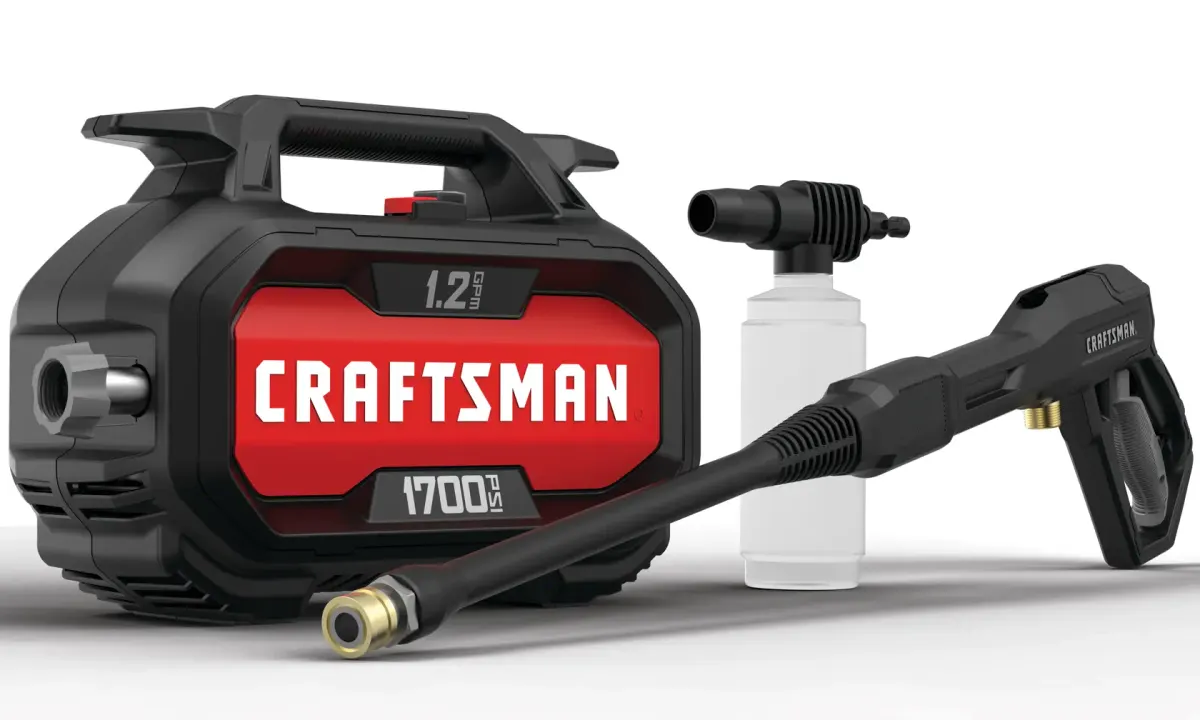
| psi | 1,700 PSI (max) |
|---|---|
| gpm | 1.2 GPM |
| motor | 13-amp universal (brush-type) motor |
| pump Type | Axial cam |
| hose Length | 20 ft. 1/4-inch high-pressure hose |
| cord Length | 35 ft. GFCI power cord |
| nozzles | 2 quick-connect nozzles: 40-degree and turbo; foam cannon also included |
| weight | 17.6 lbs |
| warranty | 3-year limited |
Pros
- At under $130, lowest entry price of any machine in this group — accessible for buyers who clean seasonally and want to avoid renting
- 17.6-lb body is genuinely lightweight and one-handed portable, easy to carry up stairs or put in a car trunk
- 35-foot GFCI power cord with 20-foot high-pressure hose provides adequate reach for most single-car driveway setups
- Axial cam pump with quick-connect nozzles and trigger lock covers the basics without extra complexity
Cons
- 1,700 PSI is the weakest output in this group — embedded stains on concrete require multiple passes and pre-treatment with detergent
- Universal brush-type motor runs hotter and will not last as long as the brushless motor in the Ryobi RY142300
- Only two nozzles included (40° and turbo) — no dedicated 25-degree general-purpose or 15-degree strip tip out of the box
- 20-foot hose is short; reaching across a two-car driveway requires moving the machine more than once
What the CMEPW1700 actually is
The Craftsman CMEPW1700 is an entry-level corded electric pressure washer built around a single premise: cover the most common light residential cleaning tasks at the lowest possible price. That premise succeeds. At $89–$130 it undercuts the Ryobi RY142300 by $100 or more and the EGO HPW3200 kit by $400+, while still producing 1,700 PSI — enough pressure to wash a car safely, rinse outdoor furniture, remove surface mold from a small deck, and keep a patio clean across a normal season.
What it does not do is clean a heavily stained concrete driveway quickly, strip paint, or match the throughput of machines two or three price tiers above it. Buyers who understand those boundaries will find the CMEPW1700 earns its price every time; buyers who do not may feel frustrated watching it struggle through an oil-soaked driveway that a gas machine would clear in 20 minutes.
Weight and portability
At 17.6 lbs, the CMEPW1700 is light enough to carry with one hand, hang from a hook in a garage, or stow in the trunk of a sedan. The compact dimensions — 17.5 inches long by 9.25 inches wide by 10.44 inches tall — mean it fits on a shelf next to typical garage storage without occupying a machine footprint. There are no wheels and no hand-truck frame; you carry it to the job and set it down. For a buyer who stores tools in an apartment closet or a small shed, this form factor is genuinely practical in a way that heavier, larger machines are not.
Performance on typical light tasks
Car washing is the task for which 1,700 PSI is arguably the best pressure in this review group. The EGO HPW3200 at 3,200 PSI peak requires active mode management and careful standoff distance to stay paint-safe. The Ryobi RY142300 at 2,300 PSI demands a 40-degree nozzle and disciplined technique. At 1,700 PSI the CMEPW1700 with the 40-degree nozzle at 12 inches is low enough risk for factory paint, rubber trim, and window seals while still providing enough force to break road grime and brake dust from wheel wells.
Outdoor furniture — plastic resin chairs, metal tables, composite loungers — cleans easily at this pressure. The lightweight machine is easy to carry around the patio rather than dragging a hose and heavy unit.
Wood decks: 1,700 PSI at the 40-degree nozzle is a safe and controlled input for most wood types. Soft pine and old, weathered cedar benefit from lower pressure that removes biological growth without lifting or fuzzing fibers. The moderate output allows slower, more deliberate passes that rinse deck cleaner thoroughly without driving excess water into board joints.
Concrete driveways: This is where the rating gap between the CMEPW1700 and higher-power machines becomes visible. Surface dirt and light mold come off fine. Embedded oil, old tire marks, and biological staining that has had years to set requires multiple passes, a degreasing pre-treatment, and more patience than the same job done with 2,300 or 3,400 PSI. The machine will get there; it just takes longer.
Hardware and accessories
The axial cam pump and quick-connect coupler are standard for this category. The GFCI cord at 35 feet is long enough to reach from a garage outlet to most single-car driveways without an extension. The 20-foot high-pressure hose is the shortest in this group — a two-car driveway will require repositioning the machine at least once per session.
Two nozzle tips (40-degree and turbo) come in the box along with a foam cannon for detergent application. The absence of a 25-degree nozzle is a minor gap that a cheap aftermarket 1/4-inch quick-connect tip fills for under $10. The turbo nozzle does useful work on concrete surfaces where the rotating concentrated stream cleans faster than the 40-degree tip.
The trigger lock prevents accidental triggering during transport or storage — a safety feature most buyers will use once to confirm it works and then ignore until a storage incident reminds them it is there.
Durability expectations
The 13-amp universal (brush-type) motor is the main durability limitation. Brush motors wear their carbon contacts against the rotor, generating heat and gradually degrading output over time. For a machine used 5 to 10 hours per year on light tasks, the motor will likely outlast the pump seals. For sustained heavy use, the brushless motor in the Ryobi RY142300 is the more durable investment. The 3-year limited warranty matches the Ryobi's coverage.
Final verdict
The Craftsman CMEPW1700 occupies a clear and useful role: it is the pressure washer for buyers who want to stop renting, need to store it in a small space, and primarily wash vehicles and furniture rather than clean full driveways. At under $130 it is the most accessible entry point in this category, and its 1,700 PSI covers light residential tasks cleanly. The short hose, brush motor, and two-nozzle kit are real limitations for heavier jobs. Buyers who know they will need more power should step up to the Ryobi RY142300 from the beginning rather than buying this machine and then replacing it a season later.
Advertisement
Frequently asked questions
- What PSI is safe for washing a car, and does the CMEPW1700 qualify?
- Safe vehicle washing stays below 2,000 PSI with a wide nozzle and adequate standoff. The CMEPW1700 at 1,700 PSI falls within that range, making it one of the safer consumer pressure washers for vehicle use. Use the 40-degree nozzle, keep the wand at 12 to 18 inches from the surface, and stay away from rubber seals and door gaps. At this PSI with the correct technique the risk of paint damage or forced water intrusion is low.
- Can the Craftsman CMEPW1700 clean a concrete driveway?
- It can remove surface dirt, light mold, and fresh staining from concrete at 1,700 PSI, but heavily embedded oil stains, old algae, and years-old grime will require multiple passes and a good concrete degreaser pre-soak. For a typical homeowner's annual driveway rinse-down the CMEPW1700 is adequate. For deep cleaning or paint-stripping work, the Ryobi RY142300 at 2,300 PSI or the DeWalt DXPW3425E gas model will cut the job time significantly.
- Is the CMEPW1700 good for cleaning a wood deck?
- Yes, and its moderate 1,700 PSI actually makes it one of the safer choices for wood surfaces. Use the 40-degree nozzle at 10 to 14 inches of standoff, move the wand continuously, and spray parallel to the grain. Lower PSI reduces the risk of raising grain, fuzzing softwood fibers, or cutting into aged or weathered boards. Apply a wood-specific deck cleaner detergent first and let it dwell before rinsing.
- Why does the CMEPW1700 only include two nozzles?
- Craftsman includes a 40-degree general-purpose nozzle and a turbo nozzle. The turbo nozzle combines the pressure concentration of a 0-degree tip with a rotating spray pattern that covers more surface area — it partially substitutes for both a 0-degree and a 25-degree tip for many tasks. If you want a full five-nozzle set, standard 1/4-inch quick-connect nozzles are widely available online for $10–$20 and fit the CMEPW1700's standard coupler.
- How does the CMEPW1700 compare to the Ryobi RY142300?
- The CMEPW1700 costs roughly half as much, weighs less than a third as much, and is easier to carry and store. The Ryobi RY142300 delivers 600 more PSI, a brushless motor, a longer hose (25 vs. 20 feet), an on-board detergent tank, and a five-nozzle set. For light tasks like car washing, rinsing furniture, and small patios, the Craftsman is the smarter purchase. For full driveway and deck sessions, the Ryobi's extra capability is worth the $100–$120 premium.
Ready to buy the CMEPW1700?
We may earn a commission if you buy through these links, at no extra cost to you.