
Ryobi TSS103 vs Metabo HPT C10FCGS Budget Miter Saw (2026)
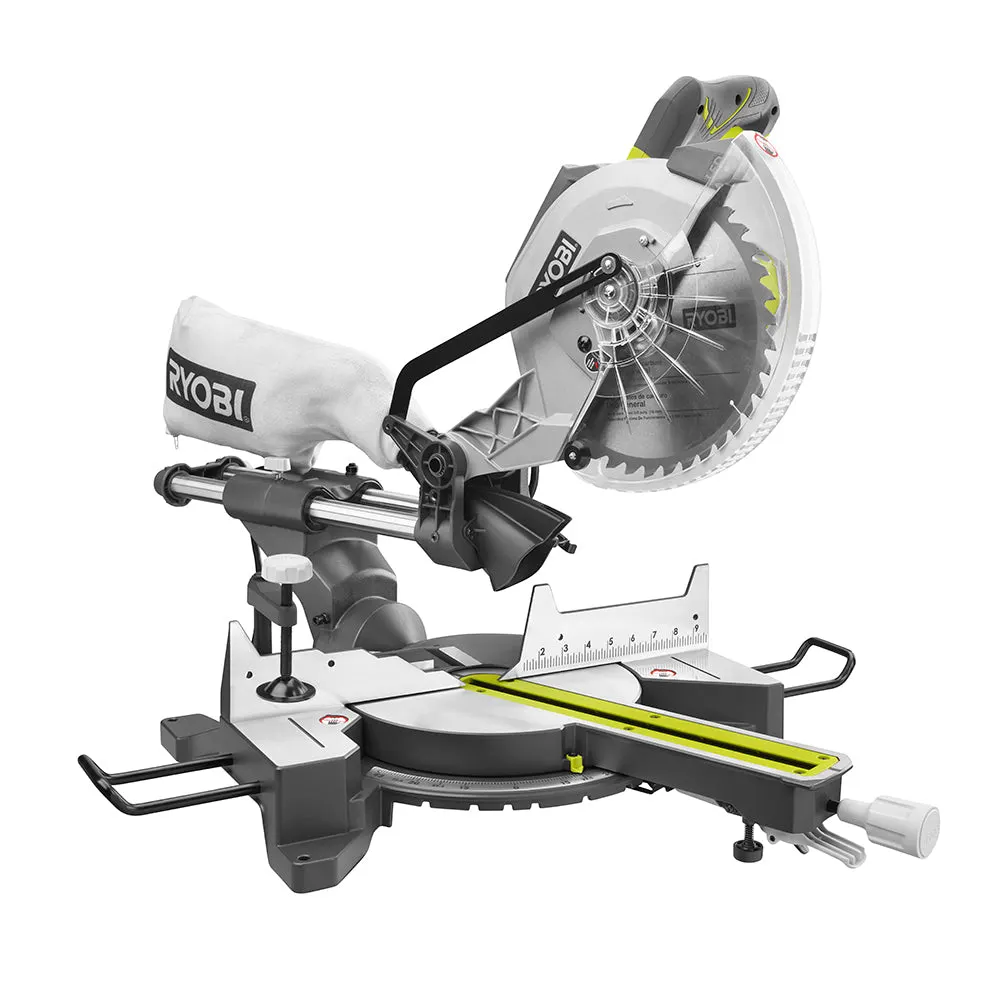
Ryobi TSS103
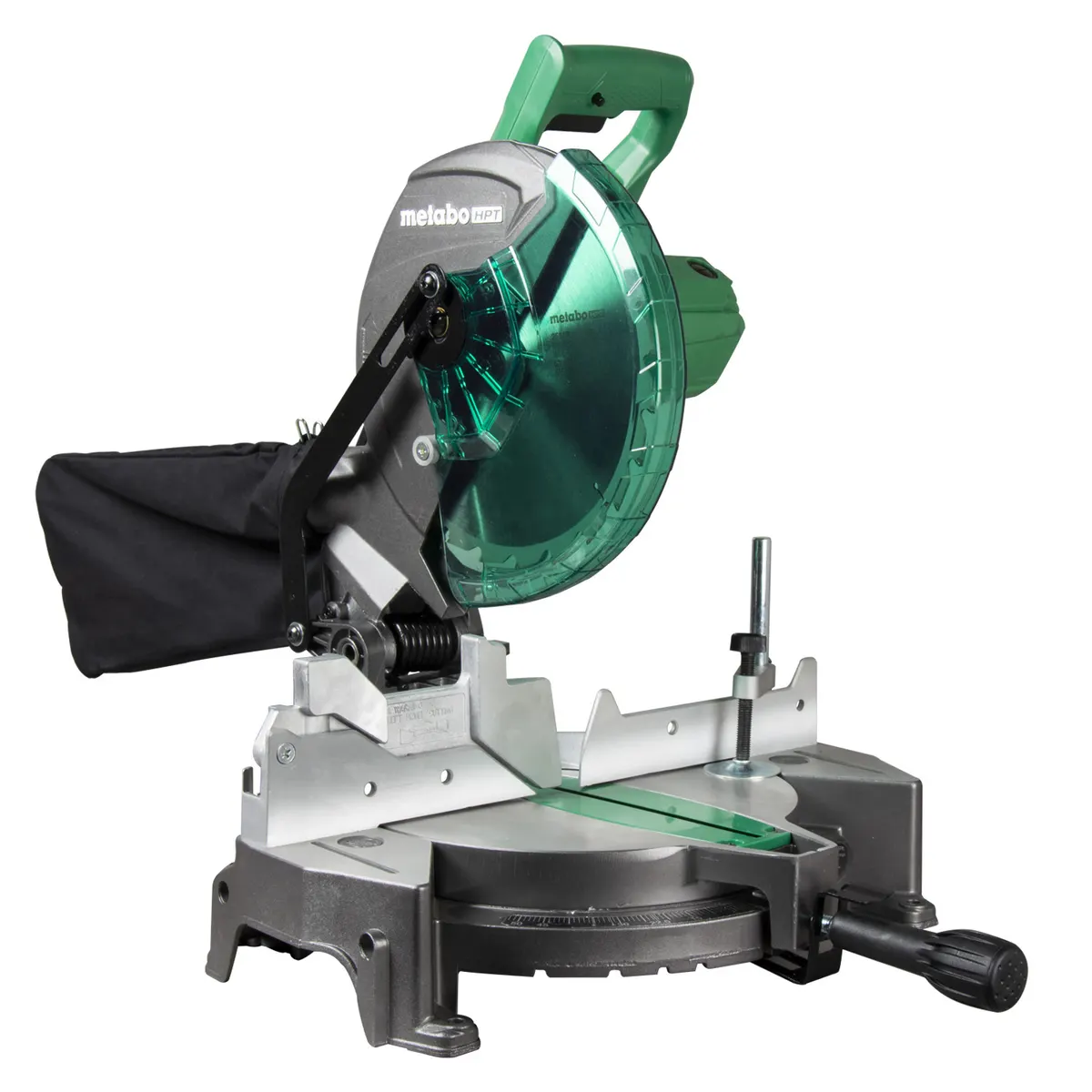
Metabo HPT C10FCGS
| Spec | Ryobi TSS103 | Metabo HPT C10FCGS |
|---|---|---|
| Blade size | 10 in. | 10 in. |
| Crosscut at 90° | Up to 12 in. | Approx. 8 in. |
| Sliding rails | Yes | No |
| Miter range | 0–47° left and right | 0–52° left and right |
| Bevel range | 0–48° (single-bevel) | 0–45° (single-bevel) |
| Motor | 15 Amp, 4,600 RPM | 15 Amp, 5,000 RPM |
| Cutline indicator | LED shadow indicator | None |
| Included blade | 10 in. 40-tooth carbide | 10 in. 24-tooth carbide |
| Weight | Approx. 28 lbs | 24.2 lbs |
| Warranty | 3-year limited | 5-year limited |
| Price range | $249–$299 | $110–$150 |
Budget tier, real-work consequences
The Ryobi TSS103 and Metabo HPT C10FCGS are both corded 10-inch single-bevel compound miter saws aimed at homeowners and light DIYers. They share the same blade diameter, the same single-bevel design, and 15-amp motors. The price gap between them — roughly $130 to $150 at full retail — is substantial relative to what both saws cost. Choosing between them starts with answering one question honestly: how wide is the material you cut most often?
If the answer is under 8 inches for all of it, the C10FCGS is the correct purchase. If any regular task involves material between 8 and 12 inches — wide baseboard profiles, 2×8 dimensional lumber, crown molding laid flat, wide door casings — the TSS103's sliding rails are the only way to complete that work on either saw.
Crosscut capacity: the primary split
The TSS103's sliding rail mechanism extends the blade's travel path to cut material 12 inches wide at 90°. Without a sliding mechanism, the C10FCGS is limited to approximately 8 inches — the fixed-arm geometry of a non-sliding saw defines an absolute crosscut limit that no amount of blade quality or motor power changes.
At 12 inches, the TSS103 cuts standard 2×10 and 2×12 dimensional lumber in a single pass. At 8 inches, the C10FCGS handles 2×6 lumber and most standard door casing profiles, but hits its limit on wider stock. For a homeowner installing 5-1/2-inch colonial base molding or wider architectural profiles, the 8-inch limit arrives before the material is centered on the blade.
The miter range is the one category where the C10FCGS reverses the advantage: 52° to the left and right versus the TSS103's 47°. For very steep picture-frame miters and unusual architectural angles, the Metabo HPT's wider miter travel gives access to angles the Ryobi cannot reach. In practice, this difference affects a small fraction of standard trim work, but it is worth noting for buyers whose projects include irregular-angle applications.
Motor speed and cutting behavior
The C10FCGS runs its blade at 5,000 RPM no-load against the TSS103's 4,600 RPM. Higher blade speed translates to faster cut cycles and marginally cleaner surface quality in softwood with a sharp blade. The 400-RPM gap is noticeable more in theory than in practice on standard trim stock, but under sustained cutting loads — running multiple molding profiles back to back — the C10FCGS's higher speed maintains better consistency through the cut.
Both saws include 10-inch carbide-tipped blades, but they differ in tooth count. The C10FCGS ships with a 24-tooth framing-grade blade; the TSS103 includes a 40-tooth carbide blade. For trim work requiring clean crosscut surfaces, the 40-tooth TSS103 blade is immediately more appropriate. Replacing the C10FCGS's 24-tooth blade with a 60-tooth or 80-tooth finish blade is the standard first upgrade — a $35–$55 expenditure that transforms cut quality on hardwood and MDF trim. That upgrade cost should be factored into the C10FCGS's effective purchase price for finish trim buyers.
The LED cutline indicator
The TSS103's LED indicator casts a blade shadow onto the workpiece before the trigger is pulled, giving the user a visual reference for cut placement. For first-time miter saw users who have not yet developed reliable eye alignment between a blade guard and a pencil mark, this feature reduces miscuts and false starts significantly. It is simpler than the DeWalt DWS780's XPS system but meaningfully better than nothing — and nothing is precisely what the C10FCGS offers for cut-line reference.
Experienced carpenters who make dozens of cuts daily develop reliable visual alignment through repetition; for them, a cutline indicator reduces cognitive overhead but is not mandatory. For a homeowner who picks up a miter saw every few months for a specific project, the LED indicator on the TSS103 reduces the margin for misread cut placements on expensive molding profiles.
Portability and long-term durability
At 24.2 lbs, the C10FCGS is genuinely portable — it can be carried from a vehicle to a work area in one hand for short distances. The TSS103's sliding mechanism and additional frame structure push its weight to approximately 28 lbs, still manageable but less so for single-hand transport. For a homeowner who moves the saw between a garage shelf and a workbench for each use, the C10FCGS's weight advantage simplifies the setup routine.
The five-year warranty on the C10FCGS is the most visible long-term ownership advantage in the comparison. At a $130 purchase price, five years of coverage extends well into the useful service life of a saw used for occasional homeowner projects. The TSS103's three-year warranty is adequate and standard for the price tier.
The budget-conscious path to sliding capacity
For a homeowner committed to the budget tier but needing more crosscut capacity than the C10FCGS provides, the TSS103 represents the most economical path to 12-inch sliding reach — roughly $250–$300 versus $500+ for professional-grade sliders. The trade-offs relative to the DeWalt DWS780 and Bosch GCM12SD are substantial: single bevel, lighter construction, functional rather than excellent dust collection, and a less refined detent system. For a homeowner tackling a room trim project annually rather than a daily production schedule, those trade-offs are appropriate to the use case.
Advertisement
Frequently asked questions
- What is the most important difference between the Ryobi TSS103 and Metabo HPT C10FCGS?
- Crosscut capacity. The TSS103's sliding rails extend the saw's reach to 12 inches of material width at 90°, while the C10FCGS is a fixed-head saw limited to approximately 8 inches. For door casing (3-1/4 inches) and narrow window trim, both saws cover the stock easily and the C10FCGS's lower price is the deciding factor. The moment you encounter wide base molding, 2×8 lumber, or crown profiles over 4 inches, the TSS103's extra reach becomes operationally necessary.
- Is the Metabo HPT C10FCGS's 5-year warranty significantly better than the Ryobi TSS103's 3-year coverage?
- The 5-year warranty on the C10FCGS is among the longest in the miter saw category and represents genuine insurance at the saw's low price — five years of defect coverage on a $130 tool is a strong value proposition. The TSS103's 3-year warranty is standard for the price tier and adequate for most homeowner use cases. For a buyer who expects light, occasional use and wants maximum peace of mind per dollar spent, the C10FCGS's warranty is a genuine differentiator. For a buyer who needs sliding crosscut capacity and will use the saw regularly, the TSS103's three-year coverage is sufficient.
- Does the Ryobi TSS103's LED cutline indicator work as well as DeWalt's XPS system?
- No. The DeWalt DWS780's XPS uses a precision LED positioned to cast the blade's exact kerf shadow, calibrated to the specific blade body. The TSS103's LED indicator is a simpler shadow system that provides useful cut-placement reference but is less precise than the XPS. The key comparison at this price tier, however, is against the Metabo HPT C10FCGS, which has no cutline reference at all. In that comparison, the TSS103's LED is a meaningful advantage for first-time miter saw users who have not yet developed an eye for blade-to-mark alignment.
- Which saw is better for crown molding?
- Neither the TSS103 nor the C10FCGS is the right tool for sustained crown molding production — both are single-bevel designs that require flipping the workpiece for opposing compound angles, a step that adds time and increases error risk compared to dual-bevel saws. Between the two, the TSS103 handles wider crown profiles (up to approximately 5-1/2 inches laid flat, versus roughly 4 inches on the C10FCGS) and the LED cutline indicator helps with compound angle verification. For occasional crown installation in a few rooms, either saw is manageable; for a full-house crown project, the DeWalt DWS780 or Bosch GCM12SD are the appropriate tools.
- How much does the $130–$150 price difference between these saws matter?
- At this end of the market, the price difference is proportionally large — the TSS103 costs roughly twice what the C10FCGS costs. If the additional crosscut capacity and LED cutline indicator are features you will use regularly, the $130–$150 premium is easy to justify. If your trim work consists entirely of stock under 8 inches wide and the saw will be used a few times a year, the C10FCGS delivers every needed capability at half the price. The decision is genuinely about matching tool capability to actual use, not about which saw is objectively better.
Ready to buy the TSS103?
We may earn a commission if you buy through these links, at no extra cost to you.