
Ryobi PBLCS300B vs Skil 5280-01 Circular Saw: Cordless vs Corded (2026)
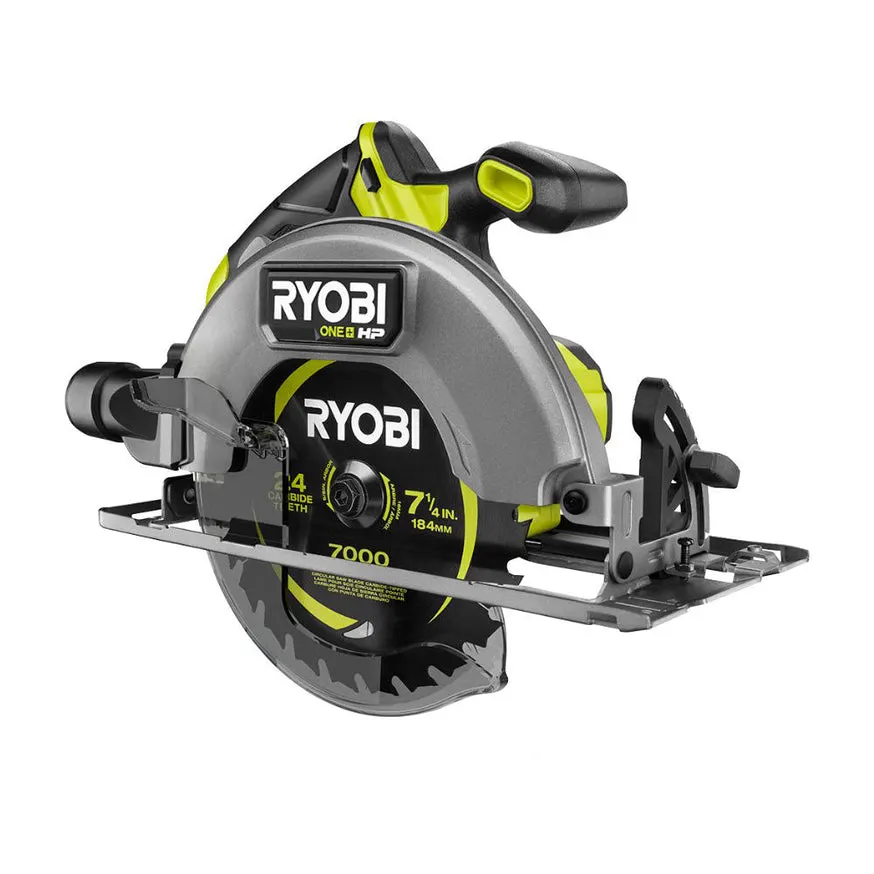
Ryobi PBLCS300B
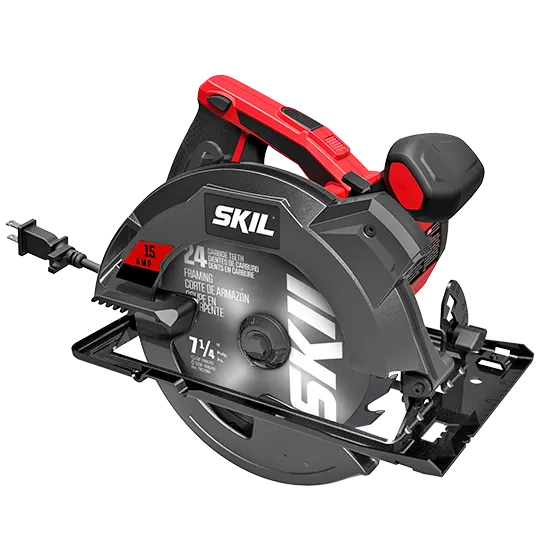
Skil 5280-01
| Spec | Ryobi PBLCS300B | Skil 5280-01 |
|---|---|---|
| No-load speed | 4,300 RPM | 5,300 RPM |
| Power source | 18V ONE+ battery (HP battery required) | 120V corded, 15 amps |
| Portability | Fully cordless | Cord-dependent |
| Bevel capacity | 0–56 degrees (6 detents) | 0–51 degrees (positive stop at 45°) |
| Depth at 90° | 2-9/16 in. | 2-7/16 in. |
| Shoe material | Composite (reinforced) | Stamped steel |
| Laser guide | None | Single-beam laser |
| Electric blade brake | Not specified (standard cordless) | No — blade freewheels after trigger release |
| Weight | 6.6 lbs (bare tool) | 8.7 lbs |
| Bare tool / saw price | $79–$90 | $65–$80 |
Cordless versus corded: the fundamental question
The Ryobi PBLCS300B and the Skil 5280-01 are at opposite ends of the circular saw market's most fundamental design divide — one runs on a battery, the other runs on a cord. Everything else in this comparison flows from that primary difference: the Skil's higher blade speed, lower price, and unlimited runtime are all consequences of drawing from wall power; the Ryobi's lighter weight, wider bevel range, and location flexibility are all consequences of running on a rechargeable pack.
For a buyer who has already decided they need a cordless saw, the Ryobi is the answer and this comparison is academic. For a buyer who has not yet decided, working through the use-case honestly is the starting point.
Where the Skil's speed advantage shows up
The Skil 5280-01 turns its blade at 5,300 RPM no-load — 1,000 RPM faster than the Ryobi's 4,300 RPM. That gap is a direct result of the power source: a 15-amp, 120V circuit delivers roughly 1,800 watts of continuous input, sustaining blade speed through hard material in a way no current 18V battery pack can match continuously. The Ryobi's brushless HP motor is efficient for its class, but brushless motor efficiency at 18V still operates within the energy density limits of a rechargeable cell.
In practice, the speed difference shows up in three ways. First, on cross-grain cuts in dimensional lumber, higher blade speed produces less tearout because each tooth contacts and exits the fiber faster. Second, through dense or wet material — pressure-treated 5/4 decking, green Douglas fir — the Skil maintains its speed more consistently than the Ryobi, which shows a measurable RPM drop through high-resistance material on a partially discharged battery. Third, cut efficiency: the Skil covers the same cut distance faster, which adds up over hundreds of cuts.
For a homeowner making occasional project cuts in dry SPF framing lumber, neither of these distinctions changes the outcome meaningfully. For a contractor making 200 cuts a day in varied material, the speed advantage is real.
The Ryobi's physical advantages
At 6.6 lbs bare, the PBLCS300B is 2.1 lbs lighter than the Skil's 8.7 lbs. Cordless saws shed weight partly because they do not carry a 120V motor and its associated mass, and the Ryobi's HP brushless design is among the lighter 7-1/4-inch cordless saws in its price tier. That weight difference is felt immediately overhead, on a ladder, and on an extended cut session where the arm supports the saw's full weight.
The 56-degree bevel range is a genuine standout specification for a saw at the Ryobi's price. The Skil tops out at 51 degrees. Those extra 5 degrees cover some hip-roof rafter angles and certain compound cuts that the Skil cannot reach. The Ryobi also provides six bevel detents at 0, 15, 22.5, 30, 45, and 56 degrees — more reference stops than the Skil's single positive detent at 45 degrees.
The Skil's included features and cost advantage
At $65–$80, the Skil 5280-01 costs approximately $15 less than the Ryobi's bare tool at $79–$90. But the real cost comparison is system cost: a first-time ONE+ buyer who needs both the saw and a battery should budget $79–$90 for the saw plus $60–$70 for a HIGH PERFORMANCE 4.0Ah pack — roughly $140–$160 total. The Skil delivers full capability at $70 with nothing else required.
For a ONE+ user who already owns compatible batteries, the Ryobi is competitive at its $79–$90 bare price, but the Skil still wins on speed and laser. The Skil's single-beam laser guide — included at this price — provides a cut-reference line that the Ryobi completely lacks. For freehand cuts on large panels without a fence, the laser reduces the sustained concentration required to track a pencil line.
Shoe and structural quality
Neither saw's shoe is a structural highlight. The Skil uses stamped steel — functional, square from the factory, but prone to flexing under sustained lateral pressure during long rips. The Ryobi uses a reinforced composite design that is flat and adequate for most tasks but similarly lacks the dimensional stability of aluminum or magnesium. Both represent honest construction for their respective price classes, and neither is the right tool for precision trim or cabinet work where the shoe is a reference surface.
The decision framework
The correct saw between these two depends entirely on where and how it will be used, not which has the better specification list.
Choose the Skil 5280-01 if the work happens near an outlet — a garage shop, a driveway project, a concrete slab, or any fixed location where an extension cord is a minor setup step rather than a daily inconvenience. The Skil's 5,300 RPM, included laser, and half the system cost of the Ryobi make it the straightforward winner for outlet-adjacent work.
Choose the Ryobi PBLCS300B if the work requires location freedom — roofing, elevated framing, second-floor decks, finished-space remodels where an extension cord across a floor is a tripping hazard, or large job sites where the nearest outlet is 75 feet away. Cordless convenience at this quality level cannot be replicated by a corded saw, and the Ryobi's brushless HP motor, 56-degree bevel range, and 6.6-lb weight are genuine strengths for that use case.
Advertisement
Frequently asked questions
- Is the Ryobi PBLCS300B worth the extra cost over the Skil 5280-01?
- If you cut near an outlet — a workshop, a concrete slab, or any fixed project area — the Skil delivers more blade speed at a lower price and the cord is a minor inconvenience at most. If you cut on a ladder, a roof, a second-floor deck, or anywhere an extension cord is a real constraint, the Ryobi's cordless freedom is worth every dollar of the premium. The honest question is: where will you actually use the saw?
- Why is the Skil 5280-01 faster than the Ryobi PBLCS300B?
- The Skil draws power from a 15-amp, 120V circuit that delivers approximately 1,800 watts of continuous input to a brushed motor — far more than an 18V battery pack can sustain during a cut. At 5,300 RPM, the Skil's blade tip moves faster than the Ryobi's 4,300 RPM, producing cleaner exit faces on cross-grain cuts and maintaining speed through denser material. The Skil's blade speed also never decreases — it is the same on cut 500 as on cut 1, while a battery-powered saw gradually loses RPM as the pack discharges.
- Does the Ryobi PBLCS300B need a HIGH PERFORMANCE battery?
- The brushless HP motor in the PBLCS300B works with any 18V ONE+ battery, but the HP designation indicates the motor is wound to draw more current than standard ONE+ tools, and it delivers its rated performance only with HIGH PERFORMANCE batteries. Running the saw on a standard ONE+ pack reduces sustained power and increases the RPM drop under load. For framing work and sustained ripping, budget for at least one HIGH PERFORMANCE 4.0Ah or 6.0Ah battery — which pushes the effective entry cost to $140–$160 for a first-time ONE+ buyer.
- Which saw is better for cutting plywood?
- For rough plywood cuts in a garage or workshop, both saws perform adequately — the Skil's higher blade speed actually reduces tearout on cross-grain cuts with a sharp 40-tooth blade. For large sheet goods where portability is needed — cutting panels in a room during a remodel, sizing flooring strips on a job site — the Ryobi's cordless convenience prevents the cord-management friction of a long run from the nearest outlet. For finish plywood where edge quality matters, both saws benefit from a quality fine-tooth blade, and neither approaches a track saw for precision.
- What is the Skil 5280-01's laser guide actually useful for?
- Skil's single-beam laser projects a line parallel to the blade's cut path, giving a visual reference for freehand cuts on large sheets and dimensional lumber. The laser is most useful for long freehand cuts across plywood sheets where following a pencil line without drifting requires sustained concentration. It is not a precision instrument — parallax and vibration affect accuracy — and for cuts referenced to a speed square, fence, or guided measurement, the laser adds no value. At the 5280-01's price, including a laser at all is a genuine bonus.
Ready to buy the 5280-01?
We may earn a commission if you buy through these links, at no extra cost to you.