
RIDGID HD1600 vs Craftsman CMXEVBE17595: 16-Gal Shop Vac Showdown
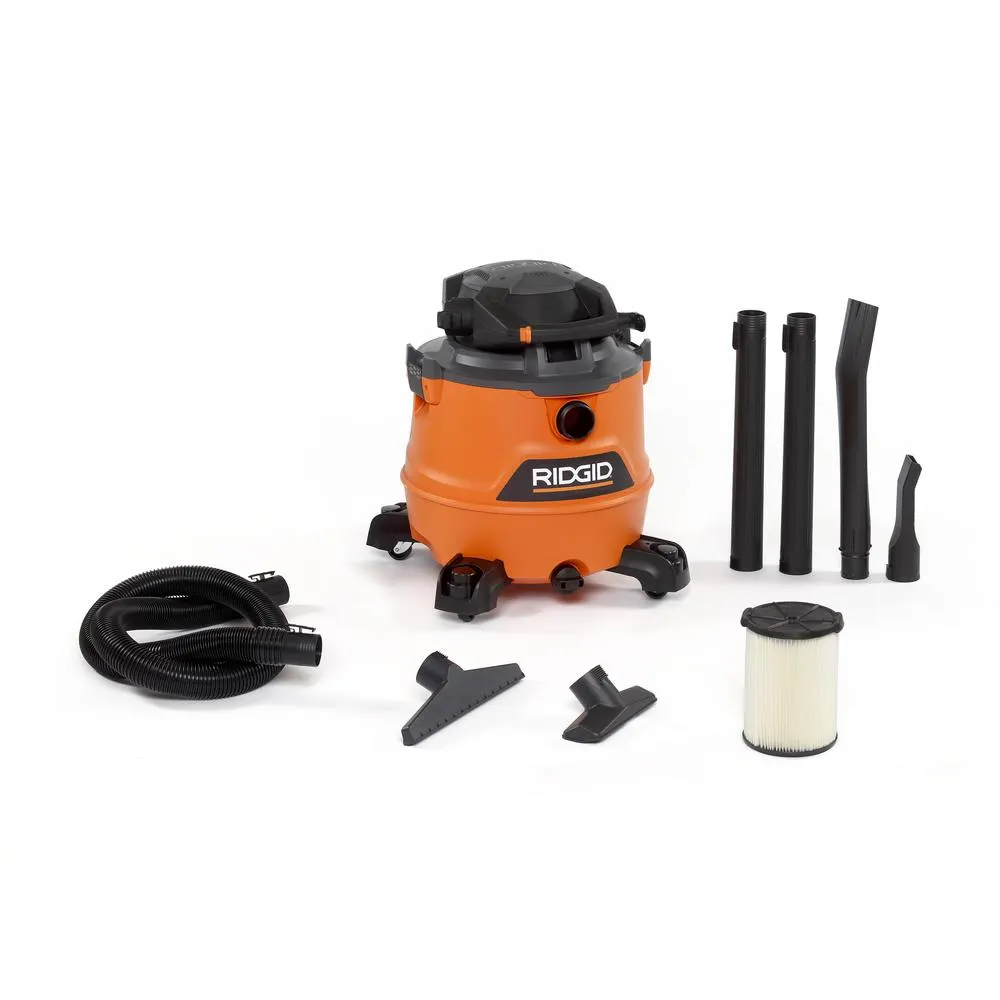
RIDGID HD1600
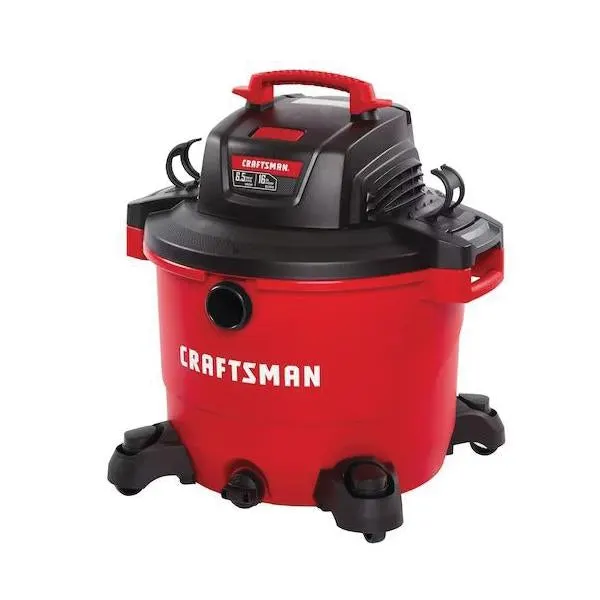
Craftsman CMXEVBE17595
| Spec | RIDGID HD1600 | Craftsman CMXEVBE17595 |
|---|---|---|
| Capacity | 16 gallons | 16 gallons |
| Peak HP | 6.5 peak HP | 6.5 peak HP |
| Airflow | 161 CFM | 177 CFM (at drum) |
| Hose | 2-1/2 in. x 7 ft. Dual-Flex locking hose | 2-1/2 in. x 7 ft. Dual-Flex hose |
| Cord | 20 ft. | 20 ft. |
| Blower | Detachable blower module + rear blower port | Rear blower port only |
| Drain port | Standard bottom-mount drain | Extra-large bottom drain port |
| Weight | 24.5 lbs (empty) | 26 lbs (empty) |
| Warranty | Lifetime warranty on vacuum | 3-year limited |
| Price range | $140–$160 | $80–$110 |
Same capacity, different value propositions
The RIDGID HD1600 and Craftsman CMXEVBE17595 share a specification foundation that is easy to mistake for interchangeability: both are 16-gallon, 6.5 peak HP wet/dry vacuums with 2-1/2 inch Dual-Flex hoses, 20-foot power cords, and accessory ecosystems distributed through major home-center chains. At a glance the spec sheet comparison ends the discussion before it starts. In practice, the two machines diverge sharply on three dimensions that matter over the life of a garage tool: blower versatility, warranty depth, and price.
Understanding those three differences — and which matters to your specific use case — is what separates a purposeful purchase from regret in either direction.
The detachable blower: RIDGID's clearest advantage
The feature that justifies most of RIDGID's price premium is the detachable blower module. The motor housing separates from the drum, clips onto a nozzle wand, and becomes a handheld blower capable of clearing sawdust off workbench surfaces, blowing debris from gutters, and dispersing leaves on a deck. The blower nozzle is included in the box, making this a two-tool machine from day one.
Craftsman's CMXEVBE17595 has a rear blower port on the drum that reverses airflow for stationary blowing tasks. It works — you can position the drum, attach a wand, and blow sawdust from a bench. But the machine stays tethered to the drum and the 20-foot cord. RIDGID's detachable design lets you carry the motor housing untethered to the vacuum drum, which is what makes it genuinely useful for gutters, tight corners, and outdoor areas away from the vacuum drum's position.
For buyers who already own a leaf blower, this distinction may carry little weight. For buyers without one, it removes the rationale for a second purchase.
Warranty: lifetime versus 3 years
RIDGID's lifetime warranty on the vacuum itself has no expiration date, no mileage cap, and no deductible. If the motor fails in year twelve, RIDGID replaces it. Craftsman's 3-year limited warranty is standard for the category but means you own the repair bill after year three on a tool that typically lasts a decade or more.
For a $150 garage appliance that sees renovation seasons, annual basement flooding events, and periodic wet work over its service life, the warranty gap is meaningful — not abstract. The RIDGID's guarantee effectively lowers its lifetime cost below the Craftsman's if you keep it for more than a few years.
Drain port and wet-pickup edge: Craftsman
Craftsman reverses the advantage in one specific scenario: draining a full drum after wet pickup. The CMXEVBE17595's extra-large bottom drain port flows faster and makes floor-level emptying into a drain more convenient than RIDGID's standard drain fitting. If you regularly use your shop vac for basement flooding, post-storm cleanup, or vehicle interior water extraction, the Craftsman's drain saves real time on each emptying cycle.
This is a narrow edge — the RIDGID's drain works, just not as quickly. For dry-debris-primary users, it is irrelevant. For wet-work-frequent users, it is one of the few spec categories where the Craftsman wins outright.
Airflow numbers in context
Craftsman's 177 CFM drum measurement sits above RIDGID's 161 CFM. Both figures are measured at the drum inlet under controlled conditions, not at the floor tool under a real 20-foot hose run. The practical suction difference through a fully extended hose and accessory is negligible for typical renovation and shop cleanup work. Both machines pull construction debris, wood chips, and coarse sawdust through their hoses without hesitation. For fine-dust collection at power tool ports — where CFM at the nozzle matters precisely — neither machine's drum-measured rating predicts real-world fine-dust capture accurately, and both benefit from a HEPA filter upgrade regardless of rating.
Hose construction: locking versus standard
RIDGID's Dual-Flex hose has a twist-lock connection at the drum inlet that resists pull-off during aggressive work — dragging the hose around a renovation site while demolishing drywall is where that lock earns its value. Craftsman's hose is also Dual-Flex construction with the same 180-degree flex at both ends, but the connection at the drum is a friction fit rather than a positive lock. Both hoses resist kinking and crushing well; the RIDGID's locking connection is the more secure design for heavy-duty drag use.
Who should buy which
Buy the RIDGID HD1600 if you use a shop vac as a regular workshop tool, want the lifetime warranty to eliminate replacement cost anxiety, plan to use the detachable blower as a second tool function, or are doing renovation work where the locking hose connection matters. At $140–$160 it is a tool that stays relevant for a decade or longer.
Buy the Craftsman CMXEVBE17595 if price is a genuine constraint, your shop vac sees only seasonal or occasional light use, the faster drain port is important for your specific wet-work needs, or you prefer shopping at Lowe's. The $80–$110 price makes it one of the best-value 16-gallon shop vacs available at a major retailer, and for occasional-use homeowners the 3-year warranty covers the most likely failure window.
Both machines handle the same category of work. The decision is really about how much that work demands of the machine and over what time horizon the cost comparison needs to hold.
Advertisement
Frequently asked questions
- Is the RIDGID HD1600 worth the extra cost over the Craftsman CMXEVBE17595?
- For most buyers who use their shop vac regularly, yes. The RIDGID's lifetime warranty means you never pay to replace the machine as long as you own it — a meaningful difference versus Craftsman's 3-year coverage on a tool that lives through annual renovations and garage cleanups for a decade or more. The detachable blower adds a second tool function that would otherwise require a separate purchase. If your shop vac sees only occasional seasonal use and the $40–$60 price gap matters to your budget, the Craftsman is a capable choice.
- Which has better suction, the RIDGID HD1600 or Craftsman CMXEVBE17595?
- Craftsman's 177 CFM drum measurement is higher than RIDGID's 161 CFM on paper, but both figures are measured at the drum under controlled conditions rather than at the hose tip under working load. Real-world suction through a long hose is comparable between the two. Neither machine is measured at the nozzle under load, which is the figure that would matter most for tool-side dust collection. Both perform similarly for renovation debris and floor cleanup at normal hose lengths.
- Does the Craftsman CMXEVBE17595 have a blower function?
- The CMXEVBE17595 has a rear blower port that lets you reverse airflow for leaf and light debris clearing without any tools — useful for blowing sawdust off benches and clearing patios. It does not have RIDGID's detachable blower module, which separates the motor housing from the drum to create a standalone handheld blower. The RIDGID's detachable approach is more versatile; the Craftsman's rear port is adequate for stationary blowing tasks.
- Which shop vac is better for wet pickup, the RIDGID or the Craftsman?
- Both handle wet pickup equally well as full wet/dry machines — remove or swap the filter, and either drum collects standing water. The Craftsman has a meaningful edge in one specific detail: its extra-large bottom drain port empties a full drum of water faster than RIDGID's standard drain port. For users who anticipate frequent large-volume wet work — basement flooding, post-storm garage cleanup — the Craftsman's drain design saves meaningful time over a season of use.
- Which filter system is better, RIDGID or Craftsman?
- Both use a Qwik-Lock quarter-turn collar for tool-free filter changes, and both use standard cartridge filters for dry debris and foam sleeves for wet work. Upgrades to HEPA-rated cartridges are available for both brands at comparable costs. RIDGID sells the VF6000 HEPA cartridge at Home Depot; Craftsman sells its HEPA-rated upgrade through Lowe's. Neither brand has a filtration advantage over the other at the same filter tier.
Ready to buy the HD1600?
We may earn a commission if you buy through these links, at no extra cost to you.