
Milwaukee 2731-20 vs DeWalt DCS573B Cordless Circular Saw (2026)
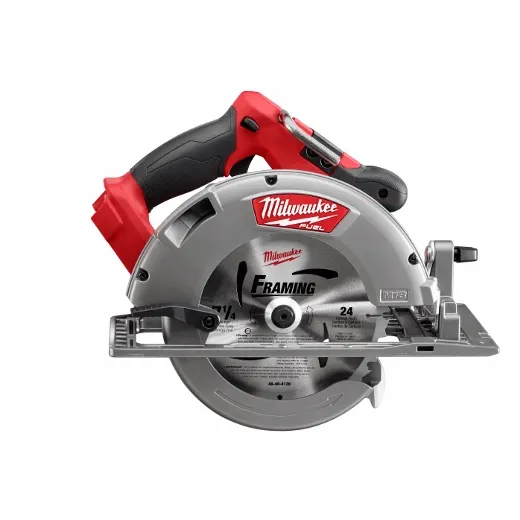
Milwaukee 2731-20
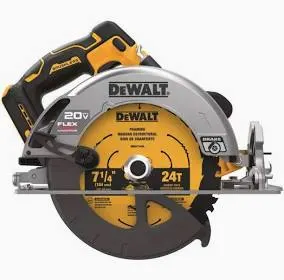
DeWalt DCS573B
| Spec | Milwaukee 2731-20 | DeWalt DCS573B |
|---|---|---|
| No-load speed | 5,000 RPM | 5,500 RPM |
| Bevel capacity | 0–50 degrees | 0–57 degrees |
| Depth at 90° | 2-1/2 in. | 2-9/16 in. |
| Depth at 45° | 1-7/8 in. | 2 in. |
| Weight (bare) | 7.5 lbs | 8.2 lbs |
| Shoe material | Magnesium | Aluminum |
| Electric brake | Yes | Yes |
| FLEXVOLT / dual-voltage | No (M18 only) | Yes — FLEXVOLT Advantage scales power with 60V pack |
| Published runtime | 300 cuts/charge (XC5.0) | Not stated; similar with comparable pack |
| Battery platform | M18 REDLITHIUM / FUEL ecosystem | 20V MAX / FLEXVOLT |
Platform loyalty and performance specs, both in the same sentence
The Milwaukee 2731-20 and the DeWalt DCS573B exist at the same price point, in the same tool category, competing for the same professional buyer — and they split the relevant specifications almost evenly. One saw is lighter. The other cuts faster and bevels further. One has the most widely used professional battery ecosystem in North America; so does the other. This comparison resolves to a draw at the top level, which means the details matter more than they do in most matchups.
Both are 7-1/4-inch brushless 18V/20V cordless circular saws retailing in the $180–$260 range as bare tools. Both include electric brakes, rafter hooks, and LED work lights. Neither will leave a professional framer or serious DIYer wanting. The specification gaps exist and they have real-world consequences — but only in specific use scenarios that may or may not describe your work.
Speed, depth, and bevel: the DeWalt's specs advantage
At 5,500 RPM no-load, the DCS573B spins its blade faster than the Milwaukee's 5,000 RPM. Blade speed correlates with cut surface quality and throughput speed in dense materials — each tooth contacts the wood faster, leaving a cleaner exit face on cross-grain cuts and maintaining momentum through knots and wet fiber better than a slower blade. For a framing contractor ripping wet pressure-treated lumber all day, the speed difference is perceptible; for standard dry SPF cuts, both saws feel comparable.
The DCS573B's 2-9/16-inch depth at 90 degrees edges out the Milwaukee's 2-1/2 inches by 1/16 of an inch — a negligible gap in practice, as both saws clear standard 2x framing lumber with margin to spare. The DeWalt's 57-degree bevel capacity is a more meaningful advantage, covering hip-roof rafter geometry and compound angles that the Milwaukee's 50-degree limit cannot reach. For contractors whose work includes steep-pitch roofing, the DeWalt's extra 7 degrees of bevel travel is operationally significant.
Weight and construction: the Milwaukee's physical advantage
At 7.5 lbs bare, the 2731-20 is 0.7 lbs lighter than the DCS573B. That margin feels abstract on a specification sheet and concrete in the arm after four hours of vertical cuts on a wall-framing session. Magnesium construction — both the shoe and the upper and lower blade guards — contributes to that weight reduction while maintaining the rigidity and impact resistance that aluminum alternatives provide. The Milwaukee's compact body fits between 16-inch on-center studs and enters roof cavities more comfortably than a heavier saw.
Milwaukee's 300-cuts-per-charge figure with an XC5.0 battery represents a full half-day of residential framing cuts without a pack swap — reasonable for a single-family site where M18 packs are rotating on chargers throughout the day.
FLEXVOLT Advantage: the DeWalt's scalability
The DCS573B's FLEXVOLT Advantage circuitry draws more current from a 60V FLEXVOLT battery than from a standard 20V MAX pack, boosting sustained power through dense lumber and extending runtime on large-capacity 60V cells. For a DeWalt contractor who already runs FLEXVOLT packs in a DCS577B worm-drive or a DCS374B band saw, the DCS573B benefits from those same batteries at no additional cost. The upgrade path is genuinely open-ended.
The Milwaukee 2731-20 runs exclusively on M18 batteries — REDLITHIUM compact through HIGH OUTPUT HD12.0. The platform is broad and the battery selection is deep, but there is no voltage-scalability equivalent to FLEXVOLT within M18. A HIGH OUTPUT 12.0 pack extends runtime substantially, but the motor's operating voltage stays at 18V regardless of pack size.
The bottom line for a fresh buyer
For a contractor starting fresh without a battery investment, the decision rationally comes down to which platform supports the broadest range of tools they plan to buy. Both M18 and 20V MAX are reasonable anchors for a full cordless system. The Milwaukee's 0.7-lb weight advantage and magnesium construction make it the better choice for constant-carry work where arm fatigue matters over a full day. The DeWalt's wider bevel range and FLEXVOLT scalability make it the better choice when steep-pitch bevel cuts occur regularly and existing FLEXVOLT packs are on the truck already.
For the majority of residential framing and renovation work — crosscutting dimensional lumber, ripping sheet goods, making standard bevel cuts for typical roof pitches — both saws deliver equivalent capability and the battery platform you already own is the correct deciding factor.
Advertisement
Frequently asked questions
- Which saw is lighter, the Milwaukee 2731-20 or the DeWalt DCS573B?
- The Milwaukee 2731-20 is lighter at 7.5 lbs bare compared to the DeWalt DCS573B at 8.2 lbs — a 0.7-lb difference. That gap matters most during overhead cuts, vertical cuts on a wall, and extended raftering sessions where arm and wrist fatigue accumulate over hours. For bench cuts with adequate material support, the weight difference is rarely a practical concern. Both saws benefit from a quality workbelt hook between cuts to reduce hold time.
- What is the FLEXVOLT Advantage on the DeWalt DCS573B and does it matter?
- FLEXVOLT Advantage is circuitry in the DCS573B that draws additional current when a 60V FLEXVOLT battery is installed, boosting power output by up to 77% compared to a standard 20V MAX pack. The practical result is faster cut speeds through dense lumber, better sustained RPM under load in wet or pressure-treated material, and more cuts per charge from a large-capacity 60V pack. For a DeWalt user who already owns FLEXVOLT batteries from a reciprocating saw, band saw, or other FLEXVOLT-compatible tool, the upgrade is free — and meaningfully expands the DCS573B's range.
- Does the Milwaukee 2731-20's 50-degree bevel limit matter?
- For most residential framing and general carpentry, 50 degrees covers every common rafter angle and standard bevel cut. The DeWalt DCS573B's 57-degree maximum becomes relevant for hip-roof rafter cuts at steep pitches, compound-angle work on deck ledgers, and some specialty millwork. If your work regularly involves bevel angles beyond 50 degrees, the DeWalt's wider range is a genuine advantage. If your work is standard wall framing, floor decking, and conventional rafter cuts, 50 degrees is sufficient and the Milwaukee's weight advantage is more practically useful.
- Is the magnesium shoe on the Milwaukee better than the aluminum shoe on the DeWalt?
- Both magnesium and aluminum are stiffer and more precise than stamped steel, and both hold their reference plane under the lateral forces of long rip cuts better than composite materials. Magnesium is lighter than aluminum — contributing to the Milwaukee's weight advantage — while aluminum is slightly more resistant to denting and surface gouging from contact with rough materials. For practical jobsite use, the shoe material difference between these two saws is less significant than their weight and blade-speed differences.
- Should I buy the Milwaukee 2731-20 if I am new to cordless tools?
- If you are starting fresh with no battery investment, the choice should also account for the full M18 tool lineup you plan to build. Both M18 and 20V MAX are enormous platforms with hundreds of compatible tools, so neither represents a dead end. Buy into the system whose tool selection best matches your anticipated needs beyond the circular saw — impact drivers, drills, reciprocating saws, and work lights will all use the same batteries, so the saw's merits are only part of the platform decision.