
Milwaukee 2724-20 vs Makita XBU02Z: Platform Angle on Cordless Blowers
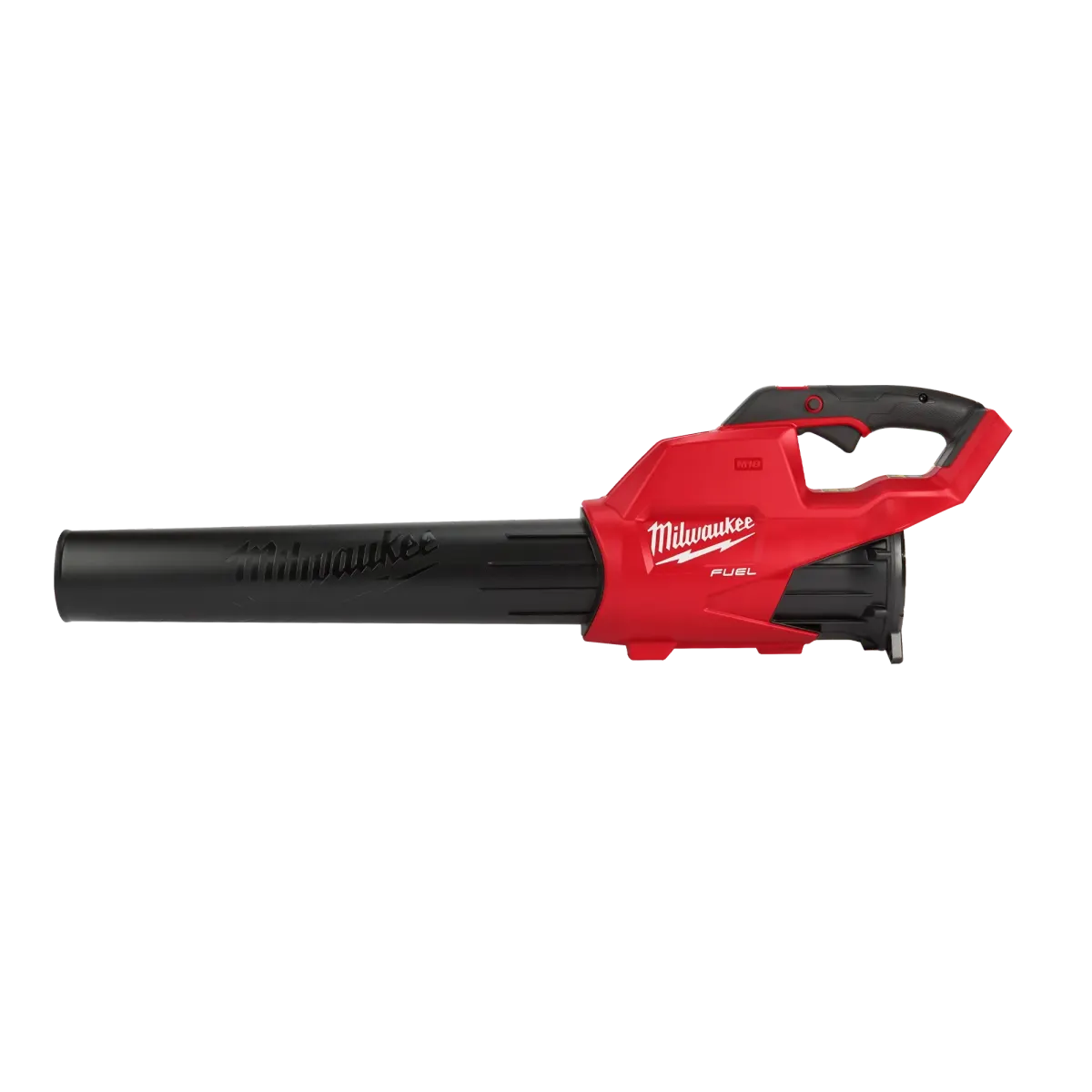
Milwaukee 2724-20
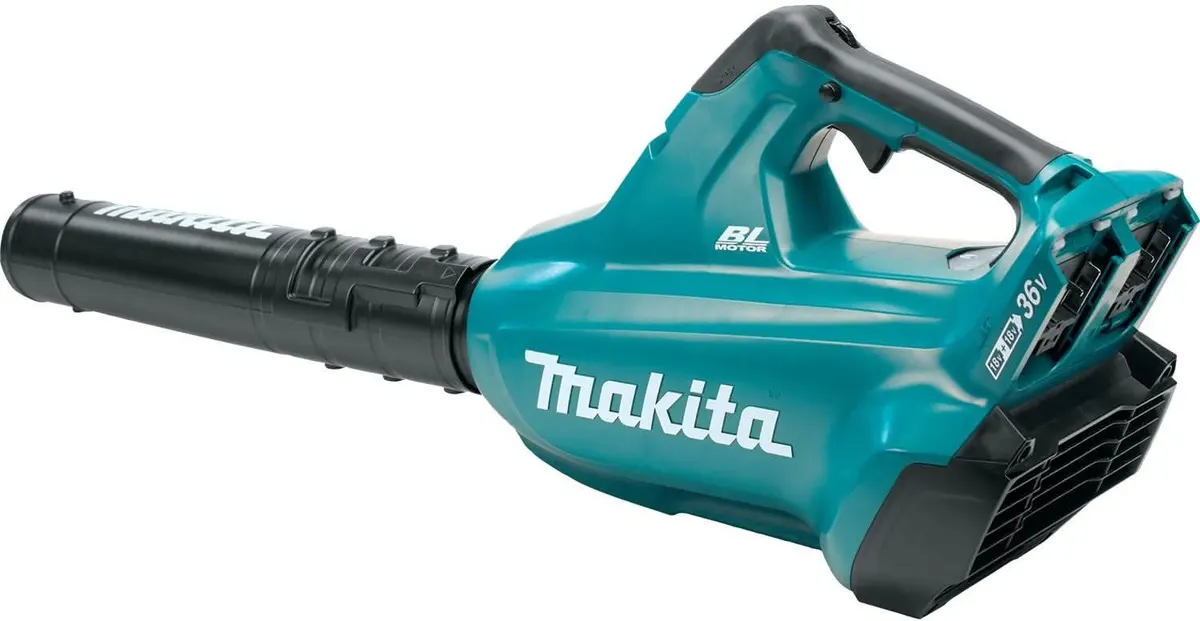
Makita XBU02Z
| Spec | Milwaukee 2724-20 | Makita XBU02Z |
|---|---|---|
| Air volume | 450 CFM | 473 CFM |
| Air velocity | 120 MPH | 120 MPH |
| Voltage / architecture | 18V M18 REDLITHIUM | 36V (two 18V LXT) |
| Bare tool weight | 5.2 lbs | 9.0 lbs (with two 5.0Ah batteries) |
| Noise level | 62 dBA | 61 dB(A) per ANSI B175.2 |
| Throttle response | Full throttle in under 1 second | 3-position dial, no burst delay |
| Speed control | Variable trigger + lock-on button | 3-position dial |
| Batteries required | 1 × M18 | 2 × 18V LXT |
| Runtime (5.0Ah) | ~30–40 min at moderate speed | Up to 28 min at speed 3 (two 5.0Ah) |
| Platform tool count | 200+ M18 tools | 300+ LXT tools |
The platform angle: why this matchup is unique
Comparing the Milwaukee 2724-20 and Makita XBU02Z reveals one of the more interesting structural contrasts in cordless blowers. Milwaukee built the 2724-20 as a single 18V product — light, fast-starting, and deployable with any M18 pack from a 2.0Ah compact to a 12.0Ah High Output. Makita built the XBU02Z on a dual-18V architecture, pairing two standard LXT batteries in series to achieve 36V output from a platform that otherwise tops out at 18V per tool.
This architectural choice shapes everything downstream: weight, battery investment, platform compatibility, and the specific users each tool is built to serve. Neither approach is universally superior, and the correct choice depends almost entirely on which platform you already operate within.
CFM and air velocity comparison
The Makita produces 473 CFM at 120 MPH; the Milwaukee produces 450 CFM at 120 MPH. Air velocity is equal, and air volume is close — the Makita's edge is 23 CFM, approximately 5 percent more volume at matched velocity. At matching settings the two tools feel nearly identical pushing dry leaves across open grass.
The gap matters more in aggregate over a larger clearing area. On a quarter-acre suburban lot with standard fall leaf accumulation, the Makita's higher volume completes a sweep slightly faster, which over a 30-minute session may mean finishing with battery capacity to spare versus needing a second pass on the Milwaukee. For a small lot with a detached garage or a modest deck, 450 CFM is entirely adequate and neither user would sense a practical limitation.
Neither machine approaches the 650 CFM class of the EGO LB6504 or Ryobi RY404014BTL. Both the Milwaukee and Makita occupy a different segment — capable residential clearing with the explicit design priority of platform integration rather than maximum CFM output.
Weight and handling
The Milwaukee 2724-20 at 5.2 lbs bare is one of the lightest cordless blowers available. With a compact 2.0Ah M18 battery (about 0.7 lbs), total in-hand weight drops below 6 lbs — comparable to a large drill. With a 5.0Ah High Output pack (about 1.9 lbs), you reach approximately 7.1 lbs: still noticeably lighter than most alternatives at higher output.
The Makita at 9.0 lbs with two 5.0Ah batteries is heavier, though the dual-battery mounting positions the weight behind the grip in a balanced arrangement that distributes load more evenly than front-heavy blowers. The Makita's 36-5/8 inch tube length and balanced center of mass make sustained operation less fatiguing than the raw weight suggests, but the Milwaukee is still the lighter tool by a clear margin in any configuration.
For overhead gutter clearing and one-handed directional work, the Milwaukee's weight advantage is most valuable. For standard two-handed clearing at waist height, both are manageable.
Throttle response and control systems
Milwaukee's POWERSTATE motor delivers full throttle in under one second — meaningfully faster than the dial-based Makita, which advances through its three speed positions with slightly more deliberate transitions. For jobs where you frequently adjust speed or need an immediate burst to dislodge a stuck debris pile, Milwaukee's throttle response is a noticeable convenience.
The two control philosophies are fundamentally different beyond throttle speed. Milwaukee's variable trigger gives stepless continuous adjustment, and the lock-on button holds full throttle without finger pressure for sustained high-output sessions. Makita's three-position dial selects one of three discrete output levels — gentle, medium, and full — each held exactly constant by the motor controller without trigger pressure at any position. The Makita's dial is more precise and more repeatable at partial speeds; the Milwaukee's trigger gives more granular control during the transition between speeds.
For users who want a set-and-hold approach to clearing, the Makita is more intuitive. For users who prefer continuous adjustment, the Milwaukee is more natural.
Battery requirements and runtime
The Milwaukee runs on a single M18 pack; the Makita requires two LXT packs simultaneously. That distinction has two practical consequences.
First, entry cost: one Milwaukee battery versus two Makita batteries to first-run the tool. If you own M18 equipment with multiple batteries, the Milwaukee adds zero incremental battery cost. If you own Makita LXT tools with two 5.0Ah cells already, the Makita adds zero incremental battery cost. For the battery-less first-time buyer, the Milwaukee's single-battery requirement is financially simpler.
Second, runtime management: the Milwaukee runs until one battery discharges; the Makita draws from both batteries simultaneously and stops when both are depleted. Swapping the Milwaukee mid-session requires one battery swap; swapping the Makita requires swapping both slots. For users with large battery inventories, neither approach is burdensome. For users with minimal battery inventory, the Milwaukee's single-pack design is more flexible.
Actual runtime is comparable: both deliver 25–40 minutes at moderate speed under typical residential conditions with appropriate battery capacities, slightly favoring the Milwaukee at matched pack capacity due to lower voltage draw.
Platform breadth
Makita's LXT lineup covers over 300 tools at 18V; Milwaukee's M18 platform exceeds 200 tools. Both represent the deepest residential and contractor cordless ecosystems available. For a homeowner who owns a Makita LXT drill, circular saw, and jigsaw, the XBU02Z is a natural add-on. For a contractor whose entire jobsite runs on M18, the 2724-20 slots into an established charging and battery-management routine without any friction.
Platform breadth is a genuine consideration for buyers choosing between equally capable tools — the platform with more useful tools from brands you trust increases the return on battery investment across the full collection.
Who buys which
The Milwaukee 2724-20 is for M18 platform owners who want the lightest option with the fastest throttle response for maintenance blowing, workshop cleanup, and small to mid-size residential clearing. Its bare-tool price and lock-on convenience make it a well-executed platform add-on.
The Makita XBU02Z is for LXT users with two 5.0Ah batteries already in service who want a quiet, precise, slightly higher-output blower with the excellent ergonomics and acoustic characteristics that Makita's 18V X2 architecture delivers for lots up to half an acre. If you are buying in without an existing platform, evaluate full ecosystem cost — battery price included — before committing to either.
Advertisement
Frequently asked questions
- Which blower is better for an M18 user versus an LXT user?
- This is the clearest version of the answer: if you own M18 tools with batteries already in rotation, the Milwaukee 2724-20 is the correct choice — lighter, fast-starting, and a direct ecosystem add-on at a competitive bare-tool price. If you own Makita LXT 18V tools with two 5.0Ah batteries available, the XBU02Z produces more air volume and integrates without a platform investment. Neither recommendation applies across the aisle — buying either blower to start the opposite brand's battery system is hard to justify when both platforms require meaningful battery investment.
- Does the Makita XBU02Z need matching batteries?
- No, the XBU02Z accepts any two 18V LXT lithium-ion batteries of different capacities in its two slots — they do not need to match. Running a 3.0Ah in one slot and a 5.0Ah in the other works, though runtime will be limited by the smaller pack. Matched pairs of 5.0Ah cells are the practical recommendation for best-balanced performance and maximum runtime from both batteries simultaneously.
- How does the Milwaukee lock-on button work in practice?
- Hold the variable trigger at full throttle, then press the lock-on button — the blower holds maximum output without requiring continued trigger pressure. To disengage, squeeze the trigger again or press lock-on a second time. The lock engages only at full throttle, so it is the tool's sustained-clearing mode rather than a mid-speed cruise control. For the Milwaukee's typical use case — workshop cleanup, deck maintenance, maintenance blowing around a small lot — holding full throttle for 10 or more continuous minutes without finger fatigue is a real convenience.
- Is 450 CFM or 473 CFM a meaningful difference for clearing leaves?
- In straightforward dry leaf clearing on a small to medium lot, the 23 CFM gap between the Milwaukee and Makita is not perceptible — both move dry leaves quickly. The practical difference shows more in how long a full cleanup session takes on a larger lot, and in handling moderately wet or compacted leaves where additional volume marginally improves single-pass clearance. For workshop and deck maintenance tasks, both are equivalent. For seasonal leaf removal on a half-acre, the Makita's modest CFM advantage adds up over the area covered.
- Can I use a single 18V LXT battery to run the Makita XBU02Z?
- No — the XBU02Z requires two 18V LXT batteries simultaneously to operate. Removing one battery from either slot prevents the machine from starting. This is the core trade-off of the dual-18V architecture: you need two batteries and both must be installed, which adds cost for users who are not already carrying multiple LXT cells. The advantage is that those same batteries power hundreds of LXT tools across Makita's lineup.
Ready to buy the XBU02Z?
We may earn a commission if you buy through these links, at no extra cost to you.