
Bosch JS365 vs Ryobi PCL525B Jigsaw (2026)
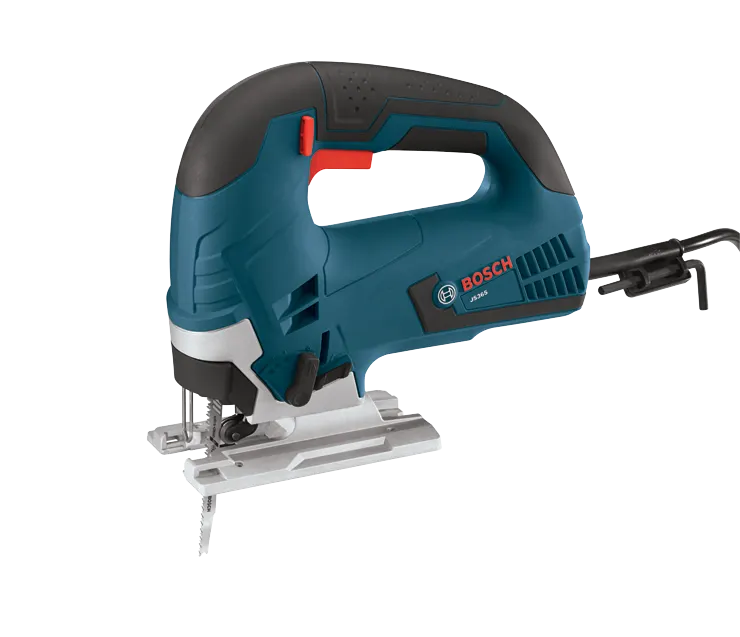
Bosch JS365 6.5-Amp Corded
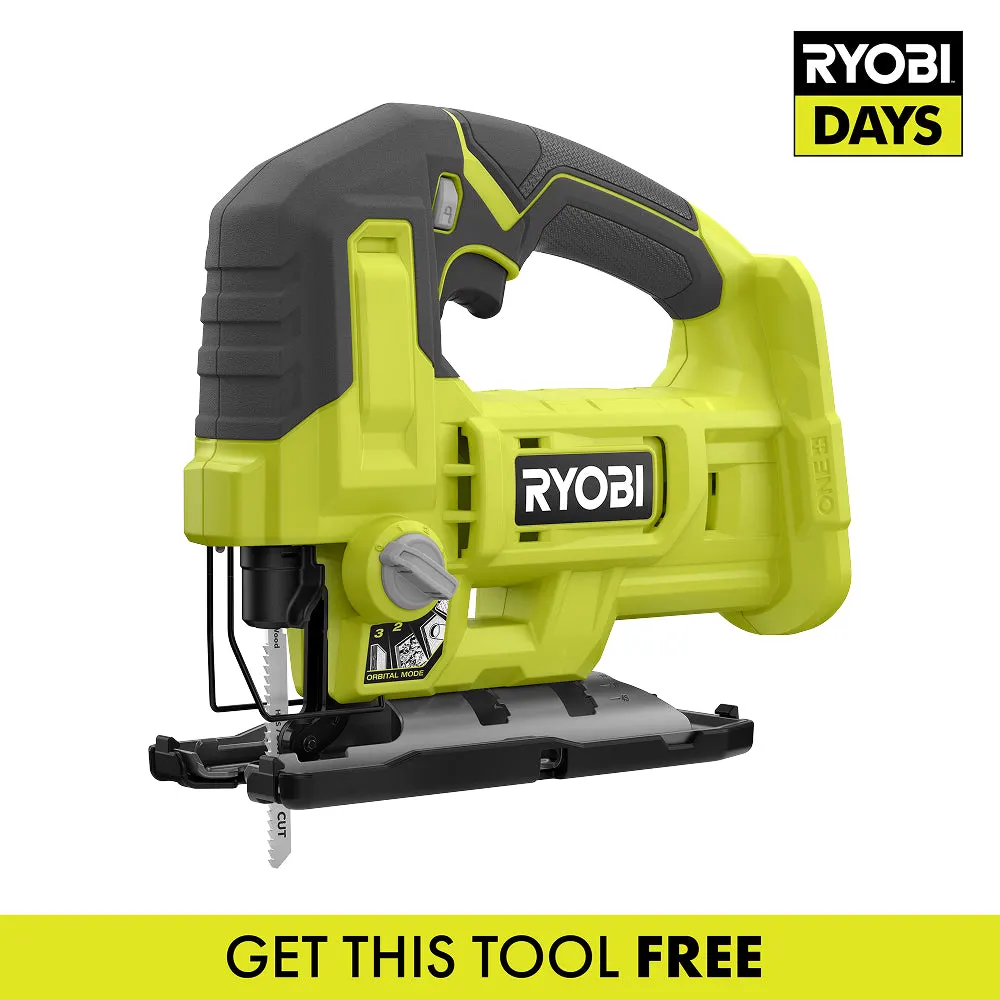
Ryobi PCL525B 18V ONE+
| Spec | Bosch JS365 6.5-Amp Corded | Ryobi PCL525B 18V ONE+ |
|---|---|---|
| Power source | Corded 6.5 amp, 120V | 18V ONE+ cordless (battery not included) |
| No-load SPM | 500–3,100 SPM (variable) | 0–3,000 SPM (variable) |
| Stroke length | 1 inch | 1 inch |
| Orbital settings | 4-position orbital action | 4-position orbital action |
| Bevel capacity | 0–45 degrees | 0–45 degrees left and right |
| Base plate | Die-cast aluminum with steel insert | Plastic |
| Motor type | Brushed (corded) | Brushed (cordless) |
| Cutting capacity (softwood) | 3-1/2 in. | Not rated (limited by brushed motor) |
| Dust management | Blower, no vacuum port | No blower |
| Weight | 5.35 lbs | 2 lbs (bare tool) |
| Price range | $100–$130 (kit with case) | $69–$99 (bare tool) |
The benchmark versus the budget entry
Putting the Bosch JS365 and the Ryobi PCL525B side by side is less a close competition and more a clarification of what separates a professional-grade corded jigsaw from a capable homeowner cordless entry. These are tools for different users, not equivalent tools at different prices. Understanding why each excels is more useful than declaring a universal winner.
The Bosch JS365 has been the corded jigsaw benchmark for well over a decade because it combines a 6.5-amp motor, a die-cast aluminum base plate, and four orbital positions in a compact, refined package at roughly $100–$130. The Ryobi PCL525B brings full four-orbital-setting capability to the homeowner market at $69–$79 bare on the 18V ONE+ platform. Both represent strong value at their respective price points.
Power and motor comparison
The 6.5-amp corded motor in the Bosch JS365 is fundamentally different from the brushed 18V motor in the Ryobi PCL525B in one critical way: load response. Corded motors draw unlimited current from the wall within their amp rating; cordless brushed motors draw from a finite battery pack and lose speed as the pack discharges or as load increases beyond the motor's efficiency band.
In 3/4-inch plywood and softwood trim, the gap is minor. In 2-inch hardwood, stacked material, or long sustained cuts, the Bosch maintains 3,100 SPM through the full pass while the Ryobi slows noticeably in the final third of the cut. For a cabinetmaker or remodeler cutting consistently through a full day of material, this distinction compounds into real productivity. For the occasional DIYer making a single countertop cutout, the Ryobi completes the task.
Base plate and cut accuracy
The Bosch JS365's die-cast aluminum base plate with a steel insert stays flat. This is not a minor material upgrade — a rigid, flat shoe is what produces straight, accurate bevel cuts and prevents the saw from tracking off a pencil line under lateral pressure. Budget and entry-level jigsaw shoes flex under sideways force in ways that introduce small, consistent errors that add up over longer cuts.
The Ryobi PCL525B uses a plastic base plate. For freehand curve cuts where the foot tracks freely, the flex is not apparent. Against a clamped straightedge or when pressing the shoe into a guide — the standard method for accurate straight cuts — the flex introduces the kind of tracking variance that shows up as a slightly bowed kerf rather than a clean straight line.
Orbital settings and bevel comparison
Both saws offer four orbital positions, which is the complete functional range. The SPM minimum is different: the Bosch starts at 500 SPM, giving a slower, more controlled entry speed that is useful for starting cuts precisely in hard materials. The Ryobi starts at 0 SPM with a gradual trigger, which achieves a similar result through trigger sensitivity rather than motor design.
The one spec where the Ryobi PCL525B wins clearly is bevel versatility. It cuts 0–45 degrees in both left and right directions. The Bosch bevels in one direction only. This matters for compound angle trim, for fitting diagonal panels, and for situations where matching a bevel on an existing cut requires the opposite angle. For a user who does compound-angle or bilateral bevel cuts regularly, the Ryobi's bevel range is a genuine advantage.
Cordless versus corded: the real trade-off
The Bosch JS365 needs an outlet or extension cord. On a fixed shop bench or at a remodeling site with power run, this is a non-issue. For deck work, shed construction, or any site without convenient power, the cord is a real constraint. The Ryobi PCL525B runs on 18V ONE+ batteries that charge away from the work site and work anywhere without a trailing cord.
For the homeowner audience the Ryobi targets, cordless flexibility is worth significant practical value. That same homeowner almost certainly does not work in dense hardwood, does not need 3-1/2-inch cutting capacity, and will not notice the base plate difference on a sink cutout. The Ryobi handles their actual use cases.
Weight and fatigue
At 2 lbs bare, the Ryobi PCL525B is dramatically lighter than the 5.35-lb Bosch. For overhead cuts, detailed scroll work, and any cut where the arm is extended, the weight difference is felt. A compact ONE+ battery adds about 0.9 lbs, bringing total Ryobi weight to under 3 lbs — still substantially lighter than the Bosch. For users with limited wrist strength or who work frequently overhead, the Ryobi's low weight is a real ergonomic advantage.
Choosing between them
Buy the Bosch JS365 when you need consistent power through thick stock, value the most rigid and accurate base plate in the price tier, and work near an outlet. It is the professional corded reference, suited to cabinet shops, remodeling sites with power, and serious DIYers who use a jigsaw frequently.
Buy the Ryobi PCL525B when you already own 18V ONE+ batteries, need cordless flexibility, and primarily cut thin sheet goods, trim, and light plywood. At $69–$79 bare, it delivers the full four-orbital-setting feature set at the lowest cost in any major platform.
Advertisement
Frequently asked questions
- Is the Bosch JS365 worth twice the price of the Ryobi PCL525B?
- For regular or demanding use, yes. The Bosch JS365 delivers more sustained power, cuts deeper, and has a more rigid base plate that produces straighter cuts under pressure. For a homeowner who uses a jigsaw two or three times per year for basic cuts in thin material, the Ryobi PCL525B is adequate and the price premium for the Bosch is hard to justify.
- Does the Ryobi PCL525B cut hardwood?
- It cuts hardwood, but its brushed motor slows noticeably under load in dense species like maple or red oak. The Bosch JS365's 6.5-amp corded motor maintains full speed through thick hardwood without hesitation. For occasional thin hardwood cuts — a shelf edge or a decorative profile in 3/4-inch stock — the Ryobi is adequate. For sustained hardwood work or thick stock, the corded Bosch is the right tool.
- Which jigsaw is better for cutting plywood?
- Both cut plywood effectively with the right blade and orbital setting at 0. The Bosch JS365 produces cleaner cuts in thick plywood thanks to its rigid aluminum base and more consistent motor speed. The Ryobi PCL525B handles 3/4-inch plywood adequately for the typical homeowner task — a kitchen sink cutout, a notch for built-in shelving — but the plastic shoe can flex under lateral pressure against a straightedge, which introduces tracking error.
- Can the Ryobi PCL525B bevel cut both left and right?
- Yes — the PCL525B bevels 0–45 degrees in both left and right directions, which is a practical feature the Bosch JS365 does not share. The Bosch bevels in one direction only (0–45 degrees). For tasks like fitting trim at compound angles or cutting sink templates that require bi-directional bevels, the Ryobi's bevel range is the broader of the two.
- Does the Ryobi PCL525B have a dust blower?
- No. The PCL525B does not include a dust blower, which means you must pause periodically to blow or brush sawdust away from the cut line. The Bosch JS365 does have a dust blower — not as useful as a vacuum port, but it keeps the cut line visible continuously during a pass. For outdoor rough cuts where sawdust does not matter, this is irrelevant. For interior finish work or detailed marking work where seeing the pencil line is important, the Bosch's blower is a genuine advantage.